Why Two Million People Flew to Korea for Their Skin
Inside Seoul's booming dermatology scene — and the three treatments everyone is getting.

In 2025, more than two million people flew to South Korea for medical treatment — the first time the country has ever crossed that line. More than 62 percent of them came for one thing: their skin.
Americans are the fastest-growing group in that count. US patient visits jumped 70.4 percent in a single year, to a record 173,000. And this isn't new momentum — 705,044 foreign nationals had dermatology treatment in Korea in 2024 alone, a 117-fold jump from 2009, according to the Korea Health Industry Development Institute.
That number isn't a spike — it's a system. South Korea has spent decades building the most advanced dermatology infrastructure in the world, and the rest of the planet is finally catching on.
It's Not Just the Price

Yes, treatments cost a fraction of what you'd pay in the US. The American Society of Plastic Surgeons puts the national average for a laser skin treatment at $697, and full skin resurfacing at $1,829. A pico laser session in Seoul runs $80–200. Most procedures — from microneedling to thread lifts — come in 30–60% cheaper than in the US, UK, or Australia.
But price alone doesn't explain a million-plus skin patients flying across an ocean.
The real draw is access. Many of the treatments trending in Seoul right now won't reach Western clinics for another two to five years. By the time something is being called "new" in New York, clinics in Gangnam have been refining it for a while — which cuts both ways, as you'll see below.
What's Trending in Seoul Right Now
Three treatments are dominating the conversation — and the appointment books — in Seoul's top dermatology clinics.
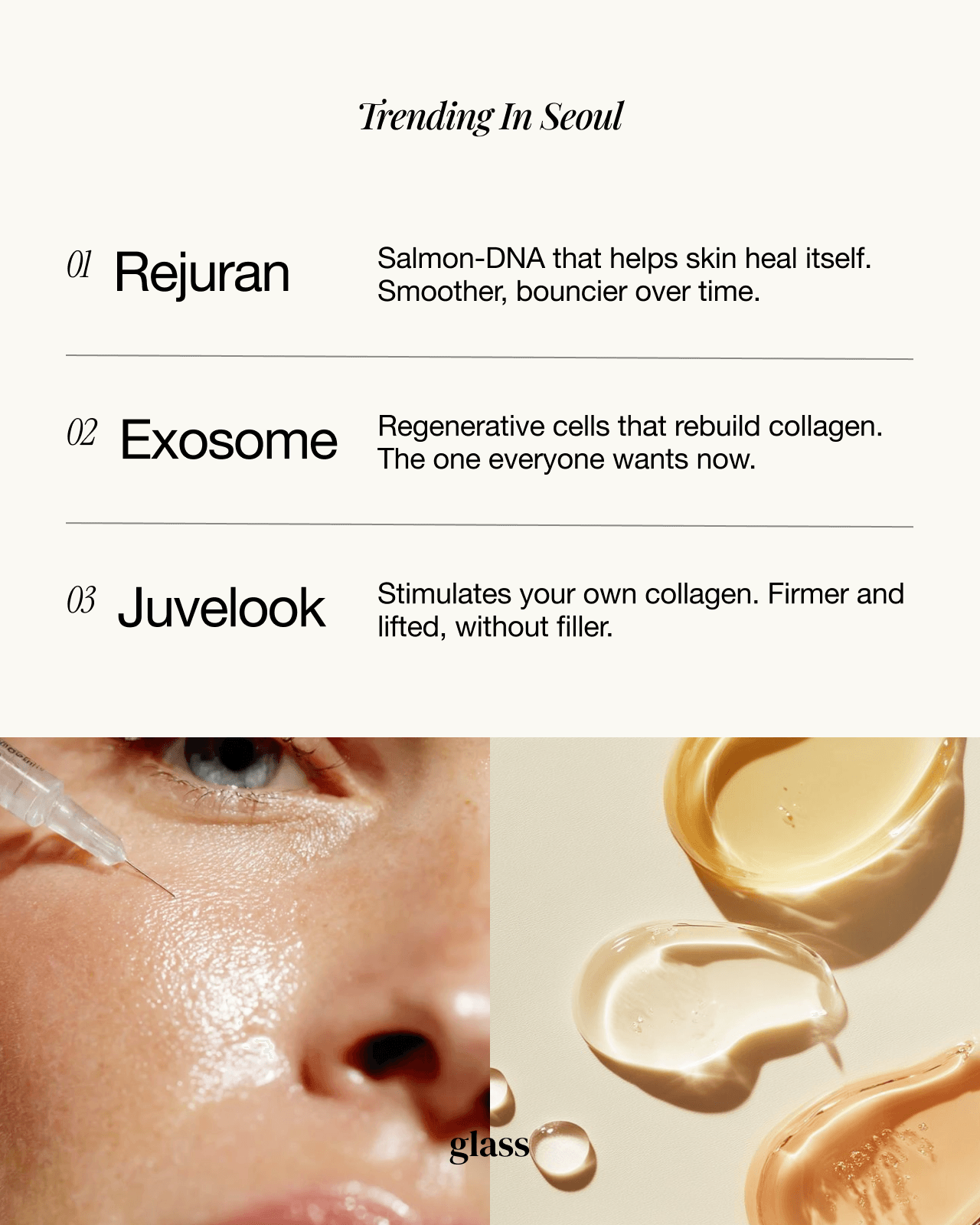
01 — Rejuran
A salmon-DNA-based injectable that helps skin heal itself from the inside out. The active ingredient is polynucleotide (PN) — short DNA fragments extracted from salmon sperm, purified until the protein is gone and only the DNA scaffold remains. Unlike fillers that add volume, Rejuran works at the cellular level, signaling fibroblasts to lay down new collagen and improving skin texture over weeks rather than days.
It's delivered as a grid of shallow micro-injections across the face, usually with numbing cream, in about 20 minutes. Korean clinics typically run it as a course of three sessions, two to four weeks apart, then maintenance every four to six months. Patients report smoother, bouncier skin that keeps improving after the last session.
It's been a staple in Korean clinics since 2014. It's only now starting to appear in select US and European practices — and only under specific conditions, which we cover in the safety section.
Who it's for: fine lines, crepey texture, dull or thin skin. Not a volume treatment — if you want lift, this isn't it.
02 — Exosome Therapy
Exosomes are microscopic vesicles that cells use to send signals to each other. In aesthetics, they're harvested from stem cell culture media and applied to skin to prompt collagen production and tissue repair. Think of them as the next evolution beyond PRP (platelet-rich plasma) — same regenerative logic, but no blood draw and a far more concentrated signal.
Korean clinics pair exosomes with microneedling or fractional laser, applying the solution immediately after the skin barrier is opened so it can absorb. It's the standard finishing step on a resurfacing menu in Gangnam, usually adding $200–500 to a session.
This is the treatment everyone in Seoul is talking about — and the one Western dermatologists are watching most closely, for reasons that aren't all good. Exosomes carry the thinnest safety record of the three. Read the next section before you book one.
Who it's for: post-laser recovery, acne scarring, overall skin quality. Best understood as an add-on, not a standalone.
03 — Juvelook
A hybrid injectable that combines poly-D,L-lactic acid (PDLLA) microspheres with non-crosslinked hyaluronic acid. The HA delivers immediate hydration; the PDLLA dissolves slowly over months, and as it does, your body builds collagen around it. Same biostimulator family as Sculptra, but the particles are smaller and rounder, which is what lets clinics inject it superficially for skin quality rather than deep for volume.
The result is firmer, tighter skin — without filler. Effects build over eight to twelve weeks and last around a year. Like Rejuran, it's usually a course of two to three sessions spaced a month apart.
Juvelook is especially popular for enlarged pores, acne scarring, under-eye hollows, and overall skin density. It gives that "glass skin" glow Korean skincare is famous for, but from the inside out.
Who it's for: pores, laxity, acne scars, and anyone who wants collagen rather than volume. Not for active acne or inflamed skin.
Safety and What to Know Before You Book
Here's what most Korea-treatment guides skip: two of these three treatments are not approved for injection in the United States, and one of them isn't approved for injection anywhere.
| Treatment | Korea (MFDS) | US (FDA) | Typical downtime |
|---|---|---|---|
| Rejuran | Approved medical device since 2014 | Not approved for cosmetic injection | 2–5 days |
| Exosome therapy | Sold as topical cosmetic products; injection is off-label | No approved exosome product — public safety notification issued | Varies; unpredictable |
| Juvelook | Approved (MFDS), CE-marked in Europe | Not approved | 1–3 days |
Rejuran. The safety record is the strongest of the three — a decade of Korean clinical use behind it. Expect transient swelling, redness, and small injection bumps that peak in the first 24–48 hours and settle within three to five days. Bruising is common, especially under the eyes. Rare but real: nodules at injection sites, and hypersensitivity in people with fish or seafood allergies. Flag any seafood allergy before you sit down.
Exosome therapy. This is the one to slow down on. The FDA has issued a public safety notification on exosome products, stating plainly that there are no FDA-approved exosome products and that patients have suffered serious adverse events. The published harm isn't theoretical. A 2025 case report in the Journal of Cosmetic Dermatology documents a 38-year-old patient who developed ischemic necrosis on both cheeks three days after intradermal injection of a Korean-manufactured lyophilized exosome product — leaving permanent atrophic scarring and hyperpigmentation that three laser sessions barely improved. Notably, the manufacturer's own instructions specified topical use with microneedling, not injection. A separate case series reports patients developing necrotizing granulomas at exosome injection sites two weeks to three months after treatment. If a clinic offers to inject exosomes, ask what the product is licensed for. Topical application after microneedling is a different risk profile than injection — and it's the one the products are actually made for.
Juvelook. Expect small bumps that resolve within hours, plus swelling and bruising for one to three days. The known risk with all PDLLA biostimulators is delayed nodules — firm lumps appearing weeks to months later, usually from injection that's too shallow, too concentrated, or in the wrong plane. They're treatable, but treating them means finding someone competent after you've flown home. Injector technique matters more here than with any other treatment on this list.
Across all three: results vary by individual, and no clinic can promise you an outcome. If you have an autoimmune condition, are pregnant or breastfeeding, or take blood thinners, these treatments may not be appropriate for you.
This article is for informational purposes only and does not constitute medical advice. Consult a licensed physician about your specific situation before pursuing any treatment.
Why Seoul, Specifically
South Korea doesn't just have good dermatologists — it has an ecosystem.
- Density: Gangnam alone has more dermatology clinics per square mile than any neighborhood on earth
- Competition: That density drives innovation. Clinics compete on technology, technique, and results — not just marketing
- Regulation: Korea's medical device approval process moves faster than the FDA's for many categories, which means new tools reach Korean clinics first
- Experience volume: A Seoul dermatologist might perform more laser treatments in a month than a US counterpart does in a year
The speed cuts both ways. Faster approval means earlier access — and it also means some treatments arrive in clinics before the long-term data does. Korea had a head start on the technology. The safety literature is still catching up.
This isn't about finding "cheap" treatments abroad. It's about accessing the best versions of treatments that exist — at prices that happen to be dramatically lower.
What It Actually Costs
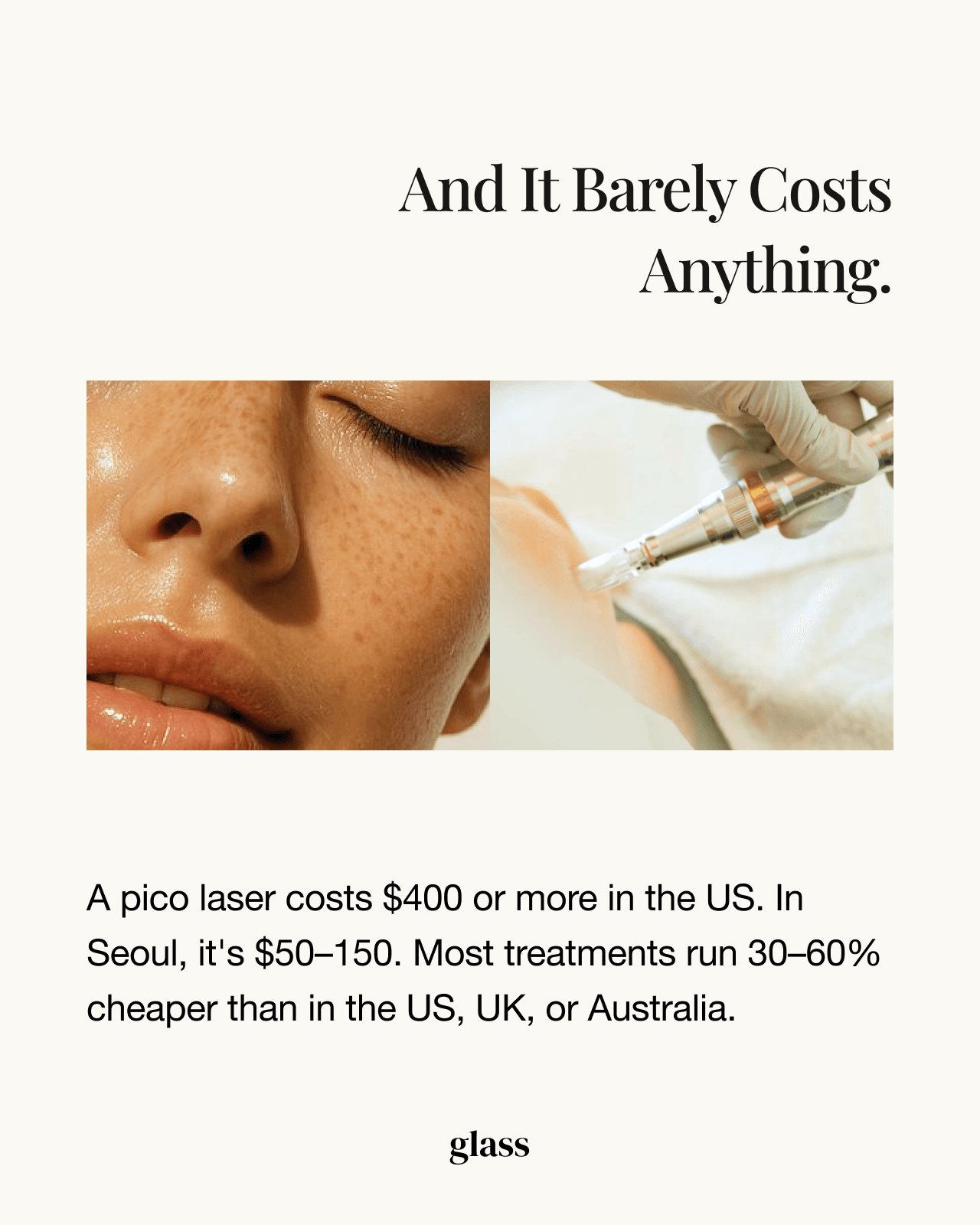
Here's a rough comparison for popular treatments:
| Treatment | US Price | Seoul Price |
|---|---|---|
| Pico Laser (per session) | $400–800 | $80–200 |
| Rejuran (per session) | $500–1,000 | $140–440 |
| Exosome Therapy (add-on) | $800–2,000 | $200–500 |
| Juvelook (per session) | $600–1,200 | $140–440 |
| Botox (per area) | $435 average | $30–120 |
US figures draw on ASPS national averages and major-metro clinic pricing; Seoul figures reflect published 2026 clinic rates for foreign patients. Prices vary by clinic, district, and treatment area, but the pattern holds: world-class results at a fraction of Western pricing.
One change to budget for. Korea ended the 10% VAT refund for foreign aesthetic patients on January 1, 2026. The program had let visitors reclaim value-added tax at the airport since 2016. It's gone. Add 10% to any quoted price and treat that as your real number.
Many patients still combine multiple treatments in a single trip — something that would cost thousands in the US but runs a few hundred dollars in Seoul.
Planning the Trip: Clinics, Visas, and Recovery
How to choose a clinic
Korea licenses board-certified dermatologists (피부과 전문의) separately from general practitioners who also offer skin procedures. Both are legal, both are common, and clinic signage rarely makes the difference obvious to a foreign visitor. Ask directly which one is treating you.
Then work through this before you pay a deposit:
- Registration: Clinics legally treating foreign patients are registered with Korea's Ministry of Health and Welfare. Verify on the government's Medical Korea portal.
- Who holds the needle: In some clinics a nurse performs injectables under supervision. Ask who does yours, by name and title.
- Product and lot: Ask for the exact brand and lot number, in writing. If something goes wrong at home, your US dermatologist needs it.
- A written quote, VAT included: Get the total in KRW and USD before your first appointment. Consultation-day upselling is the norm — decide your ceiling in advance.
- Complication policy: Ask what happens if you react badly after you've flown home. A clinic that has a real answer has seen it before.
Skip any clinic that guarantees a result, pressures you to book same-day, or won't name the product it's injecting.
Visas and logistics
US passport holders can enter Korea visa-free for stays up to 90 days, and the K-ETA travel authorization requirement is currently waived for Americans through December 31, 2026 — the exemption is renewed year by year, so confirm at k-eta.go.kr before you book. For longer treatment stays, Korea issues a dedicated C-3-3 medical tourism visa, applied for through the clinic or an appointed agency.
Book Gangnam clinics two to four weeks out; the good ones fill. Schedule injectables in the first half of your trip so swelling settles before your flight, and never book a treatment inside 24–48 hours of a long-haul departure. Most clinics in Gangnam, Myeongdong, and Apgujeong have English-speaking coordinators — confirm it when you book rather than assuming.
Recovery and aftercare
The first 48 hours matter most. Expect peak swelling and redness in the first 24, and manage it with cold compresses and sleeping elevated. Skip the jjimjilbang — no saunas, hot springs, hot yoga, or alcohol for 24–72 hours after injectables, since heat and vasodilation make swelling and bruising worse. After any laser, daily SPF is not optional: Korean sun plus fresh resurfacing is how pigmentation rebounds.
Plan for the calendar, not the trip. Rejuran and Juvelook both work as courses of two to three sessions spaced weeks apart — a single week in Seoul gets you one session, not a finished protocol. Either build a return trip into the plan or line up a US provider for maintenance before you leave.
The Glass Beauty Seoul Take
Two million people in one year. At that scale, it's not a trend. It's a system — one that Korea has been building for decades and the rest of the world is just now discovering.
The system is real, and so are the gaps. Faster approval gets treatments into Korean clinics years before Western ones, and it also means some of those treatments are ahead of their own safety literature. Rejuran and Juvelook have the track record to justify the flight. Exosomes are the one to ask hard questions about — and to think of as something applied to your skin, not injected into it.
If you've been curious about Korean skin treatments, the question isn't whether they work. It's whether you've done the homework to choose well. Start with our Skin coverage — we break down each treatment as we go.
We're building the guide to Korean skin treatments for Americans who want real results. Follow along as we break down every treatment, clinic, and decision you need to make — so when you land in Seoul, you already know exactly what to ask for.
Frequently Asked Questions
How much do skin treatments cost in Korea vs the US?+
Most skin treatments in Seoul cost 30–60% less than in the US. A pico laser session runs $80–200 in Seoul against $400–800 in the US, and Rejuran runs $140–440 vs $500–1,000. Note that Korea ended its 10% VAT refund for foreign aesthetic patients on January 1, 2026, so add 10% to any quoted Seoul price.
What is Rejuran treatment?+
Rejuran is a salmon-DNA-based injectable — polynucleotide, or PN — that has been an MFDS-approved medical device in Korea since 2014. It signals fibroblasts to produce collagen, improving skin texture over a course of about three sessions. It is not FDA-approved for cosmetic injection in the United States. Expect swelling, redness, and bruising for two to five days.
Is exosome therapy for skin safe?+
The FDA states there are no FDA-approved exosome products and has issued a public safety notification after reports of serious adverse events. Published case reports document skin necrosis, permanent scarring, and necrotizing granulomas following intradermal exosome injection. Most exosome products are licensed for topical use with microneedling, not injection — ask any clinic what its product is actually licensed for.
What is Juvelook?+
Juvelook is a hybrid injectable combining PDLLA (poly-D,L-lactic acid) microspheres with non-crosslinked hyaluronic acid. The PDLLA dissolves over months while your body builds collagen around it, producing firmer skin without filler. It is MFDS-approved in Korea and CE-marked in Europe, but not FDA-approved. The main risk is delayed nodules weeks to months after treatment.
Do Americans need a visa for medical treatment in Korea?+
US passport holders can enter Korea visa-free for stays up to 90 days, and the K-ETA travel authorization is currently waived for Americans through December 31, 2026. The exemption is renewed year by year, so confirm at k-eta.go.kr before booking. For longer treatment stays, Korea issues a dedicated C-3-3 medical tourism visa through the clinic or an appointed agency.
Why do people go to Korea for skin treatments?+
Korea offers the highest density of dermatology clinics in the world, faster device approval that puts new treatments in clinics years before the West, extremely high procedure volumes, and prices 30–60% below US rates. The same speed also means some treatments arrive ahead of their long-term safety data.
Get the Seoul Glow
K-beauty insights, treatment guides, and trend alerts — delivered weekly.