How to Find the Best Skin Clinic in Seoul as a Foreigner
Four checks that filter Seoul faster than any ranked list — starting with one word on the sign.
In Korea, any licensed doctor can open a clinic and treat skin. Only some of them can put Dermatology in the name — and that's the law, not marketing.
That single distinction filters Seoul faster than any ranked list you'll find. It's also the one most guides skip, because a list is easier to write than a rule you can apply on your own.
Here's what those guides do tell you: verify your doctor on the Korean Dermatological Association's website. We went looking. The KDA runs a site for its members — journals, meetings, committees — and no public specialist directory, in Korean or in English. The advice sounds rigorous. It doesn't survive contact with the search bar.
So here's the version that works from a laptop at home. Four checks for finding the best skin clinic in Seoul as a foreigner — all of them finishable before you book.
Seoul rewards the prepared. Gangnam, Cheongdam, and Myeongdong hold most of the clinics built to treat international patients, and those clinics run on tightly timed tracks. A week in the city gives you two treatment windows, maybe three. Spending one of them in the wrong chair is the expensive mistake — not the price of the laser. Two million people flew to Korea for medical treatment in a single year; the ones who got what they came for did this part first.
None of these checks require Korean, a local friend, or a booking agency taking a cut. They require twenty minutes and a browser.
01. Look For One Word — Dermatology
Korea licenses clinics by name. A practice can register as a dermatology clinic only if it employs a board-certified dermatologist. Everyone else registers as a general clinic and lists dermatology underneath, as one of several departments it treats. Same skin, different license — and the license decides what the sign is allowed to say.
The Korea Times said it plainly in its 2026 guide for foreign patients: clinics labeled "dermatology clinic" must have a certified dermatology specialist, and clinics without that label may not.
The title behind the word takes eleven years — six years of medical school, a one-year internship, four years of dermatology residency, then the Korean Board of Dermatology exam. In person there's a second tell: specialists display a red plaque near the entrance, issued through the Korean Dermatological Association, naming the holder as a certified dermatology specialist.
From your laptop, you're reading a Google Maps listing instead. Same rule, translated:
| What the listing says | How it's licensed | What it means |
|---|---|---|
| Dermatology Clinic | Registered as a dermatology clinic | A board-certified dermatologist is on staff |
| Clinic · Skin Clinic · Aesthetic | Registered as a general clinic, dermatology listed as a treated department | A licensed doctor who treats skin — not necessarily a specialist |
| Plastic Surgery | Registered as a plastic surgery clinic | A board-certified plastic surgeon; skin work may be secondary |
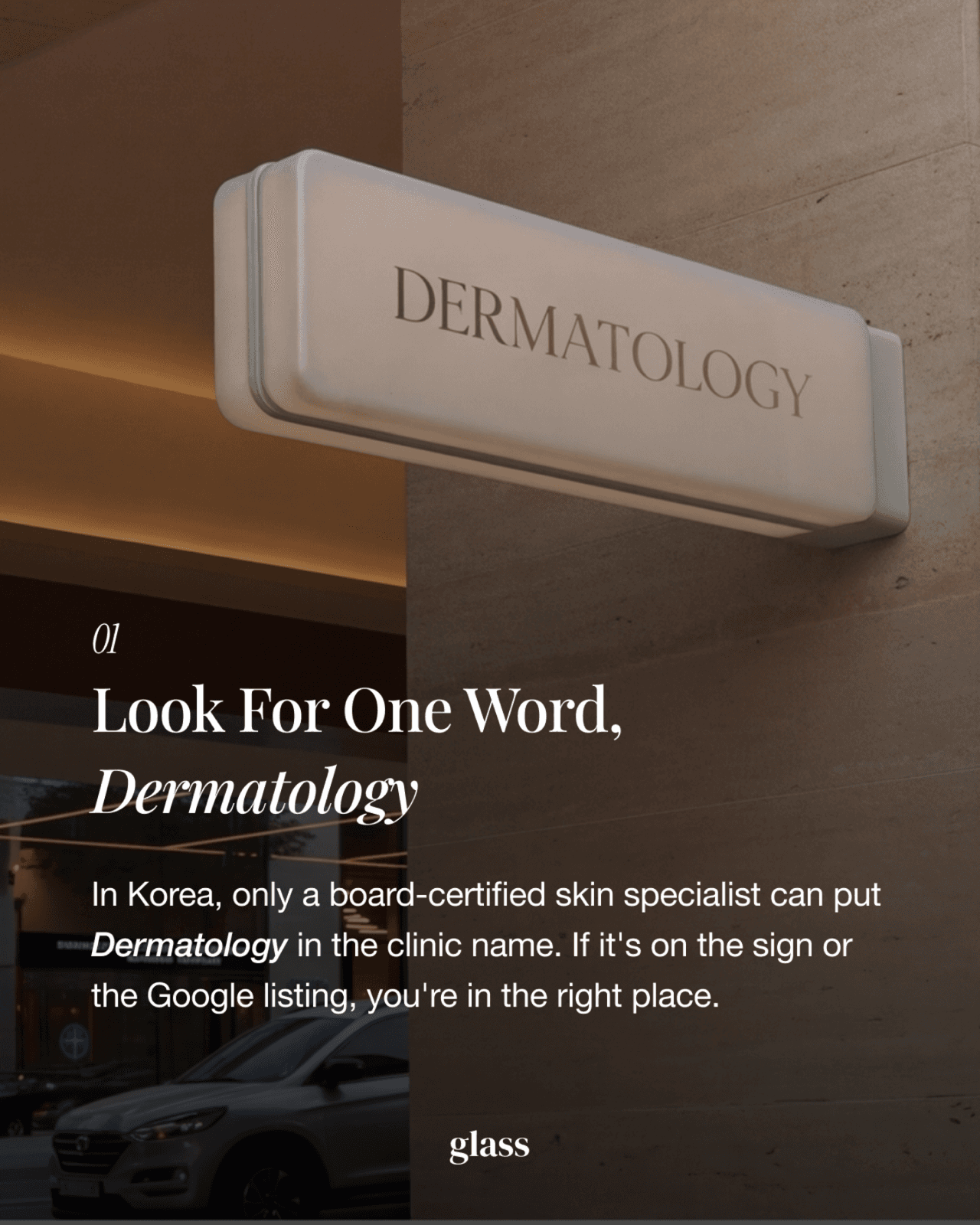
One caveat, because it matters: a Google Maps name is editable by whoever manages the listing. The licensed name isn't. Cross-check the clinic's own site — the registered name sits in the footer or on the About page, and it has to match what's on the door.
And to be clear about what this check isn't. A non-specialist clinic is not a lesser clinic. Plenty run excellent laser programs, and a doctor who has run ten thousand toning sessions is exactly who you want holding that laser. The name doesn't rank quality. It tells you what you're buying — and if you're flying in for something diagnostic, like acne that hasn't responded or pigmentation nobody has identified yet, you want the specialist reading it.
02. Ask Who's Actually Treating You
At a large clinic, the doctor who reads your skin and the person holding the laser aren't always the same. That's a design choice, not a scandal. High-volume clinics separate consultation from delivery to keep the day moving, and on standardized protocols it works.
But the result of a device treatment tracks the operator's hand, not the machine's spec sheet. Depth, passes, energy, where they slow down along the jaw — that's judgment, and judgment doesn't come bundled with the equipment.
So ask. One sentence: "Will a doctor perform this procedure?"
Ask it in the booking channel — KakaoTalk, WhatsApp, the site form, Instagram DM — before you fly. Two reasons. You get the answer in writing, and you get it while you can still book somewhere else. Asking at the counter with your passport out and a deposit paid is asking too late.
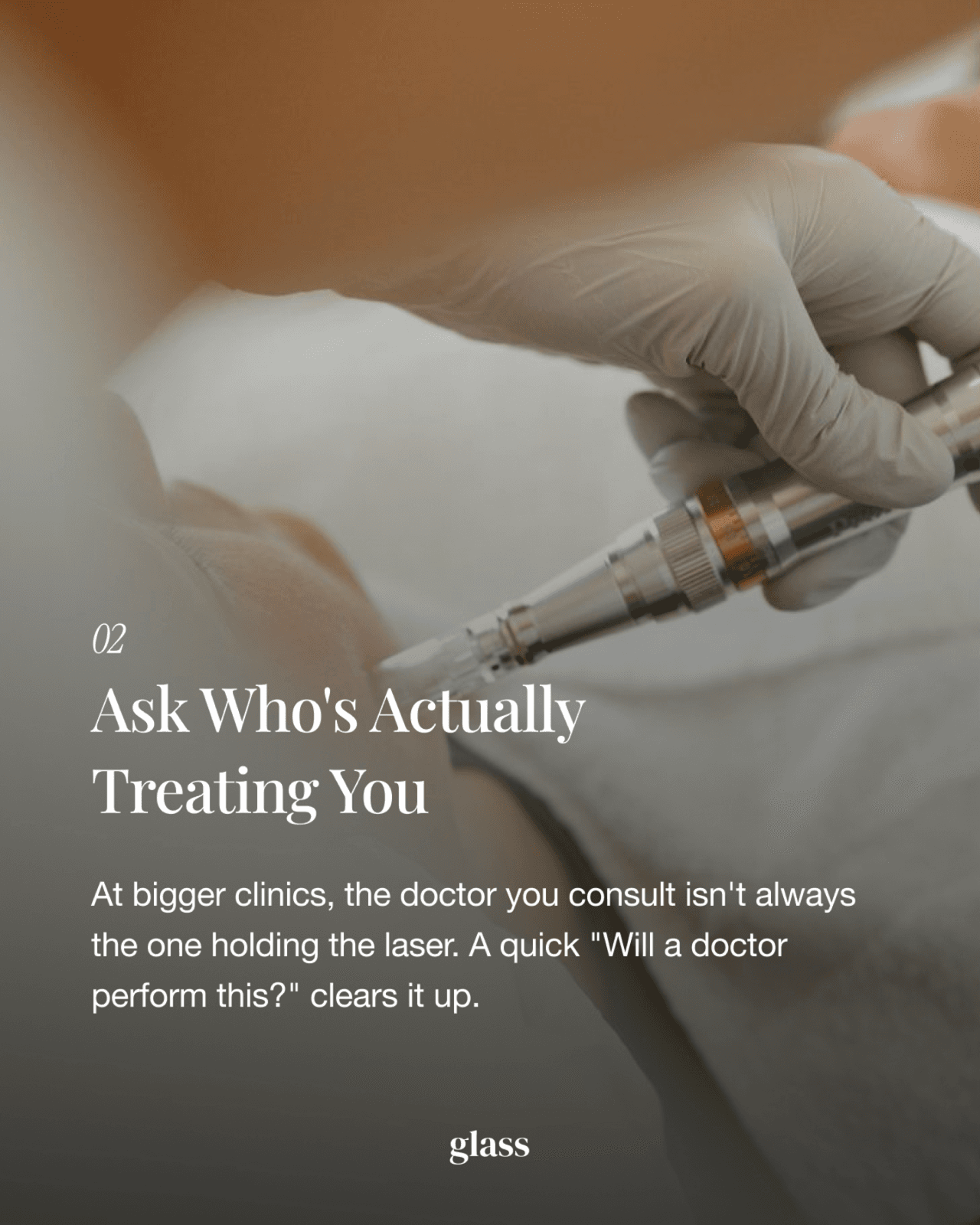
A good answer is specific and arrives fast. "Dr. Kim performs the injection; our nurse handles numbing and aftercare." That clinic has been asked before, and the division of labor is deliberate. A vague answer is also an answer — "our medical team will take care of you" tells you the question is inconvenient, which is exactly what you wanted to find out while you still had options.
There's no wrong answer here, only an unknown one.
03. Check The Reviews First — And Read Them Right
Start on Google Maps. Not because it beats Naver — most Koreans book off Naver and the Korean review volume there runs far deeper — but because Google Maps is where the foreign patient experience gets written down. English reviews from people who arrived the way you're arriving tell you the thing you actually need to know: whether the consultation happened in a language they understood.
Weight them like this.
- Recent over many. Staff turn over. A glowing review from three years ago describes a coordinator who has since left.
- Specific over enthusiastic. "The doctor mapped my pigmentation and talked me out of two treatments" is data. "Amazing place!!" is decoration.
- With photos — and not just of the lobby. Every interior in Gangnam photographs well.
- Discount the wall. Two hundred five-star one-liners posted in the same month is a marketing budget, not a reputation.

Then cross-check. Paste the clinic's Korean name into Naver Map and run the reviews through translate. Machine translation is rough on Korean, but you aren't reading for prose. You're reading for volume, for recency, and for the same complaint showing up three times.
04. Book Two Weeks Ahead
Good clinics fill. In peak season — March through May, and September through November — the popular ones run two to four weeks out, and one to two weeks is the floor at any time of year.
Booking early buys you three things a walk-in never gets.
- The doctor you researched, instead of whoever has a gap.
- The English coordinator on shift. English support is usually a person, not a policy. That person works specific days.
- A slot that fits the trip. Most treatments want a recovery buffer before a flight. Find that out while you can still move things, not on your last morning.

Bring your passport. Non-resident foreigners register with it, and at clinics enrolled in the foreign-patient VAT refund program it's what generates the paperwork you'll want on the way out. If you already know what you're going in for — PDRN, Rejuran, and the salmon-DNA treatments book out fastest in spring — say so in the first message. It moves you up the calendar.
What To Send In That First Message
Clinic coordinators handle dozens of these a day, in a second language, across time zones. A message that answers their questions before they ask gets a real slot instead of a form reply. Copy this:
Hello — I'm visiting Seoul from [country], [dates].
I'm interested in [treatment], and my main concern is [concern].
Three questions:
1. Do you have availability on [two preferred dates]?
2. Will a doctor perform the procedure?
3. Which days is your English-speaking coordinator working?
I'll bring my passport. Thank you.
Three questions, dates attached, no negotiation. You'll usually hear back inside a business day — and the quality of that reply is itself the fifth check.
The Glass Beauty Seoul Take
Every "best skin clinics in Seoul for foreigners" list has the same flaw: it was written without knowing your skin, your budget, your week, or your language. A ranked list is built for the writer's convenience. A filter is built for yours.
These four checks cost about twenty minutes end to end, and they're the same twenty minutes a Korean friend would spend on your behalf. One word on the sign. One question in the DMs. Ten minutes of reading reviews properly. One booking made two weeks early.
We aren't publishing a ranked list yet, and that's deliberate. When Glass Beauty Seoul prints a clinic's name, it'll be one we've sent people to and heard back from. Until then the more useful thing we can hand you is the filter — because a filter keeps working after this article goes out of date. Results vary, the way skin does. But your odds of walking into the right room go up the moment you stop asking which clinic is best and start asking which clinic is right for this.
If you've been putting off booking because every clinic looked the same, that's no longer the reason. Start with the sign.
Glass Beauty Seoul is building the guide we wish existed — how Korean skin treatment actually works, what it actually costs, and how to get it without guessing. Follow along in Skin →
Frequently Asked Questions
Do I need an appointment at a Seoul skin clinic, or can I walk in?+
Many clinics accept walk-ins, but foreigners do better with a booking. English-speaking staff work set days, and popular clinics run two to four weeks out in peak season (March–May and September–November), with one to two weeks the floor year-round. Book through the clinic's site form, KakaoTalk, WhatsApp, or Instagram DM.
How can I check if a Korean dermatologist is board-certified?+
Read the clinic's registered name. Only a practice employing a board-certified dermatologist can register as a dermatology clinic. Clinics without a specialist register as a general clinic and list dermatology as one of the departments they treat. In person, specialists display a red plaque near the entrance naming them as a certified dermatology specialist. The Korean Dermatological Association does not run a public specialist directory, so the licensed name is your check.
Do Seoul skin clinics have English-speaking staff?+
Clinics that market to international patients generally do — usually a dedicated coordinator rather than an English-speaking doctor. Because it is a person rather than a policy, confirm which days that coordinator works when you book.
Do I need my passport at a Korean skin clinic?+
Yes. Non-resident foreigners register with a passport, and at clinics enrolled in the foreign-patient VAT refund program it is what generates the paperwork you will need on the way out.
How much does a dermatology consultation cost in Seoul?+
A general dermatology consultation typically runs 20,000–50,000 KRW, roughly $15–37. Cosmetic procedures are not covered by foreign insurance, and most clinics accept credit cards.
Get the Seoul Glow
K-beauty insights, treatment guides, and trend alerts — delivered weekly.