Before You Book: Your Pre-Event Treatment Timeline
Count backward from the big day: months for gradual change, weeks for recovery, and a gentler finish.

Your pre-event treatment timeline starts with a date, not a clinic menu. If the wedding, reunion, or flight is already booked, the next question is not what you can squeeze in — it is what your skin has time to recover from.
A treatment can take thirty minutes and still need weeks before you want someone photographing the result. Some procedures also need months to build the change you paid for. Visible healing and finished results run on different clocks.
This is the first installment of Before You Book, our guide to making better treatment decisions in Seoul and at home. Whether you are planning pre-wedding skincare or a reunion, use this skin treatment downtime guide to organize a consultation, not to clear yourself for a procedure. You do not need something from every row. Results vary, and your clinician's assessment takes priority over a calendar.
| Time before your event | What to discuss | What the buffer is for |
|---|---|---|
| Two months or more | Resurfacing lasers, HIFU or RF tightening, a skin-booster course, first-time Botox | Gradual results, multiple sessions, and time to assess your response |
| Four to six weeks | Filler; a planned final laser or booster session when your clinician approves | Swelling, bruising, settling, and follow-up — not a universal laser clearance |
| Two to three weeks | Familiar Botox; selected microneedling protocols | Time for response and recovery; medium-depth peels need separate assessment |
| One week | Familiar, low-irritation maintenance; carefully assessed toning, light peels, or lash services | Avoiding a new reaction, not fitting in one last intervention |
| The final few days | A familiar gentle facial, selected LDM or LED care | Comfort and hydration, without injections or aggressive exfoliation |
Two Months or More: Start the Slow Work
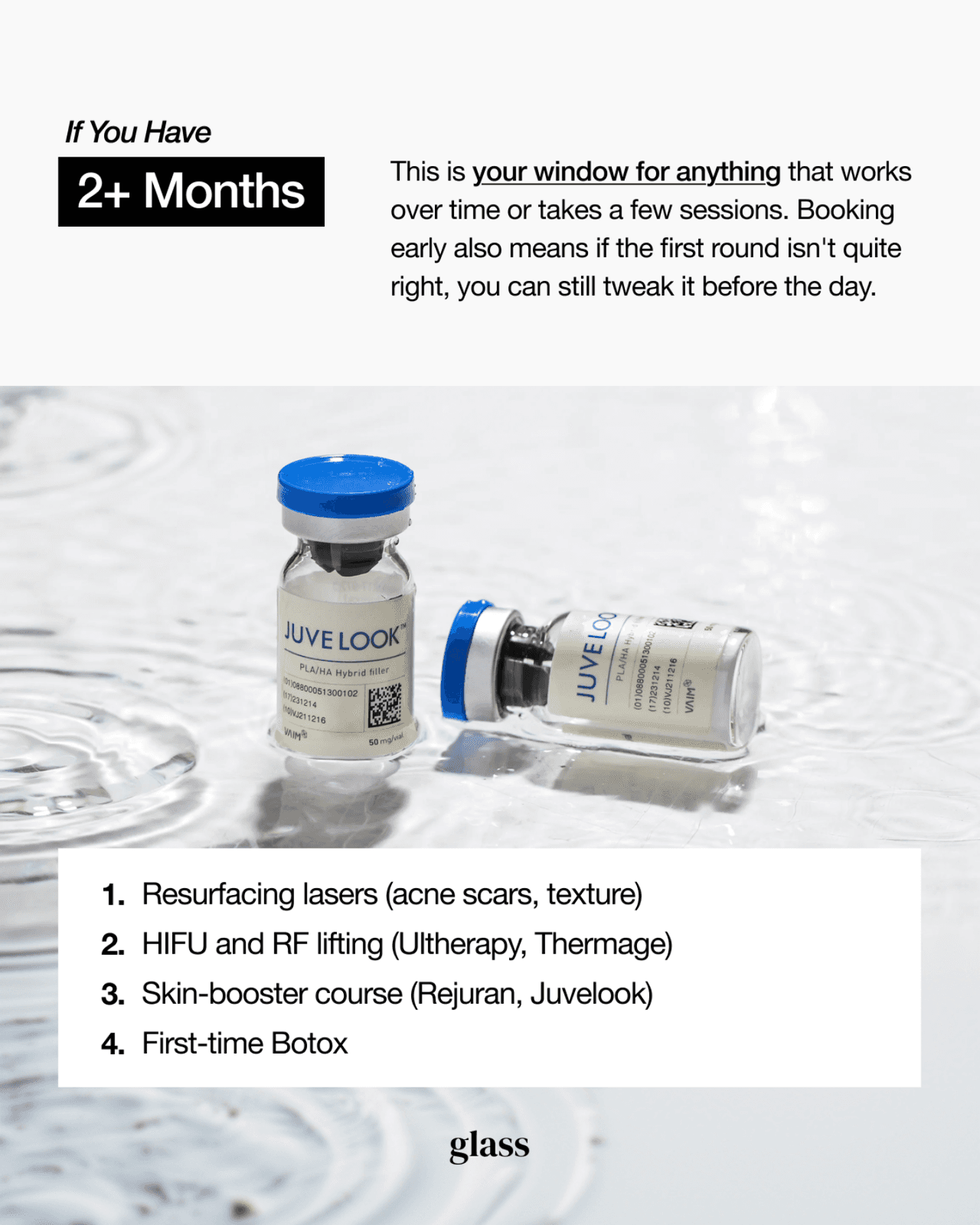
This is the window for a treatment plan rather than a finishing touch. Acne-scar resurfacing, ultrasound lifting, radiofrequency tightening, and injectable skin-booster courses belong in an early conversation because their benefits do not follow the same schedule as the appointment.
Ultrasound and RF devices use energy to stimulate changes in deeper tissue. For one specific example, Ultherapy's manufacturer describes results developing over two to three months as new collagen and elastin form. That is a product-specific timeline, not a promise for every lifting device. Our Ultherapy vs Thermage guide explains why the two are not interchangeable.
Resurfacing is a different project. The device, treatment depth, skin tone, and scar pattern affect both recovery and the number of visits. Two months is a reason to start planning, not proof that a full scar-treatment course will finish before your event. Ask when redness should settle, when pigmentation changes require review, and whether your intended outcome needs more time than you have.
Skin boosters need their own schedule. Rejuran and Juvelook are not interchangeable products, and a course can involve repeat visits. Have the clinician identify the product, interval, expected injection marks, and follow-up plan. Do not buy a multi-session package before checking whether its dates fit your trip.
First-time Botox also belongs in this early window — not because every result takes two months, but because you have no personal response history yet. An early assessment leaves room to decide whether you like the effect without putting the event under pressure. It does not mean scheduling an automatic repeat dose shortly afterward; your injector decides whether and when further treatment is appropriate.
Four to Six Weeks: Give Filler Room to Settle
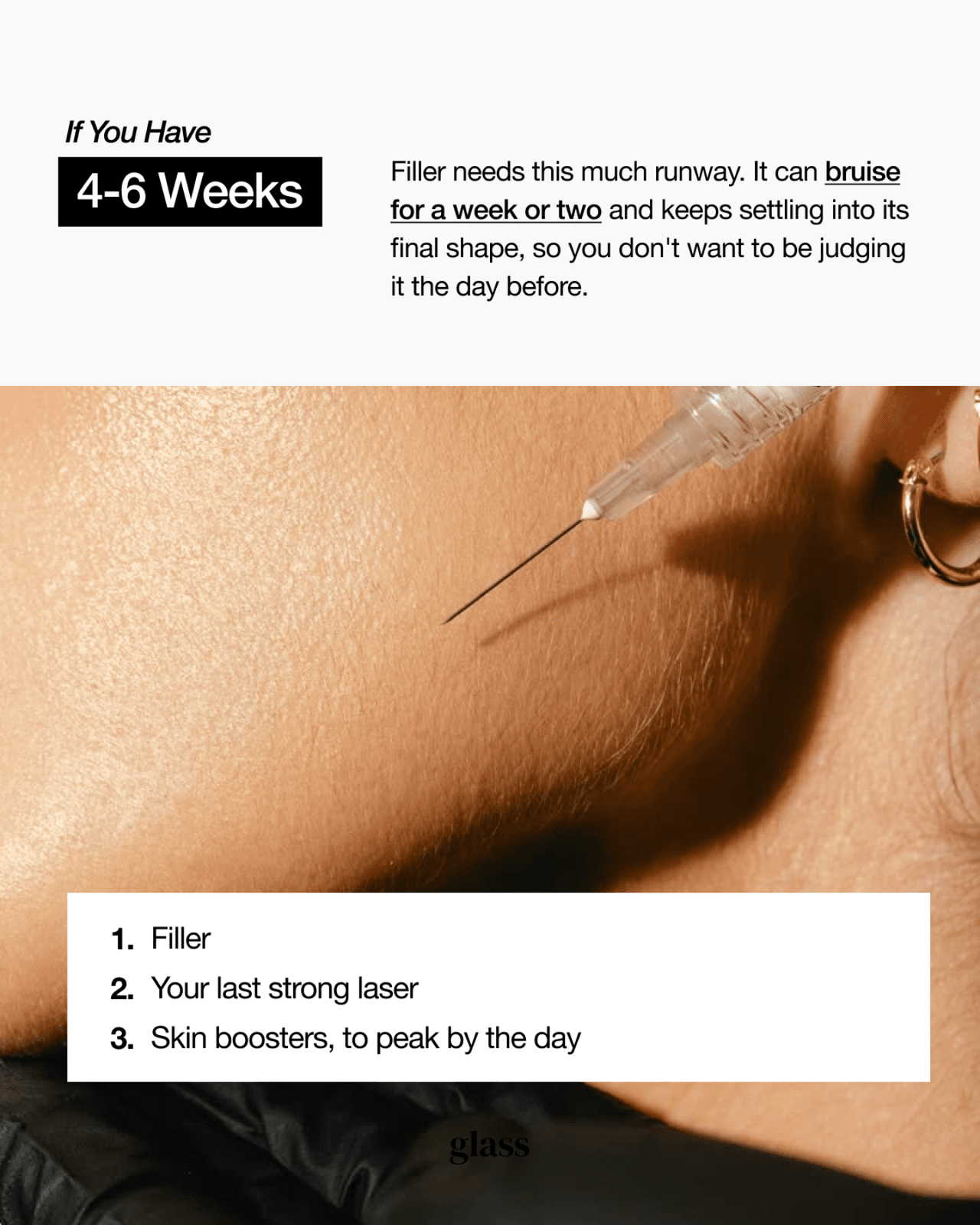
Filler changes contour immediately. That does not make the immediate contour the final one.
The American Society of Plastic Surgeons lists swelling, bruising, an overfilled appearance, and palpable firmness among possible early effects. Recovery varies by patient and filler. A four-to-six-week planning buffer gives you more room to assess the result and attend follow-up than a last-minute appointment does. It cannot guarantee that every reaction will resolve on schedule.
If you are working out when to get filler before a wedding, include the engagement shoot, rehearsal dinner, and travel days. Your first photographed event is the relevant deadline, not just the ceremony. Ask who will review unexpected swelling and how you will reach them if you have already left Korea.
Our carousel also places a final strong laser and skin boosters in this window. Treat those as clinician-planned checkpoints, not blanket booking advice. A gentle nonablative session and aggressive ablative resurfacing do not share a recovery profile. Some resurfacing plans need substantially longer. Likewise, no single four-week peak applies to every skin booster.
The useful question is specific: “With this device or product, these settings, and my history, would you recommend this appointment before my event?” If the answer requires an optimistic recovery, move the procedure earlier or leave it until afterward.
Two to Three Weeks: Familiar Botox, Not a First Experiment
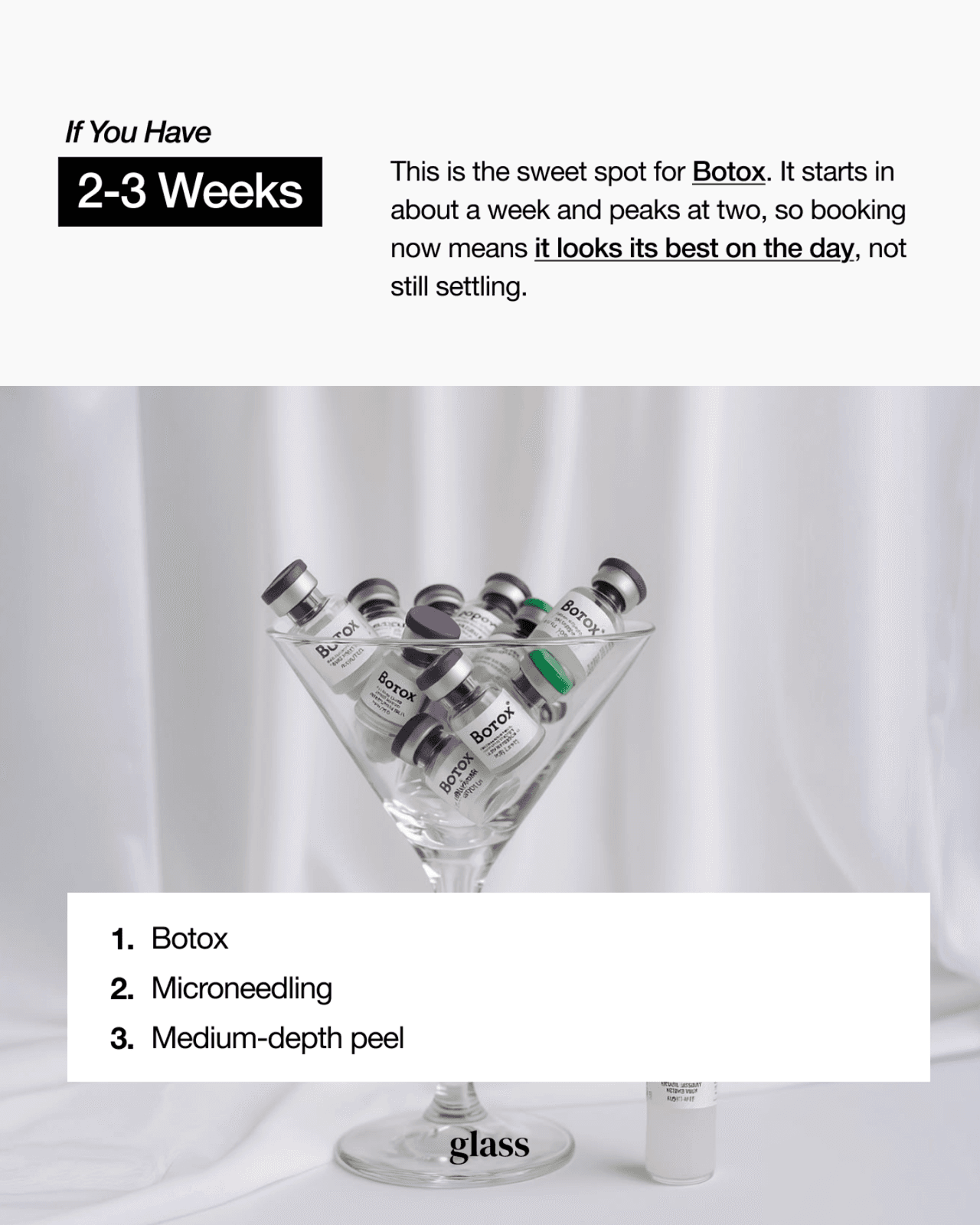
For someone who already knows their response, this is a useful window to discuss Botox before an event. The American Academy of Dermatology says most people see results within three to seven days. Starting to see a change is not the same as knowing exactly how it will look in photographs. Allow time for the effect to develop and for your injector to review it.
Keep the treatment familiar. A new area, a different approach, or a first injection deserves more planning than routine maintenance. “I have had Botox before” is not a substitute for discussing what will change this time.
Microneedling needs a separate conversation. It creates controlled punctures that trigger a repair response; it is not an instant resurfacing filter. The AAD's microneedling guide describes redness, discomfort, or swelling that usually clears within a few days to a week, while full results can take months. Depth and technique matter. Do not apply a familiar conventional microneedling recovery time to RF microneedling or a more intensive combined treatment.
Medium-depth peels are the important exception in this countdown. The carousel includes them here, but two to three weeks is not a reliable photo-ready clearance. The AAD describes seven to fourteen days of healing, and Mayo Clinic warns that redness after a medium or deep peel can last for months. A healed surface is not necessarily an even-toned surface.
Discuss a substantially earlier date for a medium-depth peel, especially if this is your first one. Do not book it simply because the appointment fits inside this row.
One Week to Go: Protect the Skin You Have
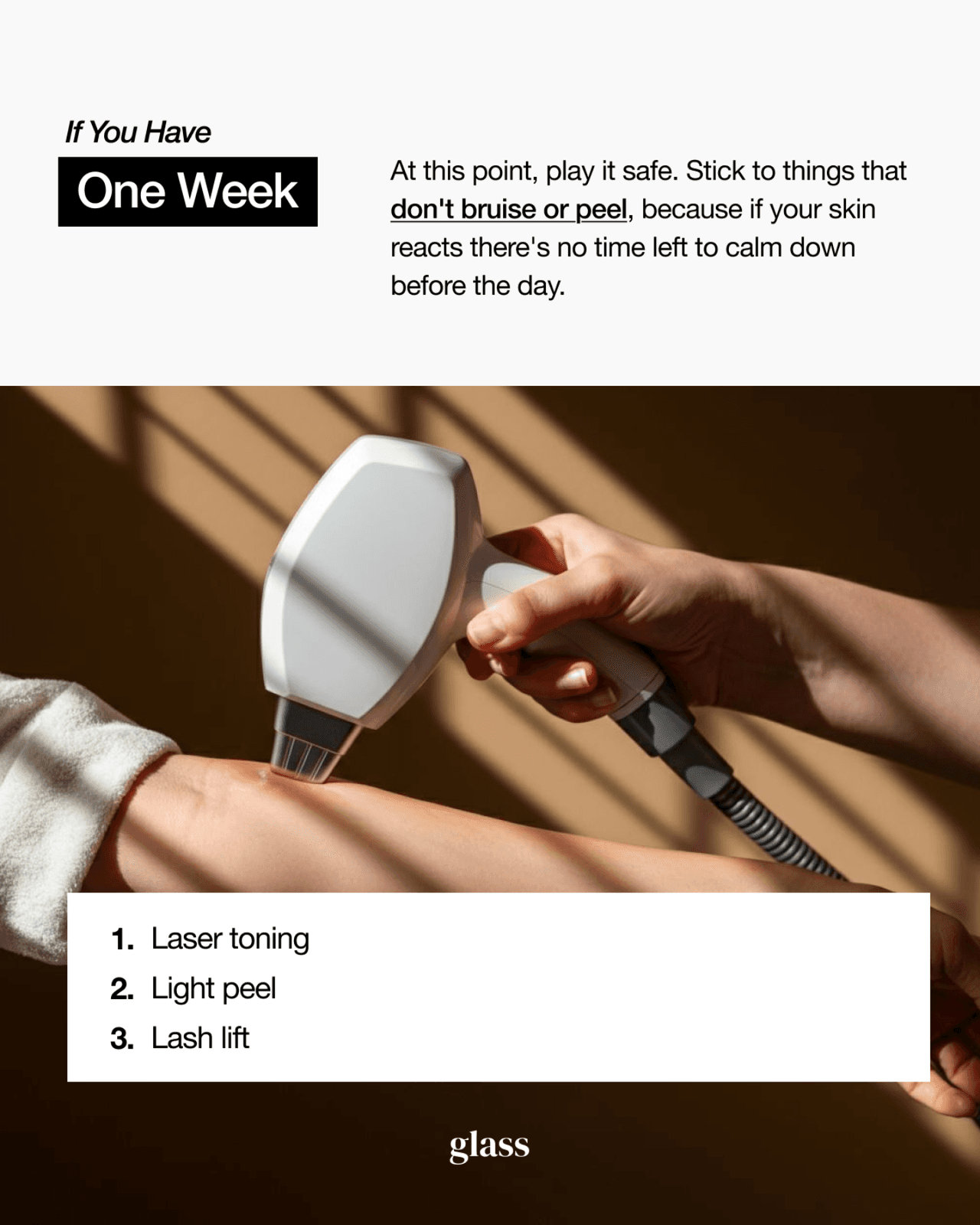
The last week is for preserving a good baseline. No new treatment within two weeks is a useful editorial rule — and two weeks is a minimum no-experiment boundary, not a safety guarantee for trying something on day fifteen.
The carousel lists laser toning, a light peel, and a lash lift at one week. None is automatically reaction-free. “Toning” describes a treatment approach rather than a universal level of risk. Ask about the actual device, settings, and your previous response. If you do not have that history, leaving laser treatment until after the event is the more conservative choice.
A light peel also removes surface skin. The AAD gives superficial peels a healing range of one to seven days, with redness and scaling possible. Booking one exactly a week before an event leaves little room for a slower response. Familiar does not mean risk-free; skip it if your skin is irritated or your clinician expects visible peeling near the date.
A lash lift avoids facial injections but uses products around your eyes. Follow the provider's allergy-screening and patch-test instructions. Do not use a major event as the first test of a new formula or technician.
If you cannot establish that an appointment is appropriate for your skin and deadline, your final-week plan can simply be your established cleanser, moisturizer, and sunscreen. There is no missing step to compensate for.
The Final Few Days: Keep the Finish Gentle
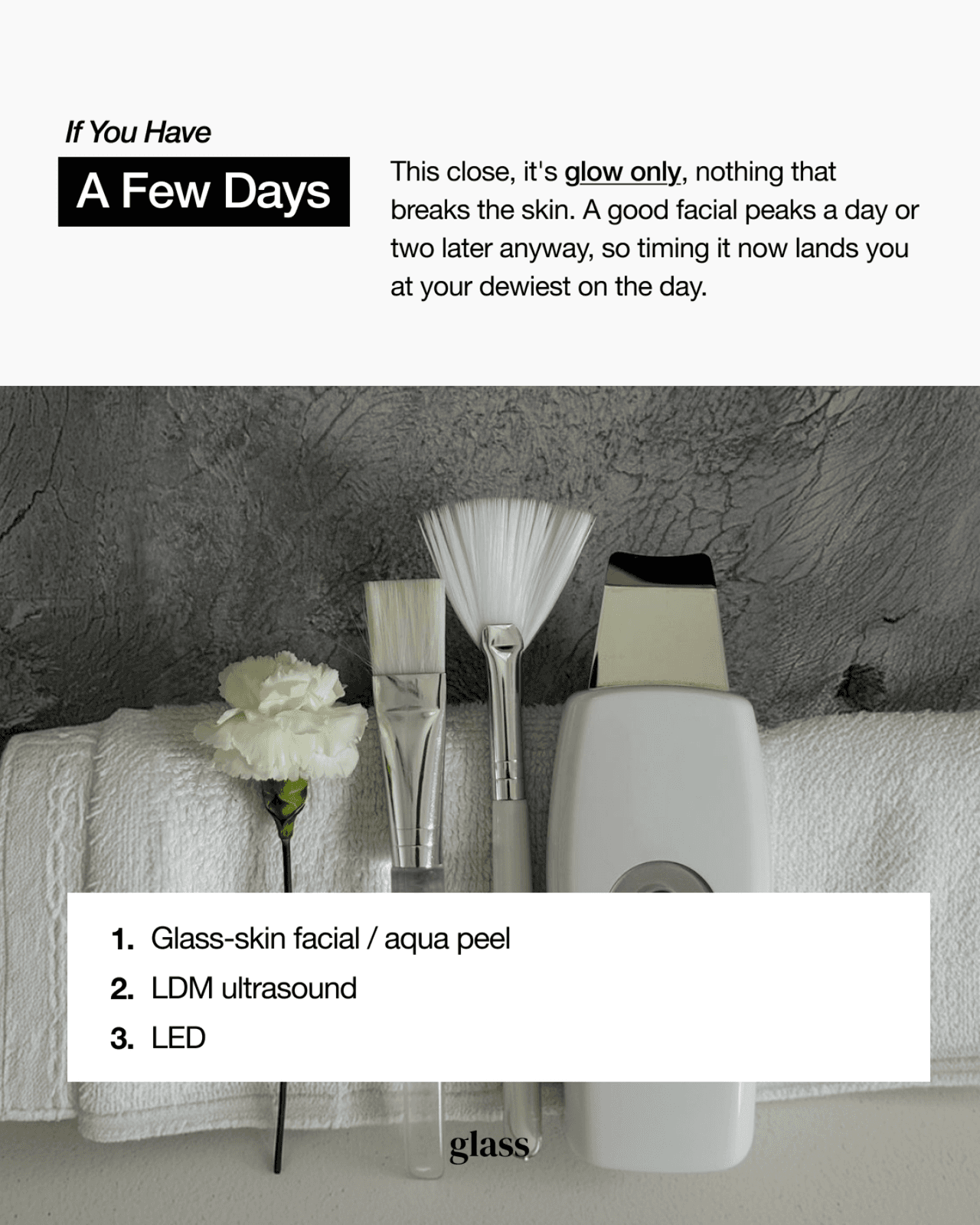
Think hydration and comfort, not correction. A familiar gentle facial is a different proposition from a treatment that punctures skin or deliberately produces peeling.
The carousel's options are a glass-skin facial or aqua peel, LDM ultrasound, and LED. The menu name alone does not tell you what happens during the appointment. An aqua peel can include exfoliation and suction; a facial can include extractions or active ingredients. Ask for the actual steps, and decline aggressive exfoliation or anything that previously left you red.
LDM and LED also require suitability checks. Neither should become a last-minute experiment because a clinic calls it soothing. Tell the provider about sensitivity, relevant medications, recent procedures, and any reaction still settling. Do not stack treatments to chase a stronger effect.
Our glass skin facial guide walks through the kind of multi-step appointment you will encounter in Seoul. Use it to ask what a clinic plans to include, not to assume every facial has the same intensity.
There is no universal day on which a facial peaks. If you know how your skin responds to a specific gentle service, use that history. If you do not, keeping your usual routine is a complete plan. In the final few days, leave needles, lasers, and aggressive peels off the itinerary.
The Glass Beauty Seoul Take
A good pre-event treatment timeline is selective. It reserves months for gradual change, weeks for assessment and recovery, and the final days for protecting what already works. It does not turn every available week into another appointment.
For a Seoul trip, bring the event date, flight dates, previous treatment details, and your usual recovery experience to the consultation. Ask which procedures the clinician would leave until afterward, when you can use makeup and return to your routine, and how follow-up works once you leave. Choose from our Seoul skin-clinic guide with that conversation in mind; explore the Skin collection for individual treatment guides.
Your deadline should help a clinician narrow the plan, not pressure them to promise faster healing. Before you book, ask for a schedule that includes recovery and follow-up — and permission to do less.
Before You Book is our series on making informed Korean skincare and treatment decisions. Follow Glass Beauty Seoul for the next guide. Editorial information, not personal medical advice.
Frequently Asked Questions
How long before an event should I get Botox?+
For familiar Botox, discuss an appointment two to three weeks before the event with your injector. The AAD says most people see results within three to seven days, but onset is not a guarantee of a settled result. Plan a first treatment well in advance rather than using your event as a trial.
When should I get filler before a wedding?+
Use four to six weeks as a planning buffer for a consultation, treatment, and follow-up, not a guaranteed recovery deadline. Swelling, bruising, the product, and the injection site affect the schedule. Count backward from your earliest photographed event.
Is two weeks enough to recover from a chemical peel?+
Not for every peel or every patient. The AAD lists seven to fourteen days of healing for medium peels, while Mayo Clinic notes that redness can last for months. Ask your dermatologist about visible redness as well as surface healing, and allow more time for a major event.
Can I get a facial a few days before an event?+
Only consider a familiar, gentle service that your provider considers appropriate for your skin. Ask whether it includes acids, suction, extractions, or other steps that previously caused irritation. If you do not know your response, keep your established routine instead.
What should I avoid in the last week before an event?+
Avoid new treatments, injections, aggressive peels, and last-minute laser experiments. Even familiar light peels, toning, and lash services can cause reactions. Your clinician can help decide whether maintenance is appropriate or whether to postpone it.
Get the Seoul Glow
K-beauty insights, treatment guides, and trend alerts — delivered weekly.