Ultherapy vs Thermage in Korea: What Lifts, What Firms
They target different layers and solve different problems. Korea does both — plus two machines that do it for less.
Every Reddit thread, every aesthetic forum, every "which one should I get" post frames the same question — Ultherapy or Thermage? Pick a side.
But they're asking the wrong thing. These two treatments do completely different jobs.
Ultherapy is ultrasound. It reaches the deep structural layer of your face — the same one a surgeon repositions during a facelift — and physically lifts sagging tissue. Thermage is radiofrequency. It works closer to the surface, tightening skin that's gone soft or crepey. One addresses sag. The other addresses firmness. Most people past their mid-thirties have both going on, which is why the "versus" framing never made sense.
Here's the part that changes everything if you're considering either: Korea has its own versions of both machines, at a fraction of the cost. And because Korean clinics run these devices at a volume that dwarfs most Western practices, the expertise behind the machine matters as much as the machine itself.
What Non-Surgical Lifting Actually Does
Non-surgical lifting uses energy to tighten skin and rebuild collagen — no scalpel, no filler, no general anesthesia. You sit for 30 to 90 minutes and leave with a face that tightens progressively over the following months as new collagen forms.
Two types of energy make this happen:
-
Ultrasound penetrates to the SMAS layer — 4.5 millimeters deep. This is the fascial layer a plastic surgeon physically lifts during a surgical facelift. Ultrasound devices heat this layer precisely, causing collagen contraction and new production. The result is a measurable lift.
-
Radiofrequency (RF) targets the dermis — roughly 1 to 2.4 millimeters deep. RF heats collagen fibers in this layer, causing immediate contraction and long-term remodeling. The result is tighter, firmer skin — but without the deep structural lift that ultrasound delivers.
They're not competing technologies. They're two tools for two different layers of your face.
The Ultrasound Side — Ultherapy and Shurink
Ultherapy
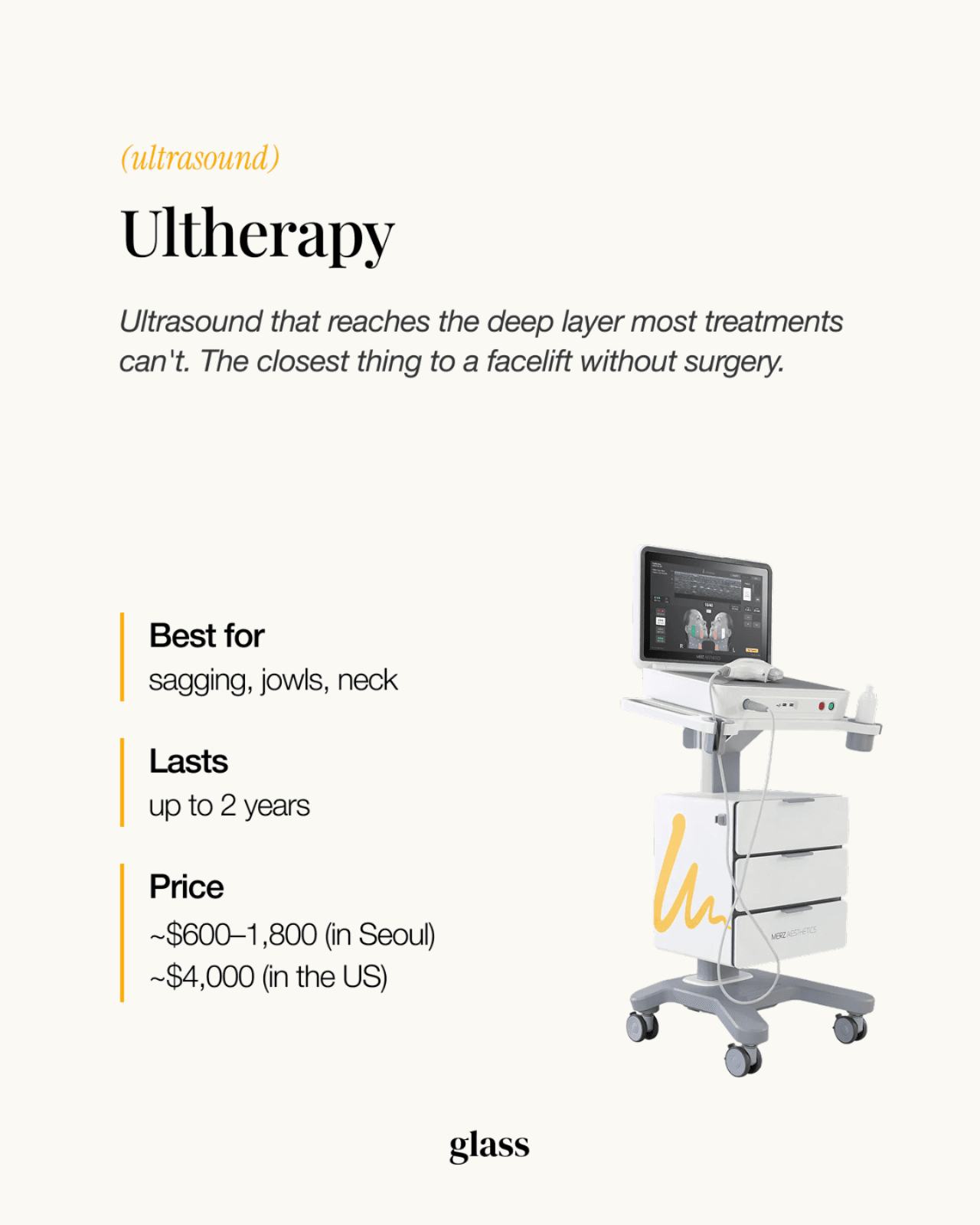
Ultherapy is the original FDA-cleared non-surgical lifting device. Developed in the US, it uses micro-focused ultrasound with real-time imaging — the doctor sees exactly which tissue layer they're hitting during treatment.
It reaches the SMAS at 4.5mm, the deepest any non-surgical device goes. This is why Ultherapy produces actual lift — not just tightening, but visible repositioning of tissue along the jawline, under the chin, and across the brow.
Results develop over two to three months as collagen rebuilds. The lift lasts up to two years. Downtime is minimal — mild redness and swelling for a day or two — but the treatment itself is intense. Most clinics offer numbing cream or mild sedation.
In the US, a full face and neck session runs around $4,000. In Seoul, the same treatment costs $600 to $1,800, depending on the clinic and line count.
Shurink
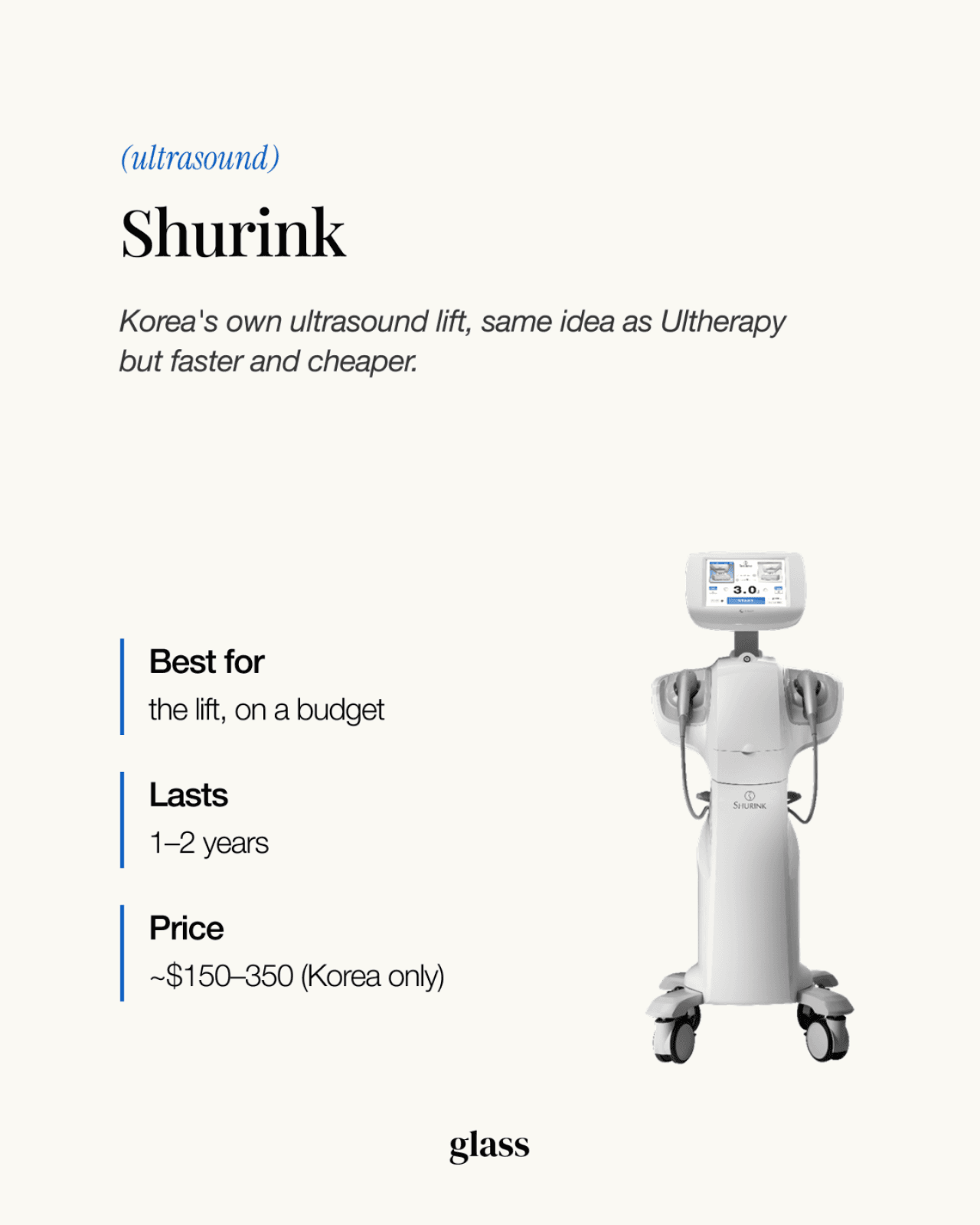
Shurink is Korea's own ultrasound lift, built by Classys. Same principle as Ultherapy — focused ultrasound, deep tissue targeting, collagen stimulation. The practical differences: Shurink skips the real-time imaging (the operator works from anatomical landmarks), sessions run faster, and the price drops dramatically.
A full face Shurink session costs $150 to $350 — available only in Korea. Results last one to two years, slightly shorter than Ultherapy on average.
Shurink is the most popular lifting device in Korean dermatology clinics. It's what most Korean patients book for annual maintenance, and increasingly what international visitors choose when they want the ultrasound lift without the Ultherapy price. The tradeoff is subtle — slightly less precision from the lack of imaging, slightly shorter duration — but at a fifth of the cost, most patients find it worth the exchange.
The RF Side — Thermage and Oligio
Thermage
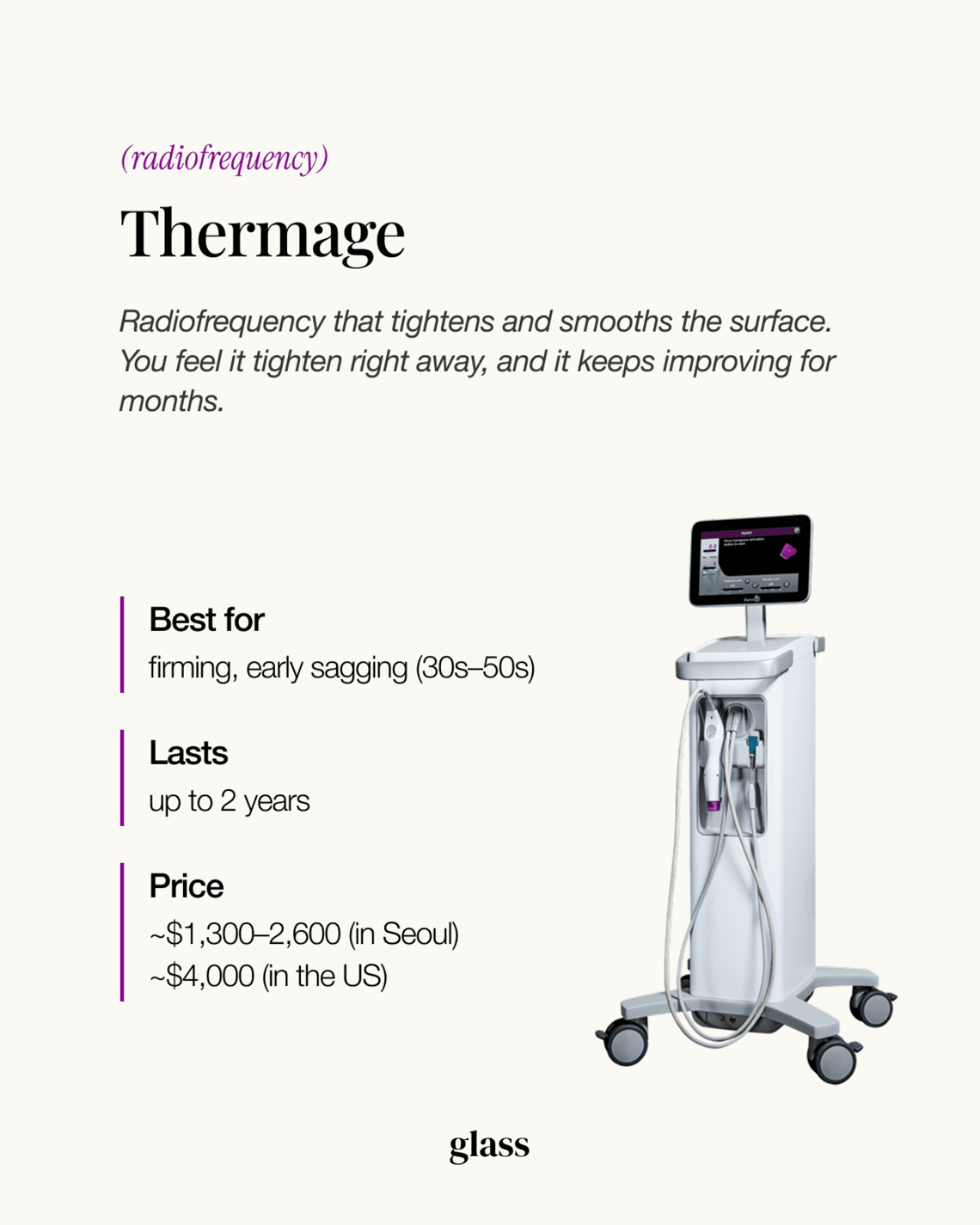
Thermage uses monopolar radiofrequency to heat the dermis uniformly. It doesn't reach the deep structural layer — it works the upper and mid-dermis, where collagen fibers contract under heat and gradually remodel over months.
The result is firming, not lifting. Skin that's gone soft, thin, or slightly loose gets tighter and smoother. Thermage is strongest for people in their 30s to 50s with early laxity — the stage where skin isn't as taut as it was, but gravity hasn't visibly pulled anything south.
You feel tightening immediately after treatment, with continued improvement over three to six months. Results last up to two years. Downtime is essentially zero.
In the US, a full face session costs roughly $4,000. In Seoul, Thermage FLX runs $1,300 to $2,600.
Oligio
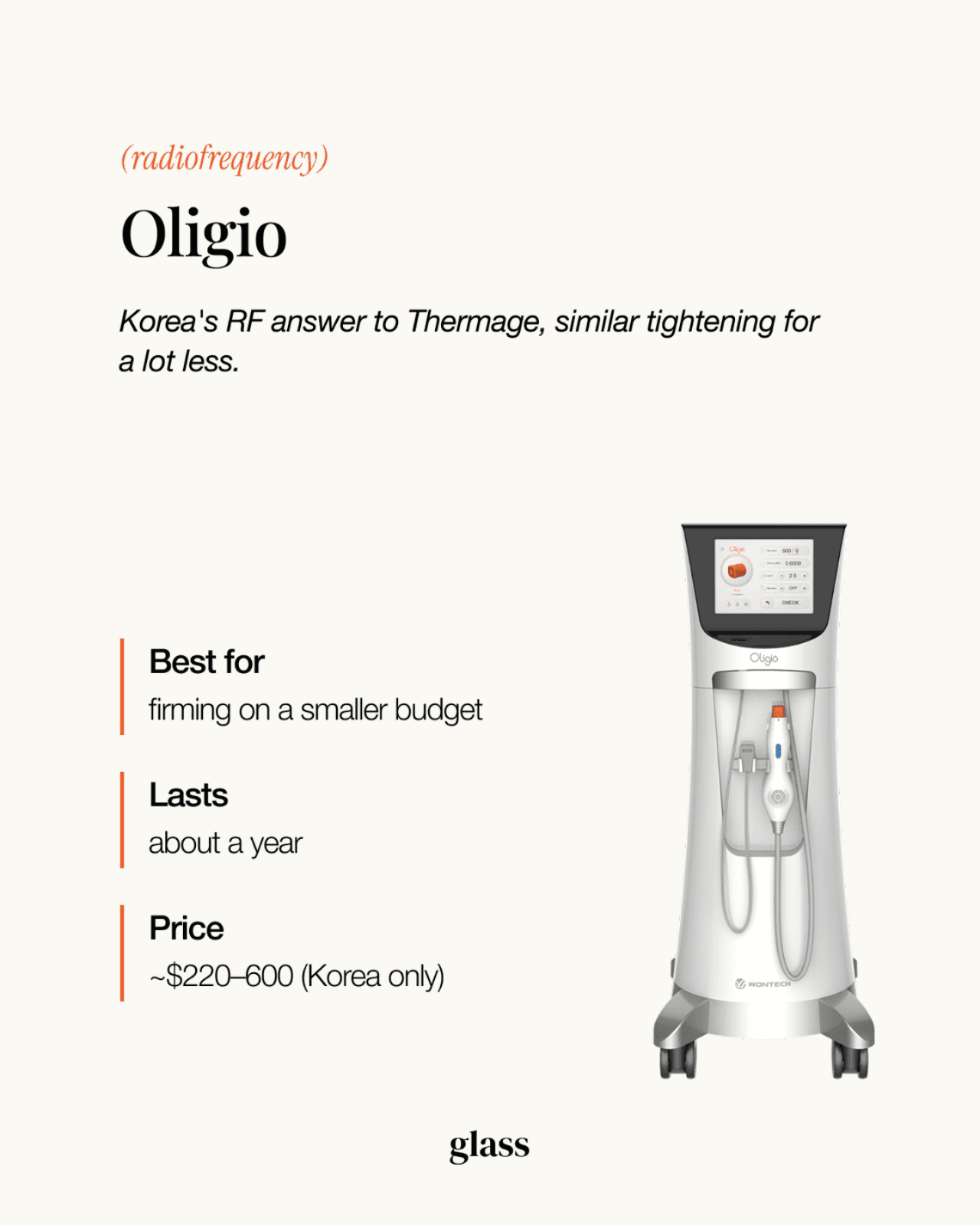
Oligio is Korea's RF counterpart to Thermage, made by WONTECH. Same monopolar radiofrequency mechanism, comparable firming results, dramatically lower cost.
A session runs $220 to $600 — available exclusively in Korea. Treatment time is shorter than Thermage, and many clinics bundle it with ultrasound lifting in combination packages.
Results last about a year, which is why Korean patients treat Oligio as semi-annual maintenance rather than a once-every-two-years procedure. At these prices, the math works.
Side by Side — What Each Treatment Costs
| Treatment | Technology | Best For | Duration | Seoul Price | US Price |
|---|---|---|---|---|---|
| Ultherapy | Ultrasound | Sagging jawline, jowls, neck | Up to 2 yr | $600–$1,800 | ~$4,000 |
| Shurink | Ultrasound | Lifting on a budget | 1–2 yr | $150–$350 | Korea only |
| Thermage | Radiofrequency | Firming, early laxity | Up to 2 yr | $1,300–$2,600 | ~$4,000 |
| Oligio | Radiofrequency | Firming on a budget | ~1 yr | $220–$600 | Korea only |
One number tells the whole story: a single Ultherapy session in the US costs more than a combined ultrasound-plus-RF session in Seoul. Swap in the Korean-made devices and you can treat both layers for under $1,000.
This is why combination protocols are the default in Korean clinics. When the pricing allows it, there's no reason to force a patient to choose between lifting and firming.
How to Choose
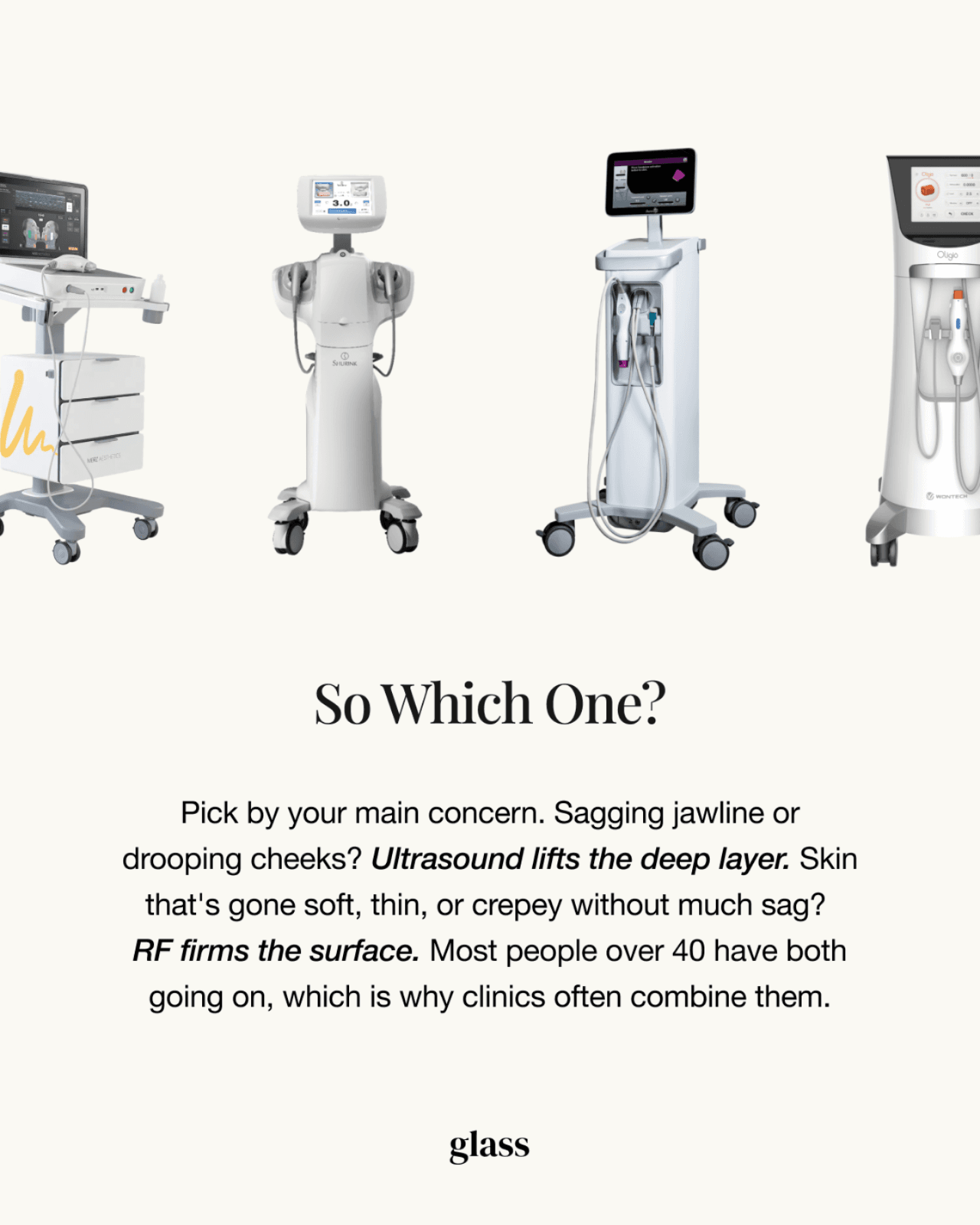
Start with your skin, not a machine name.
Sagging is your main concern — a softening jawline, early jowls, a neck losing definition — you need ultrasound. It's the only non-surgical technology that reaches the deep layer where sag originates. Ultherapy for the strongest, longest-lasting lift. Shurink for most of the result at a fraction of the cost.
Firmness is your main concern — skin that's gone soft, thin, or crepey without significant droop — RF is your match. Thermage for maximum durability. Oligio for effective firming at a lower price point.
If you're over 40, you likely have both. Sagging along the jaw and loss of firmness across the cheeks and forehead at the same time. Korean clinics handle this routinely — they combine ultrasound and RF in a single session, treating both layers in one visit. In the US, that combination runs $8,000 or more. In Seoul, depending on which devices you choose, it ranges from $370 to $2,400.
Lifting treats structure, not texture. If your goals also include improving skin quality — pore size, hydration, that lit-from-within glow — treatments like PDRN or Juvelook target the surface layer that lifting devices skip. Many patients in Seoul stack a lifting session with a skin booster on the same trip.
A good clinic in Seoul won't ask which machine you want. It will assess your skin, identify which layers need work, and build a protocol around your face — not around a brand name.
The Glass Beauty Seoul Take
The Ultherapy vs Thermage debate has always been a false choice. They target different depths, solve different problems, and work better together than alone. Asking which is "better" is like asking whether you need a foundation or a roof. It depends on what's missing.
What makes Seoul the right place to figure this out isn't just the pricing — though paying $1,000 for what costs $8,000 in New York changes the calculation entirely. It's the volume. Korean clinics have been running lifting devices at scale for over a decade. They see more patients in a week than most US practices see in a quarter. That repetition builds precision that no certification course replicates.
Your skin is going to shift. Whether it sags, softens, or does both is biology and time. The question isn't Ultherapy or Thermage — it's what your face actually needs. And the best place to get that answer costs a fraction of what you'd spend guessing at home.
We're building the guide to every skin treatment worth flying to Korea for. Follow along — we'll break down what works, what it costs, and where to go.
Frequently Asked Questions
Is Ultherapy or Thermage better for jowls?+
Ultherapy is better for jowls. It uses ultrasound to reach the SMAS layer at 4.5mm depth — the same structural layer a surgeon targets during a facelift. This produces actual lift of sagging tissue. Thermage works closer to the surface and firms skin, but it does not reposition drooping tissue the way ultrasound does.
Can you get Ultherapy and Thermage together?+
Yes. Korean clinics routinely combine ultrasound lifting and RF firming in a single session. Ultherapy or Shurink handles the deep lift, and Thermage or Oligio tightens the surface. In Seoul, this combination costs $370 to $2,400 depending on the devices used — compared to $8,000 or more in the US.
What is Shurink and how is it different from Ultherapy?+
Shurink is a Korean-made HIFU device that uses the same ultrasound principle as Ultherapy to lift sagging skin. The main differences are that Shurink does not include real-time imaging, sessions are faster, and the cost is $150 to $350 versus $600 to $1,800 for Ultherapy in Seoul. Results last one to two years.
How much does a non-surgical face lift cost in Korea?+
A non-surgical face lift in Korea costs $150 to $2,600 depending on the device. Shurink (ultrasound) runs $150 to $350, Ultherapy runs $600 to $1,800, Oligio (RF) costs $220 to $600, and Thermage costs $1,300 to $2,600. Combination treatments using both ultrasound and RF start around $370.
Get the Seoul Glow
K-beauty insights, treatment guides, and trend alerts — delivered weekly.