8 Good Skincare Habits: What's Your Skincare Score?
Most of us know the basics. Fewer of us keep them. Score yourself on eight dermatologist-backed habits, from sunscreen on cloudy days to clean brushes, and see which one to add next.

Most of us could recite the good skincare habits from memory. Sunscreen every day. Makeup off before bed. Clean brushes. The gap is not knowledge — it is follow-through, and the habits that slip first are the small, boring ones nobody posts about.
So instead of another list of rules, here is a score. Eight habits that dermatologists keep coming back to, one point each. Count the ones you already do, then read on for why each one earns its place — and which ones are worth adding first. Wondering how often to do skincare at all? Jump to the daily schedule.
Take the Skincare Score Quiz
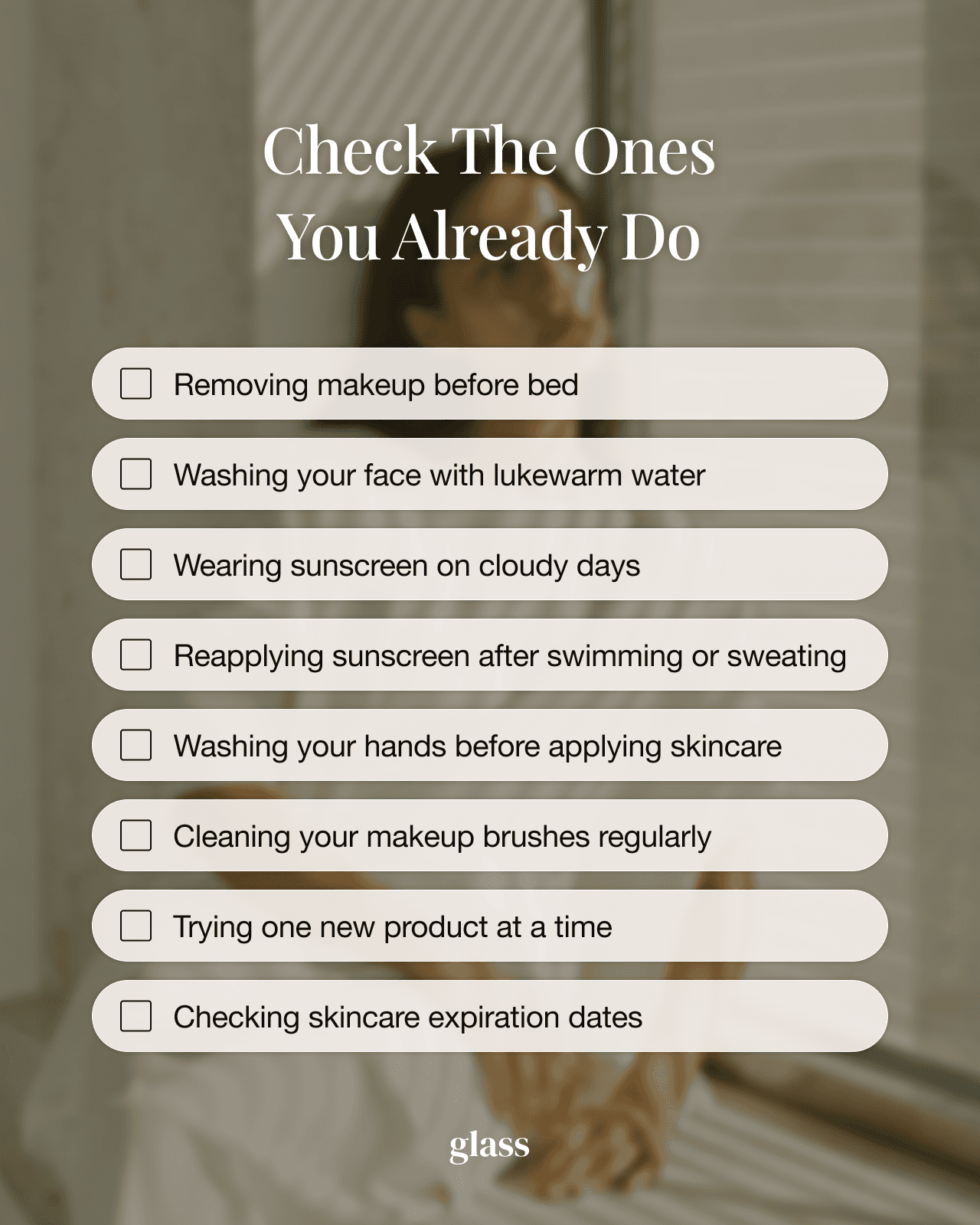
Give yourself one point for every habit you keep most days, not just on good weeks.
- Removing makeup before bed
- Washing your face with lukewarm water
- Wearing sunscreen on cloudy days
- Reapplying sunscreen after swimming or sweating
- Washing your hands before applying skincare
- Cleaning your makeup brushes regularly
- Trying one new product at a time
- Checking skincare expiration dates
What Your Score Means
| Score | What it says about your routine |
|---|---|
| 0 to 2 | You are just getting started — and you are curious enough to be reading this |
| 3 to 5 | You have the basics down. A couple of the habits below will close the gap |
| 6 to 8 | You are probably the friend everyone asks |

None of these habits costs much, and none takes more than a minute. That is exactly why they get skipped. Here is what each one does.
The Evening Habits: Makeup Off, Water Lukewarm
01. Removing makeup before bed
The American Academy of Dermatology does not soften this one. Its list of habits that worsen acne says even non-comedogenic makeup can cause breakouts if you sleep in it, and the instruction is blunt: remove it before bed, no exceptions. On nights you are too tired to wash, the same page suggests a non-comedogenic makeup remover towelette — imperfect, but far better than nothing.
If your evening routine runs longer than a wipe, our Korean night skincare routine walks through every step that comes after the makeup is off.
02. Washing your face with lukewarm water
Water temperature sounds like a detail. It is not. The AAD's face-washing guidance calls for lukewarm water and fingertips, not a washcloth, and warns that scrubbing irritates skin. Cleveland Clinic dermatologist Dr. Kathryn Anderson explains the reason to skip hot water: it can strip the skin barrier, and dryness tends to bring irritation with it.
Hot water feels like a deeper clean. Your skin reads it as a small, daily insult.
The Sunscreen Habits Most People Skip
03. Wearing sunscreen on cloudy days
This is the habit that separates a 4 from a 6. Clouds feel like protection, but the AAD's sunscreen FAQs put it plainly: even on cloudy days, up to 80% of the sun's harmful UV rays can get through. The same page recommends sunscreen every day on skin that clothing does not cover when you will be outside — year-round, not only in summer.
Sun damage adds up quietly. If you have ever wondered where sun spots come from, our guide to sun spot removal traces them back to exactly this kind of daily exposure.
04. Reapplying sunscreen after swimming or sweating
Morning sunscreen does not last all day. The AAD advises reapplying about every two hours outdoors, and again after swimming or sweating, following the directions on the bottle. A water-resistant label does not mean waterproof — it means the product holds up for a limited time in water, and then it needs another layer.
The practical version: keep a stick or a small tube in your gym bag and beach tote, so reapplying is a reflex rather than a decision.
The Hygiene Habits: Clean Hands, Clean Brushes
05. Washing your hands before applying skincare
Your fingertips are a perfectly good applicator. The problem is what they carry. The U.S. Food and Drug Administration notes that dipping fingers into a product adds microorganisms — bacteria, mold and yeast — that the product's preservatives then have to fight. Board-certified dermatologist Dr. Shamsa Kanwal makes the same point to NBC News: clean fingers are fine, but repeatedly dipping unwashed fingers into a jar is how bacteria get in.
A quick wash at the sink protects your face tonight and the jar for every night after.
06. Cleaning your makeup brushes regularly
Brushes collect product, oil and dead skin with every pass. The AAD calls them a breeding ground for bacteria that can show up as breakouts and rashes, and even as infections. Its recommendation is to wash them every 7 to 10 days: rinse only the bristle tips in lukewarm water, use a gentle shampoo instead of bar soap, and lay the brushes flat to dry.
Never share them, either. The AAD lists sharing makeup and brushes among the habits that can transfer bacteria and clog pores.
The Product Habits: One at a Time, Check the Date
07. Trying one new product at a time
When a new serum, a new toner and a new cream all start on the same night and your skin breaks out, you have no way of knowing which one did it. The AAD's tips for getting the most from anti-aging products start with exactly this: begin with one product, because using several at once can irritate skin.
Testing makes it even safer. The AAD's guide to testing skin care products suggests applying a new product to a quarter-sized spot, such as the inside of your arm, twice a day for seven to 10 days. No redness, itching or swelling? Then it goes on your face.
08. Checking skincare expiration dates
Skincare does not last forever, even sealed in a cabinet. The FDA explains that preservatives break down over time, emulsions separate, and heat, light and bathroom humidity speed up the change. Eye products age fastest: manufacturers usually recommend replacing mascara two to four months after purchase.
Here is the catch most people miss. U.S. law does not require ordinary cosmetics to carry an expiration date, but sunscreen is regulated as a drug, and drugs must print one. The FDA requires sunscreen to keep its original strength for at least three years; if a bottle has no date, the AAD suggests writing the purchase date on it. If anything changes color, smell or texture, throw it out regardless of the date.
| Habit | The one-line rule | Source |
|---|---|---|
| Makeup off | Every night, towelette if you must | AAD |
| Lukewarm water | Not hot, fingertips, no scrubbing | AAD |
| Sunscreen on cloudy days | Up to 80% of UV gets through clouds | AAD |
| Reapply | About every 2 hours, and after swimming or sweating | AAD |
| Clean hands | Fingers in jars add microorganisms | FDA |
| Clean brushes | Every 7 to 10 days | AAD |
| One new product | Patch test twice a day for 7 to 10 days | AAD |
| Expiration dates | Mascara 2 to 4 months; sunscreen at least 3 years | FDA |
Every skin is different, and results vary. If a habit on this list still leaves you with breakouts, rashes or irritation that will not settle, that is a question for a board-certified dermatologist, not for a new product.
How Often Should You Do Skincare?
Twice a day is the short answer — once in the morning, once at night. That is the rhythm the American Academy of Dermatology sets for washing: once in the morning and once at night, plus after sweating heavily, and no more than twice a day.
Here is how that maps onto the habits above:
| When | What belongs in it |
|---|---|
| Morning | Wash with lukewarm water, then sunscreen on any skin clothing does not cover — cloudy days included. Our guide to washing your face in the morning covers the details |
| During the day | Reapply sunscreen about every two hours outdoors, and after swimming or sweating |
| Night | Makeup off first, then wash. Our Korean night skincare routine covers every step after that |
| Weekly | Wash makeup brushes every 7 to 10 days |
| Whenever you add a product | One new product at a time, patch tested for seven to 10 days |
Frequency is not the same for every product. Anything new goes in on its own schedule, one product at a time, and your skin's reaction sets the pace. If you are building a routine from scratch, our piece on skincare in your 30s shows where to start.
The Glass Beauty Seoul Take
The best skincare routines we see in Seoul are not the longest ones. They are the ones built on unglamorous basics, repeated every day until they stop feeling like effort. A serum can only do its job on skin that is clean, protected from UV and not fighting off an expired product or a dirty brush.
That is why a score is more useful than a shopping list. If you landed at 3 to 5, you do not need anything new — you need one more habit. Start with sunscreen on cloudy days or a brush wash this weekend. If you scored 6 to 8, check the one you missed and send this to the friend who always asks you for advice.
Then share your score and compare. Good skincare habits stick faster when somebody else is counting too. For more routines that respect your skin, browse our beauty guides.
Glass Beauty Seoul is building the most honest guide to Korean skin care and treatment for readers outside Korea. Follow along as we break down what Seoul knows first.
Questions.
What are good skincare habits?+
Dermatologists keep returning to the same basics: remove makeup before bed, wash with lukewarm water, wear sunscreen daily including cloudy days, reapply after swimming or sweating, wash your hands before applying skincare, clean makeup brushes, introduce one new product at a time, and replace expired products.
Do you need sunscreen on a cloudy day?+
Yes. The American Academy of Dermatology says up to 80% of the sun's harmful UV rays can pass through clouds, so it recommends sunscreen every day on exposed skin when you will be outside.
How often should you clean makeup brushes?+
The American Academy of Dermatology recommends washing makeup brushes every 7 to 10 days. Rinse the bristle tips in lukewarm water with a gentle shampoo and lay the brushes flat to dry.
How long should you test a new skincare product?+
The American Academy of Dermatology suggests applying a new product to a small test spot, such as the inside of your arm, twice a day for seven to 10 days. If there is no redness, itching or swelling, it is usually fine to use on your face.
Does skincare expire?+
Yes. Preservatives break down over time, and heat and humidity speed that up. U.S. law does not require most cosmetics to show an expiration date, but sunscreen must, and the FDA requires sunscreen to keep its original strength for at least three years. Manufacturers usually recommend replacing mascara two to four months after purchase.
How often should you do skincare?+
Twice a day for the basics: once in the morning and once at night. The American Academy of Dermatology advises washing your face once in the morning, once at night and after sweating heavily, and no more than twice a day. Sunscreen goes on every day, reapplied about every two hours outdoors.
Should you wash your face twice a day?+
The American Academy of Dermatology says to limit face washing to twice a day and after sweating: once in the morning and once at night.
Do you need a skincare routine every day?+
The habits here are daily or near-daily: makeup off at night, sunscreen in the morning, a gentle wash twice a day. Brush cleaning is weekly, every 7 to 10 days, and new products are added one at a time.