The Korean Night Skincare Routine, Step by Step
Six steps, nine minutes, and one measurement that explains the order — your skin loses the most water while you sleep.
Your skin leaks more water at midnight than it does at breakfast. That isn't a metaphor — it's a measurement.
Researchers tracked 16 healthy adults every two hours across a full 24-hour cycle and published the numbers in the Journal of Investigative Dermatology. Transepidermal water loss — the rate moisture escapes through the skin — climbed in the evening and stayed high overnight. Skin permeability peaked while people slept.
The Korean night skincare routine is built around that window. The morning routine defends. The night routine rebuilds. Six steps, in a fixed order, all of them answering the same question: what does skin need during the eight hours it spends both repairing itself and losing water faster than at any other time of day?
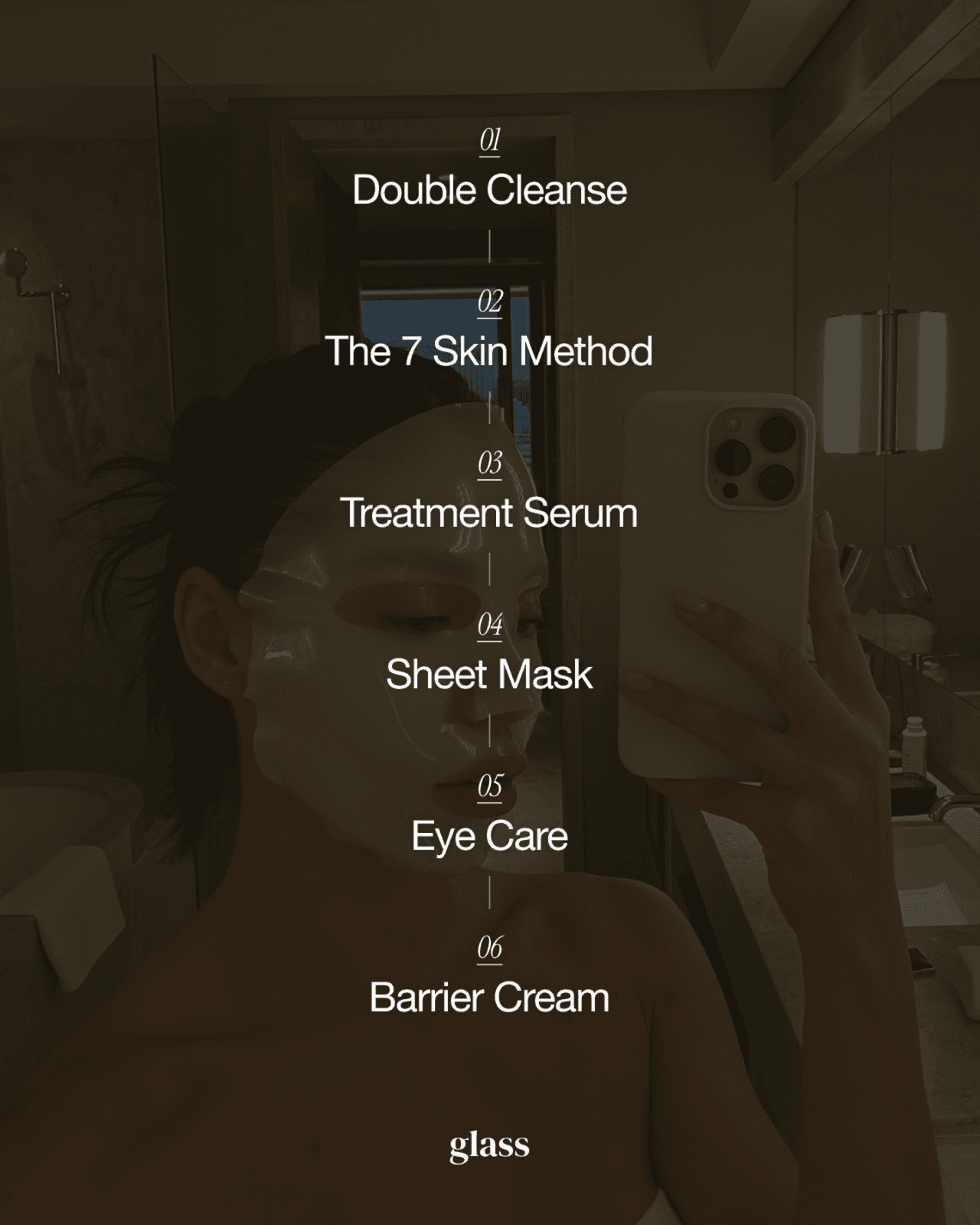
The order, in one line: oil cleanser, then a water-based cleanser, then hydrating toner pressed on in thin layers, a regenerating serum, a sheet mask two or three nights a week, eye cream, and a ceramide barrier cream to finish. Thinnest to thickest, about nine minutes on a night without a mask.
Why Your Skin Loses The Most Water At Night
Two things happen after dark, and they pull in opposite directions.
The first is repair. Cortisol drops, cell turnover accelerates, and the skin gets on with the work it can't do while defending against UV and pollution. This is the part everyone knows — the reason "beauty sleep" outlived every other Victorian beauty phrase.
The second is loss. That same permeability spike means the barrier holds moisture less tightly overnight. Body temperature rises slightly during sleep, which speeds water diffusion through the outer layer. Your skin is at its most receptive and its most leaky at the same time.
A Western routine reads that first half and stops — apply the strongest active you tolerate, let it work overnight, done. A Korean routine reads both halves. Hydrate hard, treat gently, then seal. The sequence below is that logic made literal, and the order isn't decorative. Products go on thinnest to thickest, because a rich cream applied before a watery layer blocks everything behind it.
| # | Step | What it's for | Minutes |
|---|---|---|---|
| 01 | Double cleanse | Remove sunscreen and the day, without stripping | 3 |
| 02 | 7 skin method | Build hydration in thin layers | 3–5 |
| 03 | Treatment | Regenerating actives, not aggressive ones | 1 |
| 04 | Sheet mask | Concentrated boost, a few nights a week | 15–20 |
| 05 | Eye care | Prevention where skin creases first | 1 |
| 06 | Barrier cream | Seal everything against overnight water loss | 1 |
Nine minutes on an ordinary night. Closer to thirty when a mask goes on. That's the whole commitment.
01. Double Cleanse
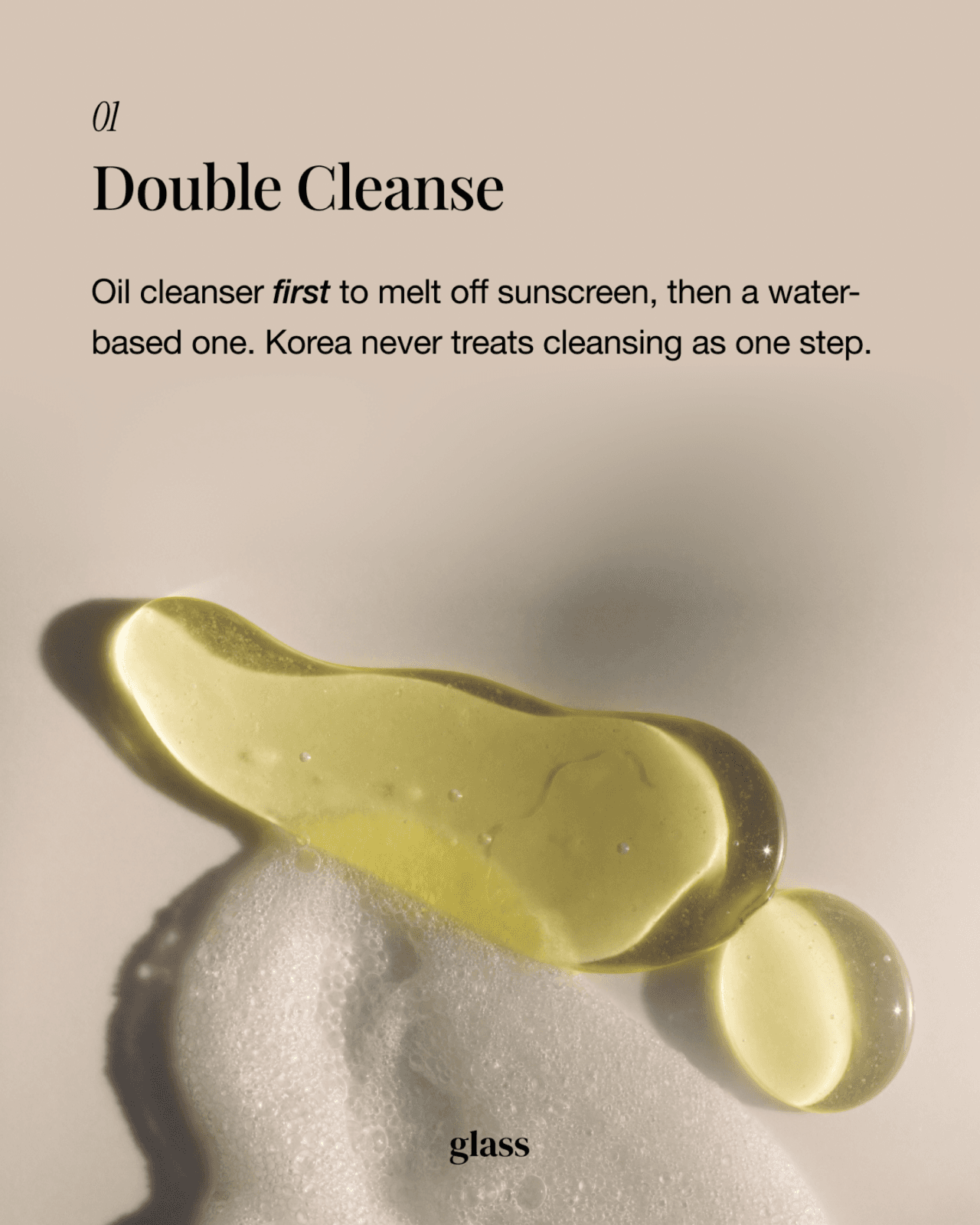
Sunscreen does not come off with water. Neither does long-wear foundation, sebum that has oxidized over twelve hours, or the film city air leaves behind. These are oil-soluble, and a foaming cleanser pushes them around instead of lifting them.
So Korea splits cleansing in two. An oil cleanser goes on dry skin first — balm, oil, or cleansing milk — and you work it in for a full minute before adding water to emulsify. It dissolves like into like. Then a low-pH water-based cleanser takes off the residue and anything sweat-soluble underneath.
The reason this matters more at night than in the morning is simple arithmetic. Everything in the next five steps has to travel through whatever you leave behind. A serum applied over half-removed sunscreen is a serum you paid for and didn't use.
Skip the washcloth and the scrubbing. Water should be lukewarm, not hot — hot water strips the lipids you're about to spend five steps replacing.
02. The 7 Skin Method
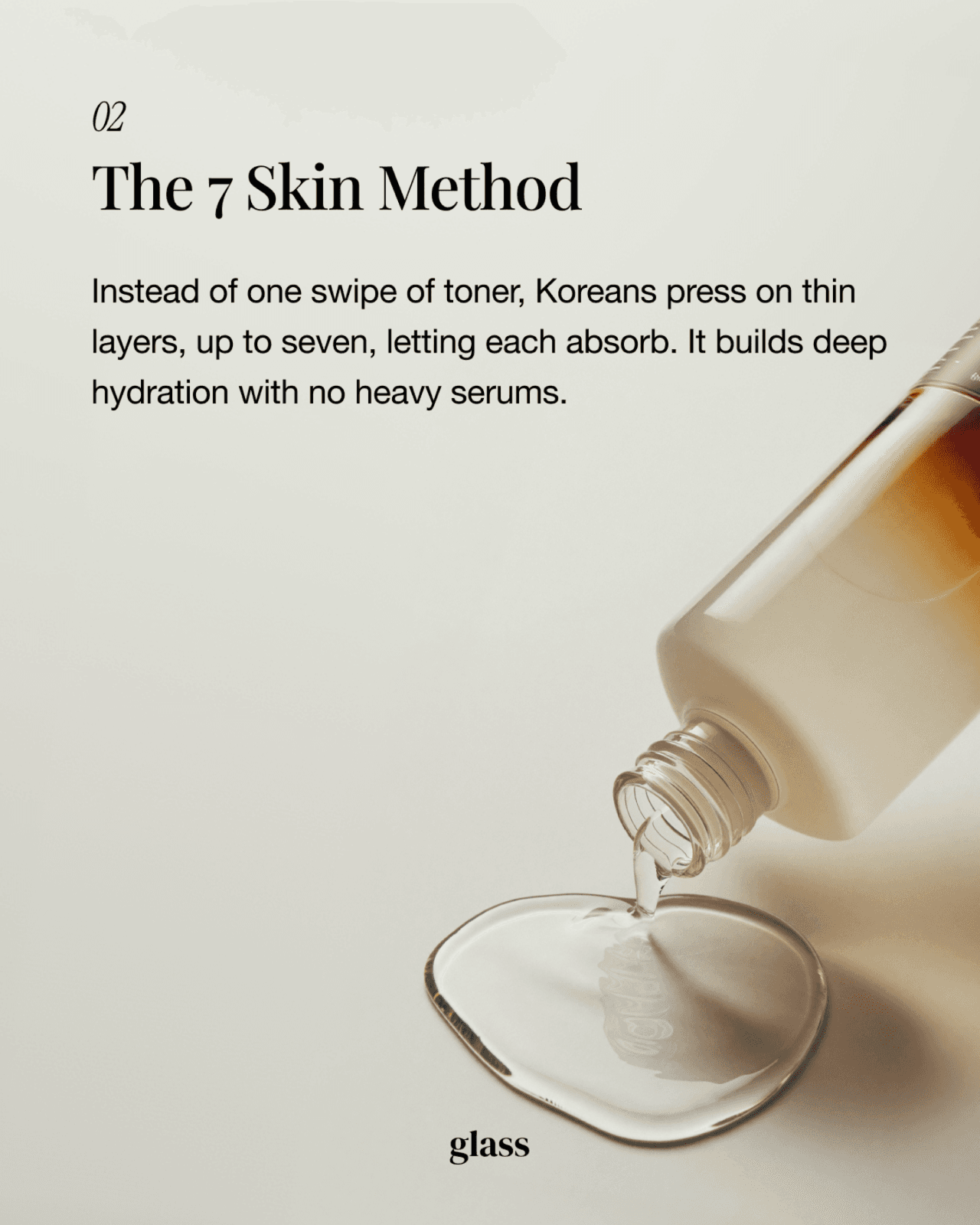
Here's the step Western routines don't have an equivalent for. Instead of one swipe of toner, you press on a thin layer, wait for it to sink in, then press on another. Traditionally seven times.
Seven is the name, not the prescription. Most skin stops taking it up somewhere around the third or fourth layer, and the honest instruction is to stop when your face feels comfortable rather than counting to a number. Give each pass 30 to 60 seconds before the next one. Rush it and the layers sit on top of each other and pill.
The logic is dosing. Several light applications absorb better than one heavy one, and hydration delivered this way sits in the outer layers where the overnight water loss actually happens. Skin looks plumper within a week, pores read smaller because the tissue around them is fuller, and the barrier has more to work with.
Use a hydrating toner — glycerin, hyaluronic acid, panthenol, beta-glucan. Not an exfoliating one. Seven layers of acid is a chemical peel you didn't book.
03. Treatment
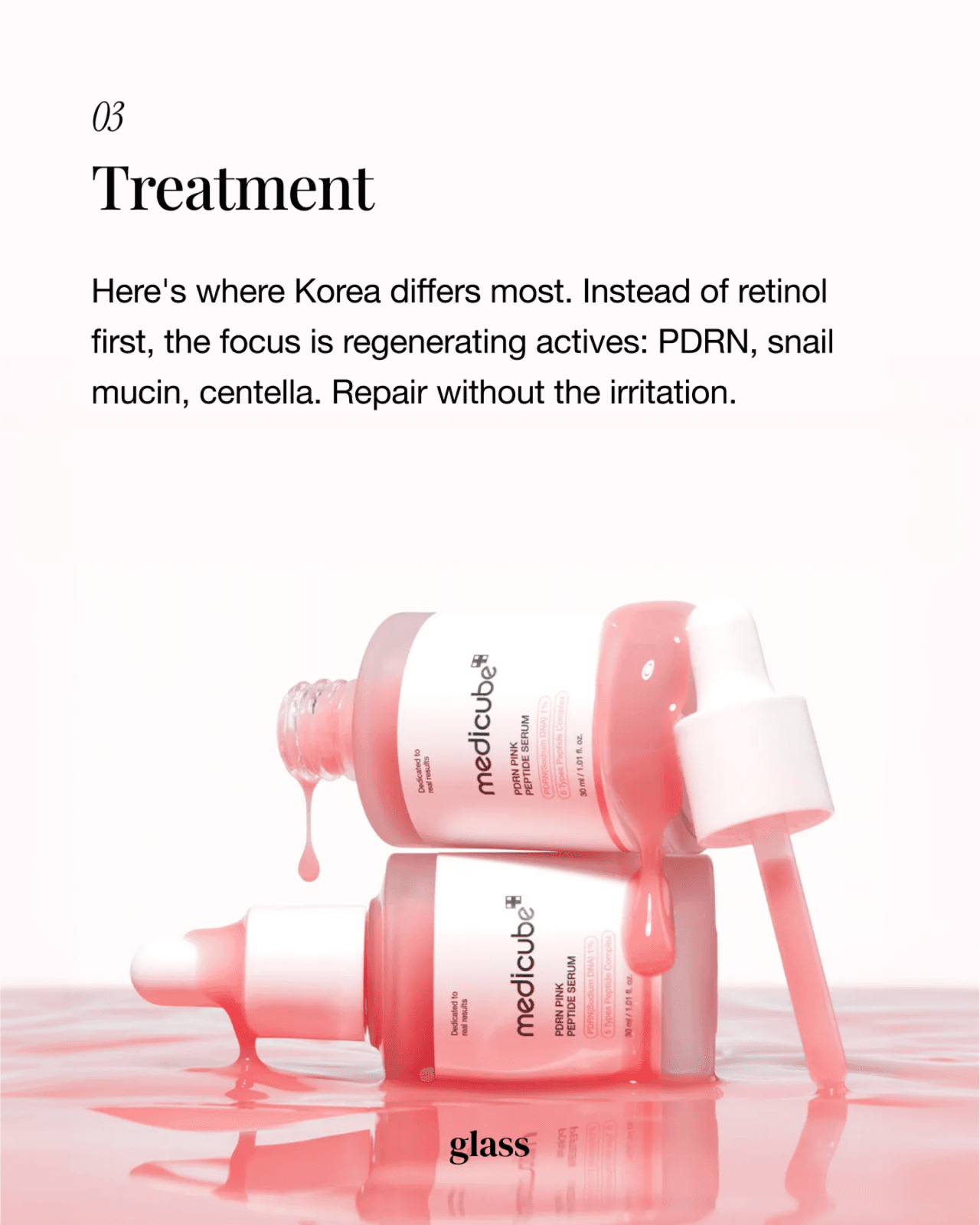
This is where the two philosophies split hardest.
American anti-aging starts with retinol and treats the irritation as a toll you pay — the purge, the flaking, the weeks of building tolerance. It works. It also compromises the barrier while it does, which is a strange trade to make during the exact hours the barrier is already at its weakest.
Korean anti-aging leads with regenerating actives instead. PDRN, snail mucin, centella, peptides. Repair-side ingredients instead of turnover-side ones. In human patch testing, a PDRN complex lowered redness and softened the water-loss spike that retinol produces; in an eight-week consumer study, 90% of users reported no irritation at all.
That's the trade in plain terms: retinol pushes harder and costs barrier integrity, PDRN moves slower and costs nothing. Korea picks the second and compensates with consistency. Nobody in Seoul is trying to fix their skin in six weeks.
None of this bans retinol. Plenty of Korean dermatologists prescribe it. It arrives later in the sequence, after the barrier can take it, and it's often buffered by the hydration layers underneath — which is what those seven passes of toner were quietly setting up.
If PDRN is the ingredient you keep hearing about, we broke down what it is and how the injectable version works separately, and compared five topical PDRN serums you can use in this step.
04. Sheet Mask
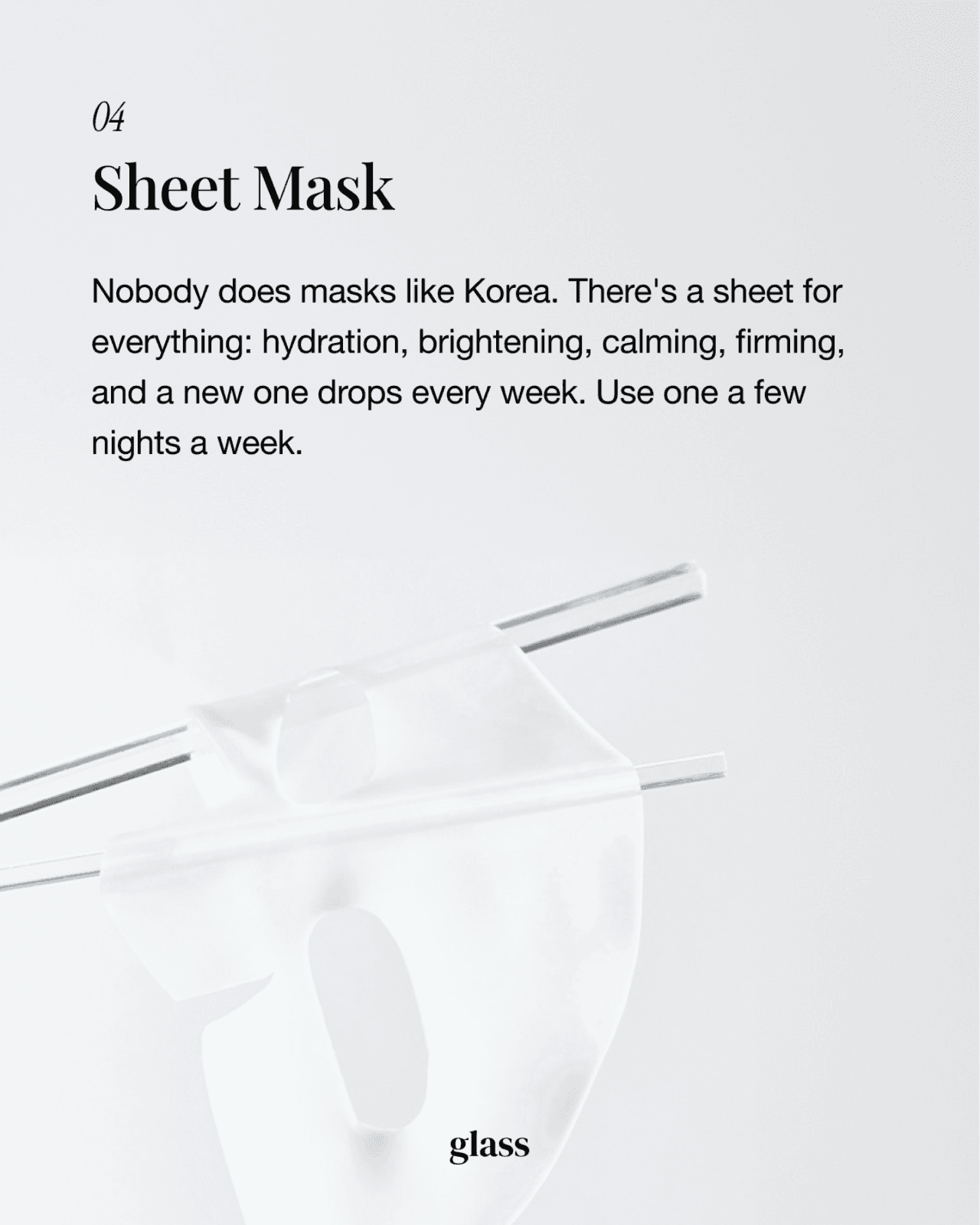
Korea makes a sheet mask for everything. Hydrating, brightening, calming, firming, and a new formulation lands every week. Drugstores stock them by the wall, and they cost a dollar or two each.
What the sheet actually does is occlude. It holds a serum against skin for twenty minutes and stops it evaporating, which pushes far more of the formula in than the same serum applied by hand. That's the whole mechanism, and it's a good one.
It's also the step most often overdone. Studies of frequent maskers found more transient redness and mild dermatitis among people going past four times a week, particularly with masks carrying botanical extracts or certain preservatives. Two or three nights a week is the range that keeps the upside.
Take it off at twenty minutes. Once the sheet dries it reverses — the evaporating essence pulls moisture out of your face on its way. Pat in what's left, skip the rinse, and carry on with eye cream.
05. Eye Care
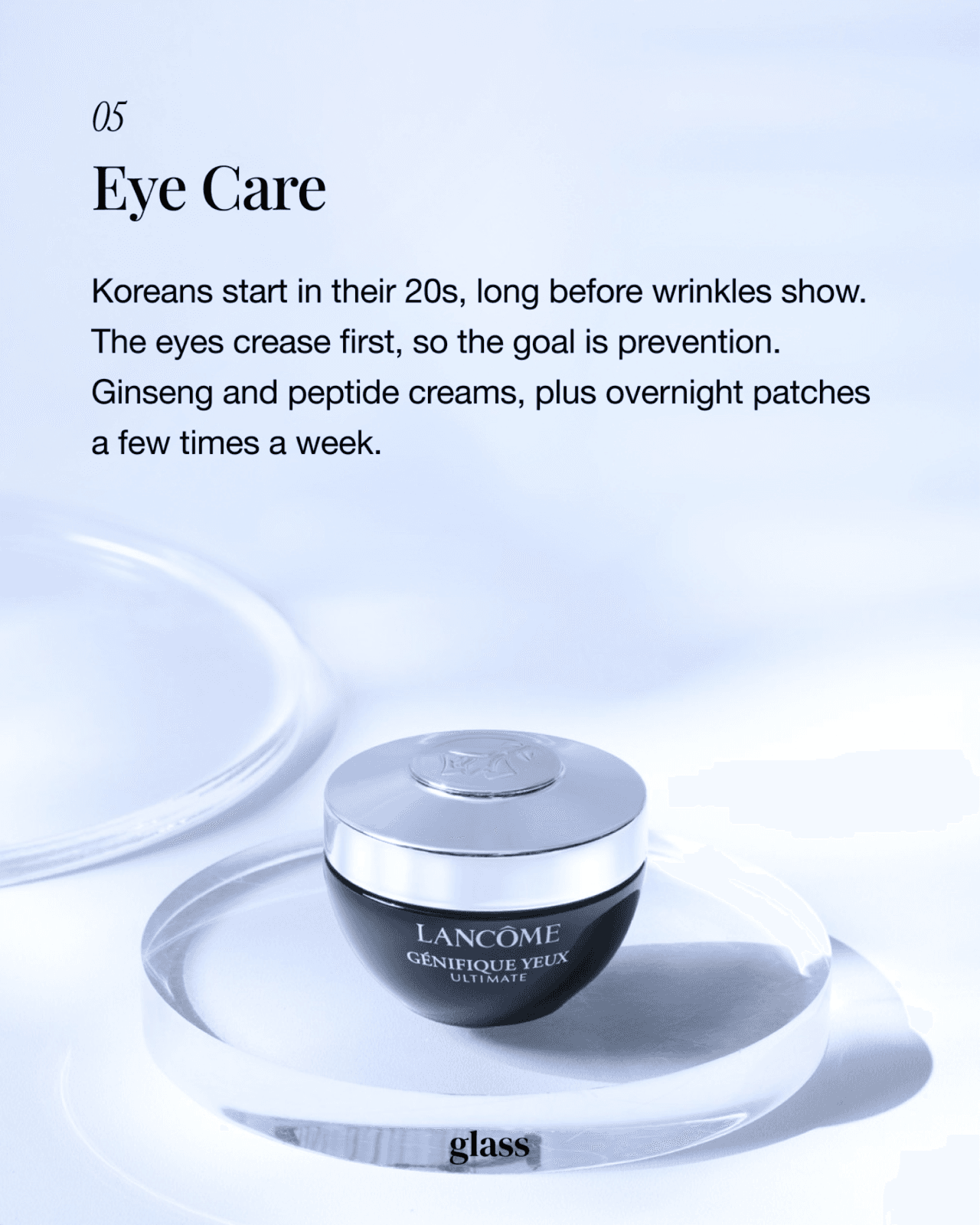
Korean women start eye cream in their twenties. Not because anything is wrong yet — because of where the first line always shows up.
Eyelid skin runs a fraction of the thickness of cheek skin, carries almost no oil glands, and folds tens of thousands of times a day. It dehydrates first and creases first. Waiting for a wrinkle to appear before treating the area means starting the work at the point it becomes hardest.
So the framing is prevention. Ginseng and peptide formulas most nights, hydrogel patches a few times a week for a concentrated soak. Apply with your ring finger, tapping rather than dragging, and stay on the orbital bone instead of pushing product toward the lash line.
Expect it to be undramatic. The return on eye cream shows up in the decade, not the month — which is precisely why the routine starts it early and treats it as maintenance rather than repair.
06. Barrier Cream
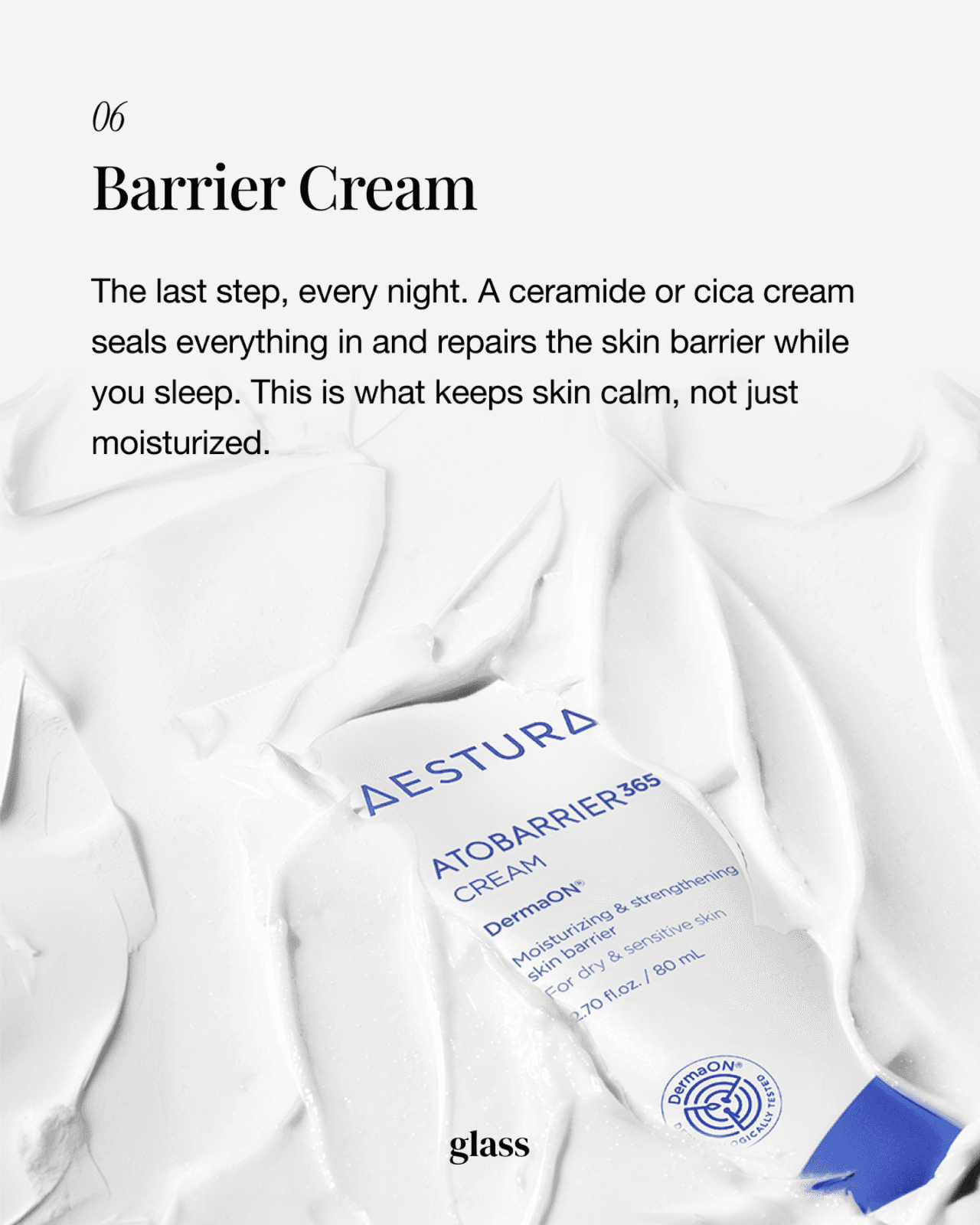
Everything above was hydration. This is the step that keeps it.
Recall the measurement the routine is built around: water leaves your skin fastest overnight. Five steps of moisture with nothing on top is five steps evaporating into your pillowcase by 3 AM. A ceramide or cica cream goes on last and closes the system.
Ceramides do it structurally — they're the lipids that hold your barrier's cells together, and topping them up reinforces the layer that's leaking. Cica, or centella asiatica, works on the calming side, which is why Korean formulas so often pair them.
The distinction worth holding onto is between comfort and repair. A cream that only hydrates leaves you soft in the morning and reactive by the weekend. One that rebuilds leaves the barrier stronger than it was the night before — the only version of this that compounds.
Korean Skincare Routine, Day and Night: What Changes
The morning routine and the night routine share most of their products. What changes is the job. Morning defends against the day ahead — UV and pollution. Night removes the day and rebuilds through the hours when skin loses the most water. The steps that differ follow directly from that.
| Morning | Night | |
|---|---|---|
| Cleanse | One gentle, low-pH wash — or just water | Double cleanse: oil first, then water-based |
| Hydrate | One or two layers of toner | The 7 skin method, layered until comfortable |
| Treat | A light serum | A regenerating serum — PDRN, snail mucin, centella, peptides |
| Mask | — | Sheet mask, two or three nights a week |
| Eyes | Eye cream | Eye cream, hydrogel patches a few nights a week |
| Last step | Sunscreen | Barrier cream |
The two routines hand off to each other. Sunscreen is the last thing on in the morning, which is exactly why the night routine opens with an oil cleanser — it's the step built to take sunscreen off. And the night routine ends on barrier cream because the morning one can afford to stay light: the heavy sealing work already happened while you slept.
If you only have time for one full routine, make it the night one. It's the one with more to remove and more hours to work.
Making the Night Routine Yours
The six steps are the frame. Most Korean routines you'll see online list more — ten, sometimes twelve. Here is where the extra products go, and how to bend the frame to your skin.
Where Essence, Exfoliation, and Sleeping Masks Fit
The longer "10-step" lists aren't a different routine. They split the same six jobs into more bottles.
- Essence is a hydrating layer, slightly thicker than toner. It belongs to step 02 — press it on after your toner passes, before the serum.
- Ampoules and serums are the same job at different concentrations. Both live in step 03. Pick one per night rather than stacking three.
- Exfoliating toners and acids get a night of their own. Use one in place of the 7 skin layers on that night, never underneath them — seven layers of acid is the peel step 02 warns against.
- Sleeping masks are occlusives. On nights you use one, it takes the place of barrier cream as step 06, the final seal. An overnight hydrogel mask, like the one in our Korean picks from Sephora, does the same job.
Thinnest to thickest still decides the order. Any product you add slots in by texture.
Dry, Oily, or Sensitive Skin
The order doesn't change with skin type. The amounts do.
- Dry skin — Take the 7 skin method further. Keep adding layers until your face feels comfortable, and choose the richest barrier cream you like the feel of.
- Oily or combination skin — Stop the toner layers sooner, and pick a lighter, gel-textured cream for step 06. Don't drop the last step. Water leaves oily skin overnight too, and the seal is what keeps the hydration you just layered on.
- Sensitive skin — Stay with the regenerating actives in step 03, add one new product at a time, and patch test it first. Keep sheet masks at two nights a week, not four.
Where Retinol and Spicule Serums Go
Both are strong actives, and both go in step 03 — just not on the same night. Retinol goes on top of the hydration layers, once your barrier can take it. Spicule serums like VT Reedle Shot go on dry skin, usually right after cleansing, and VT tells you to alternate them with retinol rather than layering the two. Our VT Reedle Shot guide covers how often each strength goes on.
On those nights, keep everything after step 03 simple — VT's own instructions say the same. Those are not the nights for trying something new.
The Glass Beauty Seoul Take
Six steps sounds like a lot until you time it. Nine minutes on a normal night — less than the Western routine most people abandon, and gentler than any of them.
What makes it work isn't the step count. It's that every step is doing the job the hour calls for. Hydration goes on when skin is most permeable. The gentlest actives go on when the barrier is weakest. The occlusive goes on last because water loss peaks in the middle of the night. Korea didn't arrive at this through tradition — it arrived through paying attention to when skin does what.
And there's a ceiling, which nobody selling you a cream will mention. Topicals reach the outer layers. They hydrate, protect, calm, and prevent, and consistency over years genuinely shows. What they don't do is rebuild collagen at depth or fix laxity that's already set in. That's where Seoul's clinics take over — skin boosters, regenerative injectables, laser toning — and where the same regenerating ingredients you've been layering get delivered somewhere your hands can't reach. If you're weighing that step, start with how to pick a clinic in Seoul that will actually treat a foreigner well.
The Korean night skincare routine rewards starting small. Begin tonight with the two steps that change the most — cleanse twice, and put something occlusive on last. The other four can arrive whenever you're ready.
Glass Beauty Seoul is building the guide we wanted before our first flight to Seoul — how Korean skin actually works, what it costs, and which parts you can do from your own bathroom. Follow along as we take apart the rest of the routine.
Frequently Asked Questions
Is retinol part of the Korean night skincare routine?+
It can be, but it is not the starting point. Korean routines lead with regenerating actives — PDRN, snail mucin, centella, peptides — because they repair without compromising the barrier, and retinol arrives later once skin can take it. In patch testing a PDRN complex reduced redness and softened the water-loss spike retinol causes, which is why the two are often layered together rather than swapped.
What is the difference between a Korean morning and night skincare routine?+
The morning routine defends and the night routine rebuilds. Mornings are lighter: one gentle cleanse, a layer or two of toner, a light serum, eye cream, and sunscreen last. Nights add a double cleanse to remove that sunscreen, the 7 skin method, a regenerating serum, a sheet mask a few nights a week, and a barrier cream last to hold hydration through the hours skin loses the most water.
Do I really need seven layers in the 7 skin method?+
No. Seven is the name, not the dose — most skin stops absorbing around the third or fourth layer. Stop when your face feels comfortably hydrated, and use a hydrating toner rather than an exfoliating one, since seven layers of acid is an unplanned chemical peel.
How often should I use a sheet mask?+
Two or three nights a week. Studies of frequent maskers found more transient redness and mild dermatitis past four times weekly, especially with botanical extracts or certain preservatives. Remove the mask at twenty minutes — once the sheet dries it pulls moisture back out of your skin.
How long before a Korean night routine shows results?+
Hydration shows first: plumper skin and softer texture within about a week of consistent layering. Barrier strength — less redness, fewer reactive days — takes four to eight weeks. Fine lines and firmness move on a scale of months to years, which is why the routine treats prevention as the point rather than correction.
Get the Seoul Glow
K-beauty insights, treatment guides, and trend alerts — delivered weekly.