Botox vs Filler: What Each One Does and Which You Need
Both leave your face looking more rested, so they are easy to mix up. Botox relaxes the muscle behind a line. Filler puts back lost volume. Here is how to tell which change you are seeing.

You look in the mirror and something has changed. A line between your brows that used to leave when you relaxed. Cheeks that sit a little flatter than they did five years ago. Someone tells you to "just get Botox." Someone else says filler. Both leave a face looking more rested — and that is exactly why they get confused.
Botox vs filler is not a question of which one is better. They do different jobs. Botox relaxes the muscle that creases your skin. Filler puts back volume your face has lost. Once you can tell which change you are looking at, you know what to ask for.
Why Botox and Filler Get Confused
Both are injectables. Both happen in a short office visit. Both leave a face that reads as fresher. From across the room, the results can look alike.
Under the skin, they could not be more different. Cleveland Clinic dermatologist Dr. Shilpi Khetarpal puts it plainly: Botox goes into a muscle and weakens it, while fillers go into the skin, not the muscle, to plump and smooth. One changes how your face moves. The other changes its shape.
A quick note on the name. Botox is one brand of botulinum toxin — the vial reads onabotulinumtoxinA — and it has become the everyday word for the whole category. We use "Botox" here the way most people do.
What Botox Does: Relaxes a Muscle
Some lines are made by movement. A frown, a squint, a lifted brow — each one pulls a muscle tight and creases the skin on top of it. Repeat that thousands of times and the crease starts to leave a mark.
Botox interrupts that signal. The neurotoxin blocks the nerves so the injected muscle weakens — the muscle pulls less, and the line it was carving softens. That is why it works best on lines that show when your face moves, which doctors call dynamic wrinkles.

According to Cleveland Clinic, the three most common areas are all in the upper face:
- Between the brows — the "11s" that show when you frown or concentrate
- The forehead — horizontal lines that appear when you raise your brows
- Around the eyes — crow's feet that fan out when you smile
What about a line that stays even when your face is still? Botox can help there too, just more slowly. A review in American Family Physician notes that people with dynamic wrinkles see the most dramatic improvement, while static lines may need two or three consecutive treatments before the change is significant. Deep lines may not fully respond to Botox alone.
What Filler Does: Adds Volume
Other changes are not about movement at all. They come from volume loss. Over the years, the cheekbones lose some of their lift, the lips lose some of their fullness, and certain creases stop disappearing when you relax. No muscle is pulling those lines into place — the support underneath has thinned.
That is filler's job. Fillers are gel-like implants, most often made of hyaluronic acid, that sit under the skin and add back fullness. The American Academy of Dermatology describes them as a way to restore lost fullness to the face, lips and hands. The FDA lists the areas they are used for:
- Nasolabial folds — the lines from the sides of your nose to the corners of your mouth
- Cheeks — to restore fullness that has flattened
- Lips — for shape and volume
- Chin — for contour
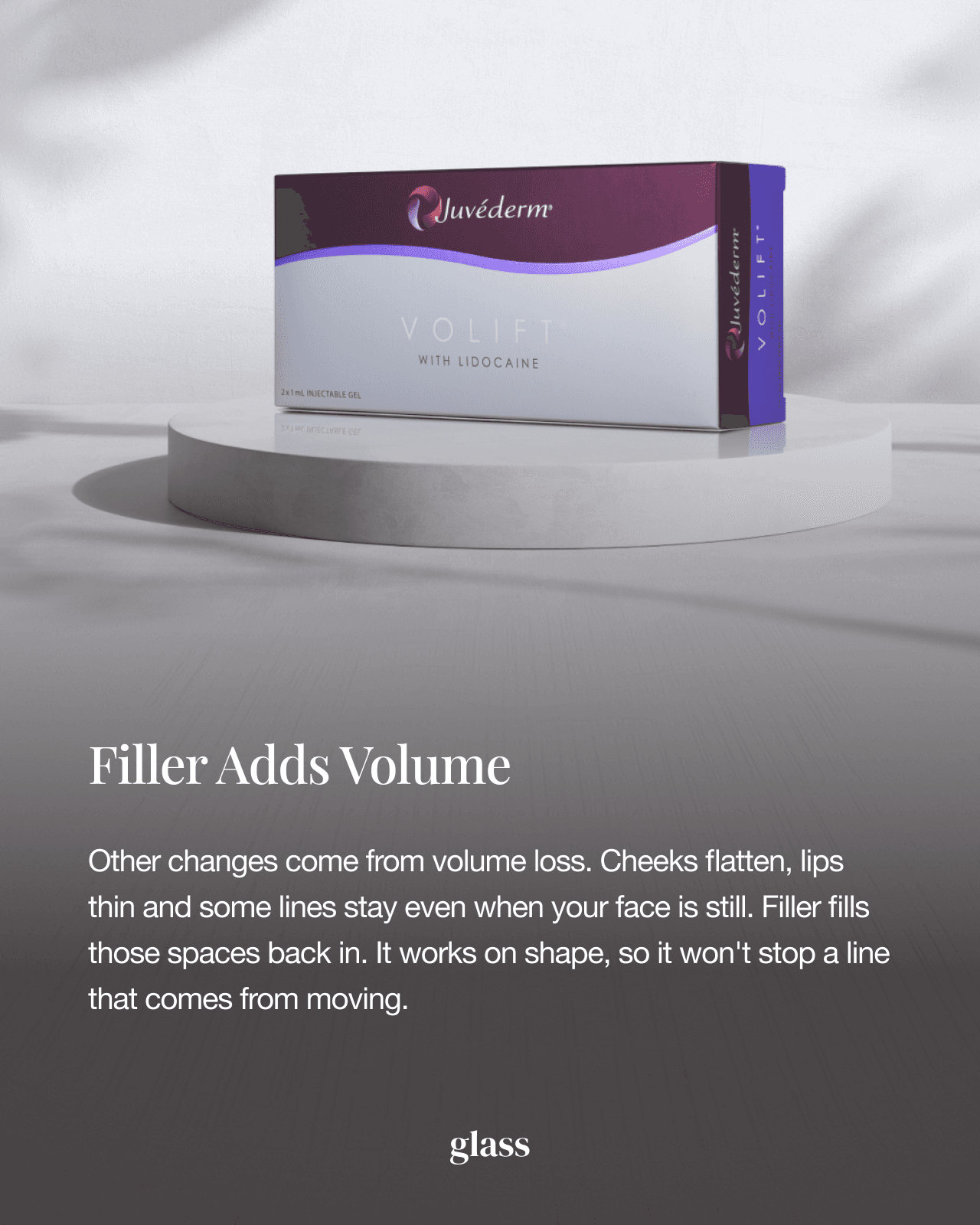
Here is the part people miss: filler changes shape, not movement. A line drawn by a working muscle comes back every time that muscle works. Fill a frown line and the muscle keeps folding the skin every time you frown. If the problem is movement, filler alone is the wrong tool.
Botox vs Filler, Side by Side
| Botox | Filler | |
|---|---|---|
| What it is | A botulinum toxin (a neuromodulator) | A gel implant, most often hyaluronic acid |
| Where it goes | Into a muscle | Into the skin, under the surface |
| What it changes | How much a muscle moves | How full an area looks |
| Best for | Lines that show when you move | Volume loss and lines that stay at rest |
| Typical areas | Between the brows, forehead, crow's feet | Cheeks, lips, smile lines, chin |
| What it will not do | Replace lost volume | Stop a line made by movement |
Botox fits if the thing that bothers you shows up with expression — the frown line in a video call, the forehead lines when you are surprised, the crow's feet in every smiling photo.
Filler fits if the thing that bothers you is there even in a neutral face — cheeks that look flatter, lips that look thinner, a fold beside the mouth that does not go away when you stop smiling.
Both fit if you see a little of each. That is common, and it is why a single-product answer to a two-part question rarely looks right.
A simple test before your appointment: make the expression, then relax. If the line appears with the expression and fades when you relax, movement is the main driver. If it stays — or the area just looks flatter than it used to — volume is part of the story. Treat that as a starting point for the conversation, not a diagnosis.
What to Ask at Your Consult
You do not need to walk in knowing whether you need Botox or filler. That is your provider's call. What you need is a clear way to describe what bothers you.

Start with what you see. Lines when you smile. Flatter cheeks. Both. Be specific about where and when you notice it — in photos, in the morning, only when you laugh.
Then ask:
- What is causing this change? Movement, volume loss or both. The answer decides which treatment makes sense
- How would each treatment help here? A good provider can explain why one fits better for this area
- Would you use them together? Sometimes the honest answer is both. Cleveland Clinic notes it is common to receive filler and a neuromodulator in one appointment — Botox for the line made by movement, filler for the volume underneath
- What will it look like when I move? You want to hear about expression, not just how your face looks at rest
Results vary from person to person, and a good provider will tell you which problem you actually have before recommending anything. If the change in your cheeks came after fast weight loss, our guide to Ozempic face, Sculptra and filler goes deeper on volume. If you have a date in mind, our pre-event treatment timeline shows when to book.
The Glass Beauty Seoul Take
Botox vs filler is the wrong argument. Botox quiets a muscle. Filler rebuilds volume. The face in your mirror is often asking for one, sometimes for both, and almost never for whatever was trending the week you booked.
That is how the best consults run — at home or in Seoul. The provider looks at your face moving and at rest, names the cause, then names the tool. If you are planning treatment in Seoul, start with our guide to finding the best skin clinic in Seoul as a foreigner and look for a clinic that explains that reasoning in plain English.
Before you book, do the mirror test, write down what bothers you, and bring one question: what is causing this change?
Glass Beauty Seoul is building the most honest guide to Korean skin care and treatment for readers outside Korea. Follow along as we break down what Seoul knows first.
Frequently Asked Questions
What is the difference between Botox and filler?+
Botox relaxes the muscle that creases your skin, so it softens lines that form when you move. Filler is a gel placed under the skin that adds back volume, so it treats flattened cheeks, thinner lips and lines that stay when your face is at rest.
Is Botox or filler better for smile lines?+
It depends on the line. The folds from the nose to the corners of the mouth are mainly volume, so they are usually treated with filler. Crow's feet that fan out when you smile come from muscle movement, so they are a Botox area.
Can Botox and filler be done at the same time?+
Yes. Cleveland Clinic notes that it is common to receive filler and a neuromodulator such as Botox in one appointment, with Botox for lines made by movement and filler for lost volume. Your provider decides whether a combined plan makes sense for you.
Does Botox work on wrinkles that are there at rest?+
It can, but more slowly. A review in American Family Physician notes that static lines may need two or three consecutive Botox treatments for significant improvement, and deep static lines may need filler as well.
How do I know whether I need Botox or filler?+
Make the expression, then relax. A line that appears with movement and fades at rest points to Botox. Flatter areas or lines that stay at rest point to filler. Treat it as a starting point and ask your provider what is causing the change.
Get the Seoul Glow
K-beauty insights, treatment guides, and trend alerts — delivered weekly.