Ozempic Face Treatment: Sculptra vs Filler for Hollow Cheeks
Ozempic face is not the drug. It is fast weight loss taking fat from your cheeks. How Sculptra rebuilds fullness slowly, how filler adds it the same day, and why many plans use both.
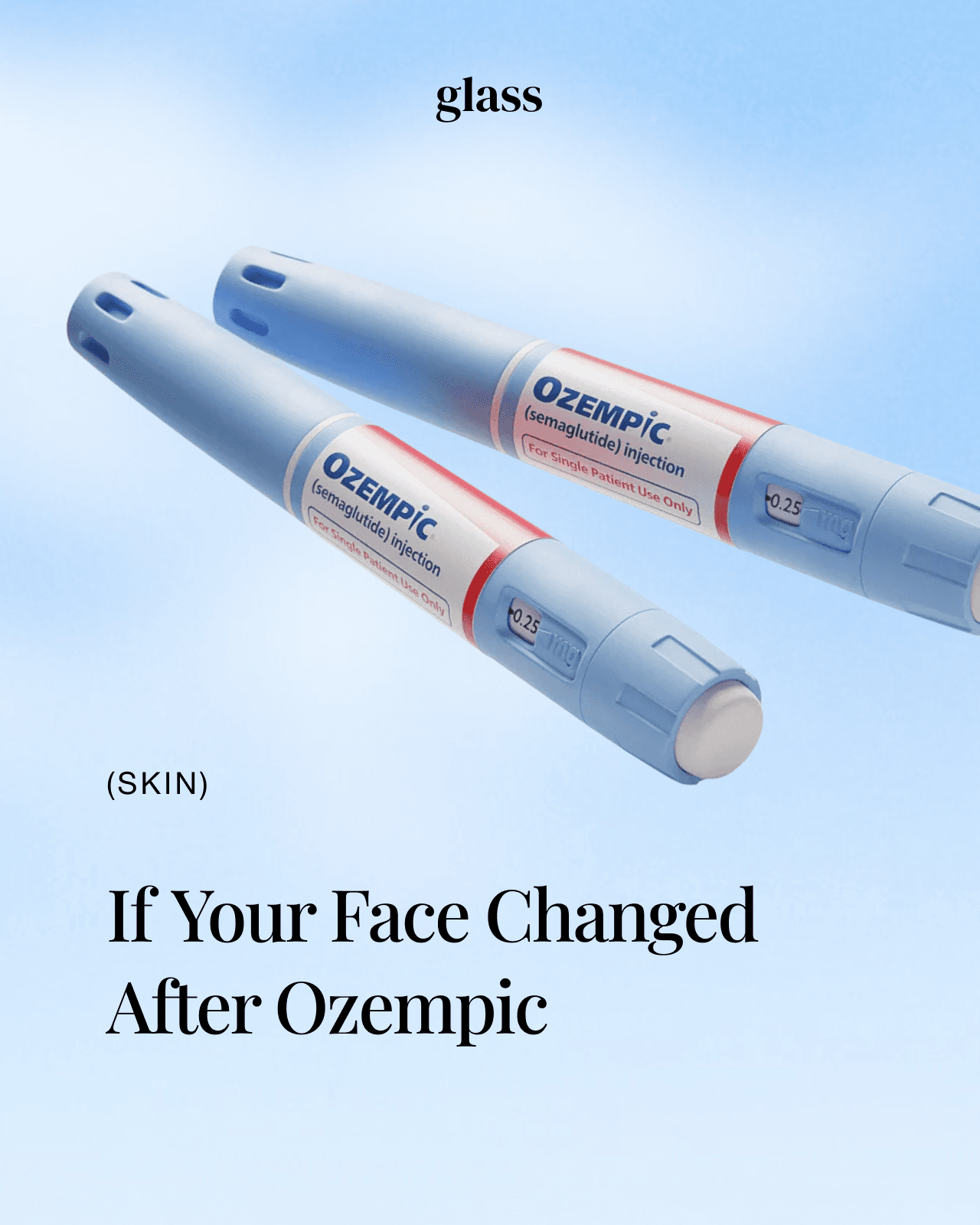
In a small pilot study, people who had lost a large amount of weight were judged to look 5.1 years older than their actual age, an expert guidance paper on GLP-1 patients notes. If your face changed after Ozempic, you already know the feeling behind that number. The scale went the right way. The mirror did something else.
The good news is that "Ozempic face" has a clear cause and two established treatments. This guide to Ozempic face treatment covers what is actually happening to your cheeks, how Sculptra and hyaluronic acid filler each bring fullness back, and why a lot of treatment plans end up using both.
Why Your Cheeks Change First
"Ozempic face" is not a medical term, and it is not a side effect of the drug itself. Cleveland Clinic is direct about this: it is a side effect of the rapid weight loss the medication can bring. The same thing can happen after bariatric surgery or any diet that takes weight off fast.
Your face holds a layer of fat just under the skin. It is part of what makes a face look full and rested. Lose weight quickly and you lose some of that fat too — and the loss is not even. Volume measurements cited in the same GLP-1 guidance paper found larger reductions in the fat pads of the cheeks than in the temples.
That is why the cheeks are usually where you notice it first. They look flatter. The area under the cheekbones looks hollow. The whole face reads as more tired, even when you feel better than you have in years.
A few things make it more likely, according to Cleveland Clinic:
- Speed. The faster the weight comes off, the more likely your face shows it
- Age. Older adults start with less facial fat in reserve
- Time alone will not fix it. If you keep the weight off, the change in your face tends to stay
One more point from Cleveland Clinic is worth holding onto: Ozempic face carries no health risk. It needs treatment only if you want it treated. Do not stop or change a medication over your reflection — talk to your prescriber about pacing first, then talk to an aesthetic provider about your face.
Sculptra: The Slow Rebuild
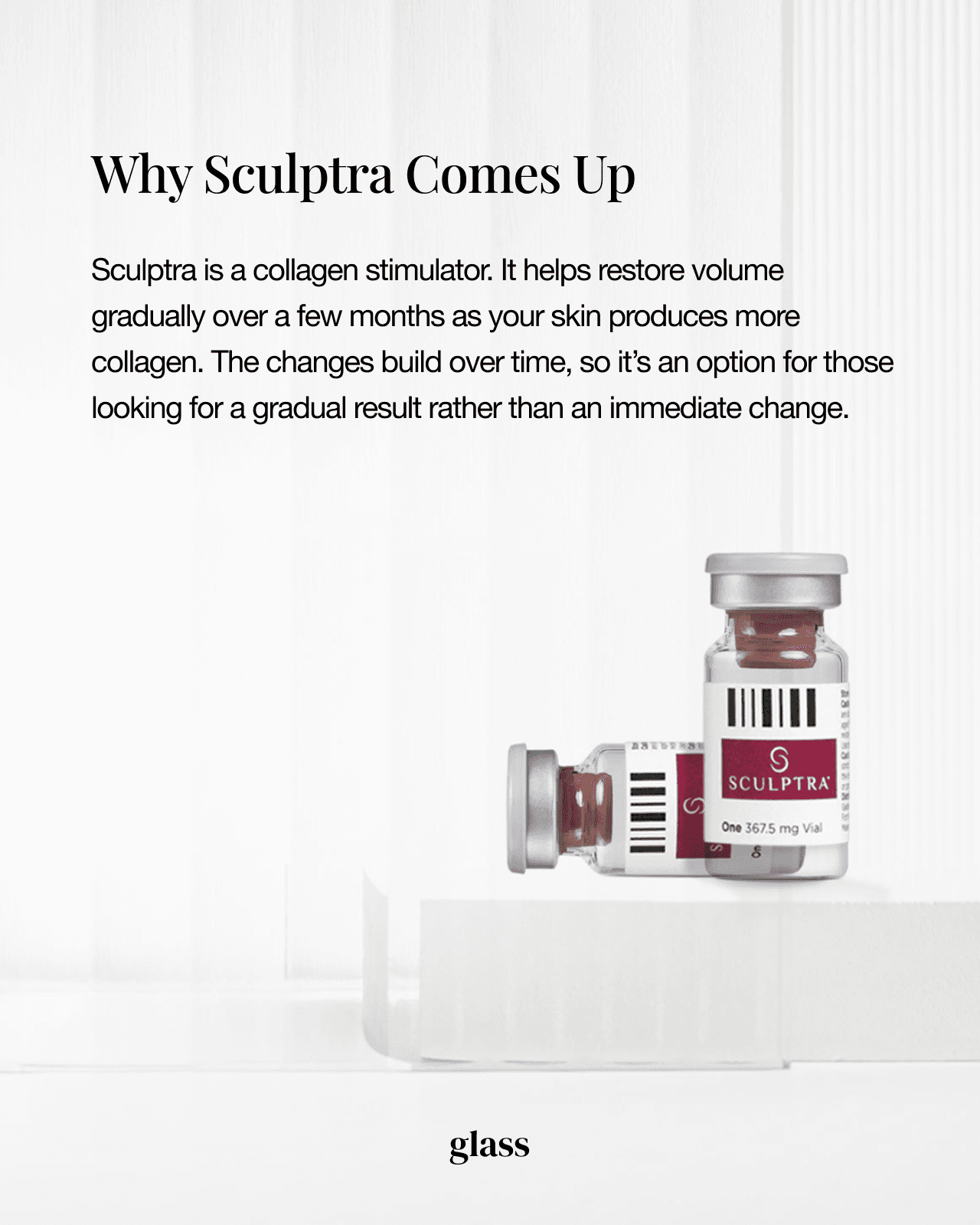
Sculptra is not a filler in the usual sense. It is an injectable made of poly-L-lactic acid (PLLA), a biodegradable material that also shows up in dissolvable stitches. Once injected, it prompts your skin to produce more of its own collagen. The fullness you see later is your own tissue.
That is also why it is slow. The FDA describes PLLA as a material given in a series of injections over several months, with results that become more visible over weeks and can last up to 2 years. Sculptra was first approved for aesthetic use in the US in 2009, and in 2023 the FDA approved it for wrinkles across the full cheek area.
What that means in practice:
- You will not walk out with your final result. Early swelling settles, and the real change builds over the following months
- It works across a broad area. Because it rebuilds rather than fills a single spot, it suits general thinning rather than one deep hollow
- It is a commitment. Plan for more than one visit, spaced weeks apart
The trade-off is control. There is no quick undo for Sculptra the way there is for hyaluronic acid filler. Galderma's safety information also lists small lumps under the skin as a possible side effect. That is one more reason to choose an experienced injector who has treated weight-loss patients before.
If you want results that look like nobody did anything — just a face that looks rested again — Sculptra is built for that.
Hyaluronic Acid Filler: The Same-Day Option
Hyaluronic acid (HA) filler is the faster route. HA is a sugar your body already makes, and in gel form it binds water and adds volume right where it is placed. You see the change the same day, though swelling and bruising can take a little time to settle.
HA filler is not one product. Some are designed specifically for this job. Restylane Lyft, for example, is FDA-approved for cheek augmentation and age-related midface volume loss. The FDA puts the typical effect of HA fillers at roughly 6 to 12 months before the body absorbs it.
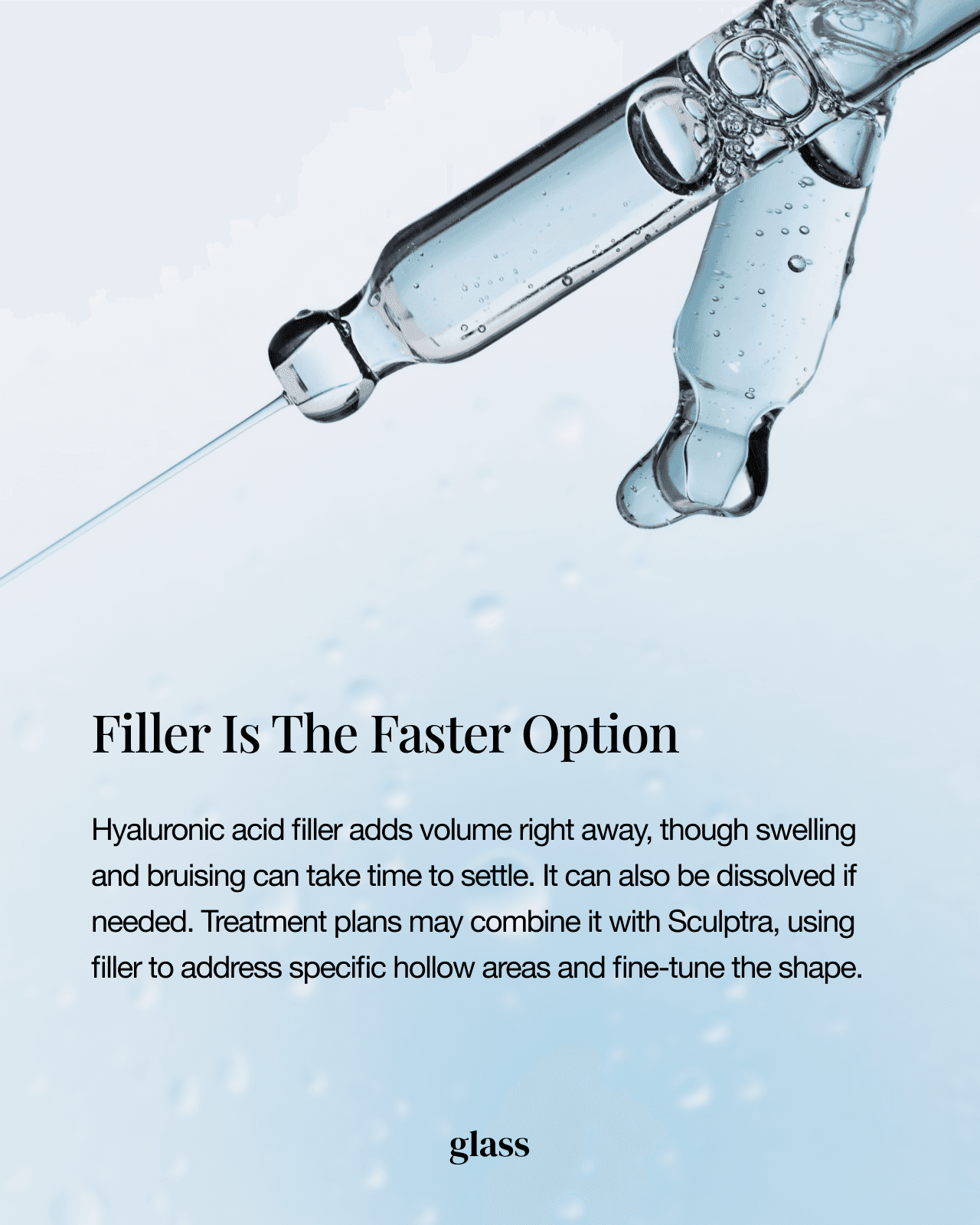
The biggest advantage is reversibility. HA filler can be broken down with an enzyme called hyaluronidase, which providers use to correct results that are not right. For a first treatment on a face that is still changing, that safety net matters.
There is a caution here too. Any injectable placed in the wrong spot can block a blood vessel, and both the Restylane Lyft and Sculptra labels warn against injecting into vessels. This is rare, but it is the reason your injector's anatomy knowledge matters more than the brand on the syringe.
Sculptra vs Filler: Which One, or Both?
Side by side, the two treatments answer different questions.
| Sculptra | Hyaluronic Acid Filler | |
|---|---|---|
| How it works | Prompts your skin to make more collagen | Adds volume directly with an HA gel |
| When you see it | Gradually, over months | Same day, after swelling settles |
| How long it lasts | Up to 2 years (FDA) | About 6 to 12 months (FDA) |
| Sessions | A series, spaced weeks apart | One or more, depending on how much volume is needed |
| Can it be undone? | No | Yes, with hyaluronidase |
| Best at | Broad, overall thinning | Specific hollows and shaping |
Sculptra suits you if you can wait, you want the most natural-looking change, and your volume loss is spread across the face.
Filler suits you if you want to see a difference now, you have a particular hollow that bothers you, or you want the option to reverse it.
Both is where many plans land. Sculptra rebuilds the overall foundation slowly, and filler fine-tunes specific hollow areas and the shape of the cheek. Experts writing about GLP-1 patients say combined, multi-treatment plans are usually needed, and they name midface volume as the top priority for many people.
Timing matters as well. The same experts note that some patients want help right away, while others wait until their weight stabilizes for more predictable results. Continued weight loss can shorten how long any result holds, so that decision belongs in your first consultation.
Questions to Ask at Your Consultation
- How many GLP-1 patients have you treated? Faces that are still changing need someone who plans for it
- Is my main issue volume, laxity, or both? The answer decides whether Sculptra or filler is even the right starting point
- What is the plan if I lose more weight? Ask how touch-ups work and what they would involve
- Which product, and how much? A clear answer, with the brand named, is a good sign
- How do you handle a result I do not like? For HA filler, that means hyaluronidase. For Sculptra, it means a conservative first session
If loose skin, not lost volume, is your main concern, volume alone will not solve it. Skin tightening is a separate conversation — our guide to Ultherapy vs Thermage explains what lifts and what firms. Results vary from person to person, and a good provider will tell you which problem you actually have before recommending a product.
The Glass Beauty Seoul Take
Ozempic face is not a reason to regret your weight loss. It is a predictable change in facial fat, and it has established answers. The mistake is treating it like a single-syringe problem. The best Ozempic face treatment is usually a plan, not a product. The faces that look best after GLP-1 weight loss are usually treated with a plan: slow collagen work for the foundation, precise filler where a hollow needs it, and patience while your weight settles.
Bring that same question to any clinic, at home or in Seoul. If you are considering treatment in Seoul, you will also hear about Juvelook, a Korean collagen-stimulating skin booster that is not FDA-approved in the US, and you will want a clinic that explains its plan in plain English. Start with our guide to finding the best skin clinic in Seoul as a foreigner, and if you are planning a Sculptra series, our laser and collagen treatment calendar shows why fall is a good time to begin.
Your face changed for a good reason. Getting your fullness back starts with booking a consultation and asking one question: what is your plan for my face over the next six months?
Glass Beauty Seoul is building the most honest guide to Korean skin care and treatment for readers outside Korea. Follow along as we break down what Seoul knows first.
Frequently Asked Questions
Is Ozempic face a side effect of the drug?+
No. Cleveland Clinic describes it as a side effect of the rapid weight loss the medication can bring, not of the drug itself. The same facial changes can follow bariatric surgery or any very fast weight loss.
Does Ozempic face go away on its own?+
Usually not. If you keep the weight off, the facial changes tend to stay. Regaining weight may restore some fullness, but treatment is the main way to bring volume back if you want to.
Is Sculptra or filler better for Ozempic face?+
It depends on what you want. Sculptra builds collagen gradually over months and suits overall thinning. Hyaluronic acid filler adds volume the same day, targets specific hollows, and can be dissolved. Many plans use both.
How long do Sculptra and filler last?+
The FDA says poly-L-lactic acid such as Sculptra can last up to 2 years, and hyaluronic acid fillers typically last about 6 to 12 months before the body absorbs them. Results vary by person and by product.
Should I wait until I stop losing weight to treat Ozempic face?+
Many people do, because continued weight loss can shorten how long results hold. Others prefer to start sooner. Discuss your expected weight trajectory with your provider at the first consultation.
Get the Seoul Glow
K-beauty insights, treatment guides, and trend alerts — delivered weekly.