Korean Laser Treatment for Acne Scars: Cost, Types & Results
Fractional CO2, Pico, and RF microneedling — what each one treats, what it costs in Seoul, and how to plan your sessions.
Over 2.3 million people visited South Korea for medical treatment in 2024 — and a significant share came for one thing: their skin. Among the most common concerns driving those visits are acne scars.
Korean dermatologists treat acne scars every single day. Not once a week between other appointments — constantly. That volume changes everything. Clinics don't reach for one laser and hope for the best. They match the treatment to your scar type, your skin tone, and your recovery timeline.
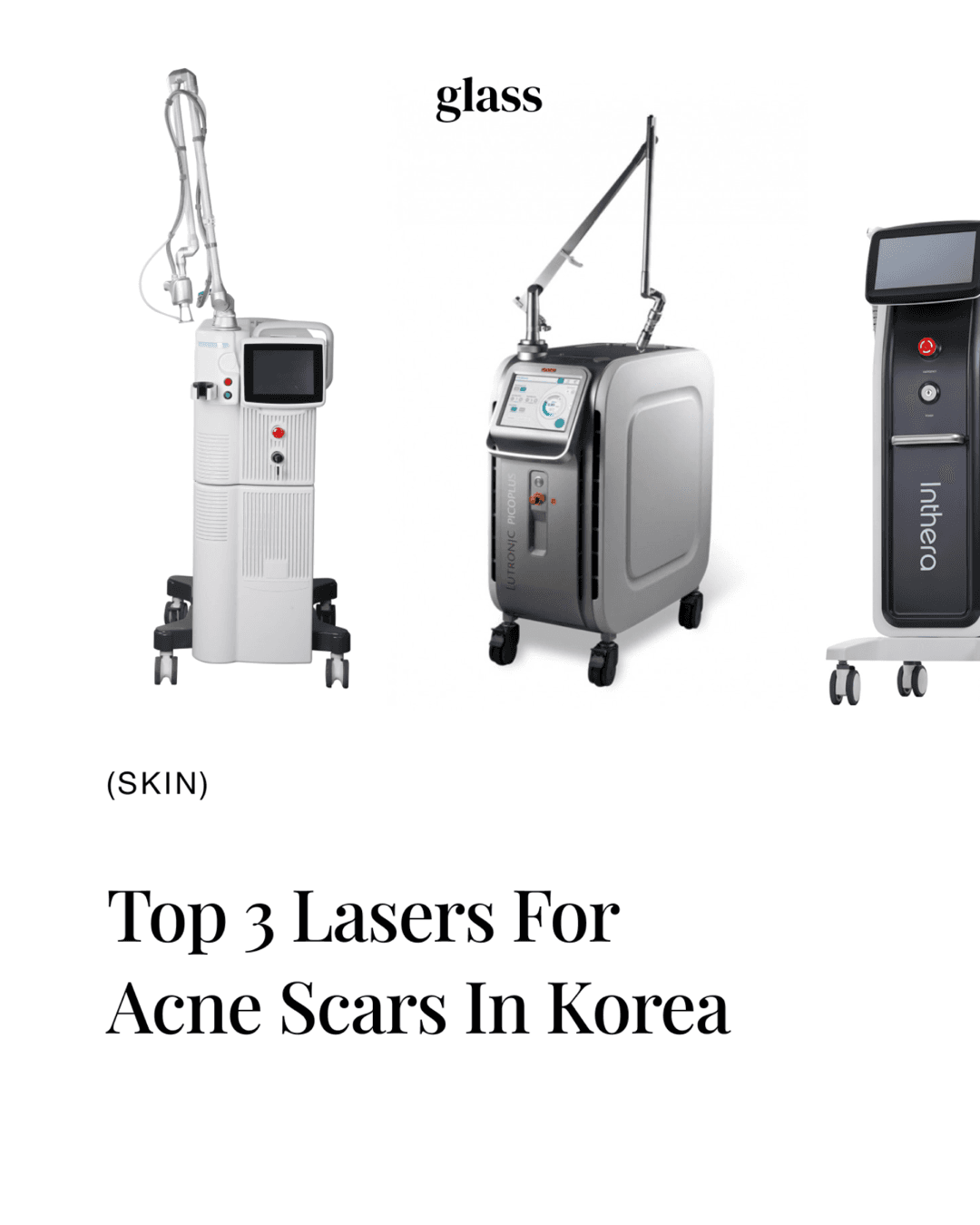
Three treatments dominate Korean acne scar protocols — fractional CO2, Pico laser, and RF microneedling. Each one targets different scar types at different depths with different tradeoffs. Here's what each one does, what it costs in Seoul versus the US, and what to know before you book.
Why Korean Clinics Handle Acne Scars Differently
The difference starts with volume. South Korea performs more dermatological procedures per capita than any other country. Acne scarring — ice pick, boxcar, rolling, post-inflammatory hyperpigmentation — ranks among the top reasons international patients fly to Seoul.
That volume creates expertise you cannot replicate in a low-volume practice. Korean dermatologists don't rely on a single device. They build layered treatment protocols — combining ablative lasers, non-ablative energy, RF microneedling, and sometimes subcision or biologic boosters into a single plan tailored to your specific scar map.
Most US dermatology practices own one or two laser platforms and use them for everything. Korean clinics routinely stock five to eight devices and switch between them within a single treatment session. The reason is structural — competition in Seoul is fierce enough that clinics invest in equipment the way restaurants invest in kitchens. More tools, better outcomes, more patients.
This matters because acne scars are not one thing. Ice pick scars sit deep and narrow — they're the hardest to treat and need the most aggressive energy. Boxcar scars are wide with sharp, defined edges, often responding well to resurfacing. Rolling scars create gentle, wave-like depressions caused by tethered tissue underneath. And dark marks from post-inflammatory hyperpigmentation sit on the surface, requiring wavelengths that target pigment without damaging surrounding skin.
Each type responds to different depths, wavelengths, and energy levels. A clinic that treats all of them with one machine is guessing. Korean clinics don't guess — they diagnose your scar map, then build a protocol around it.
The 3 Laser Treatments Korean Dermatologists Actually Use
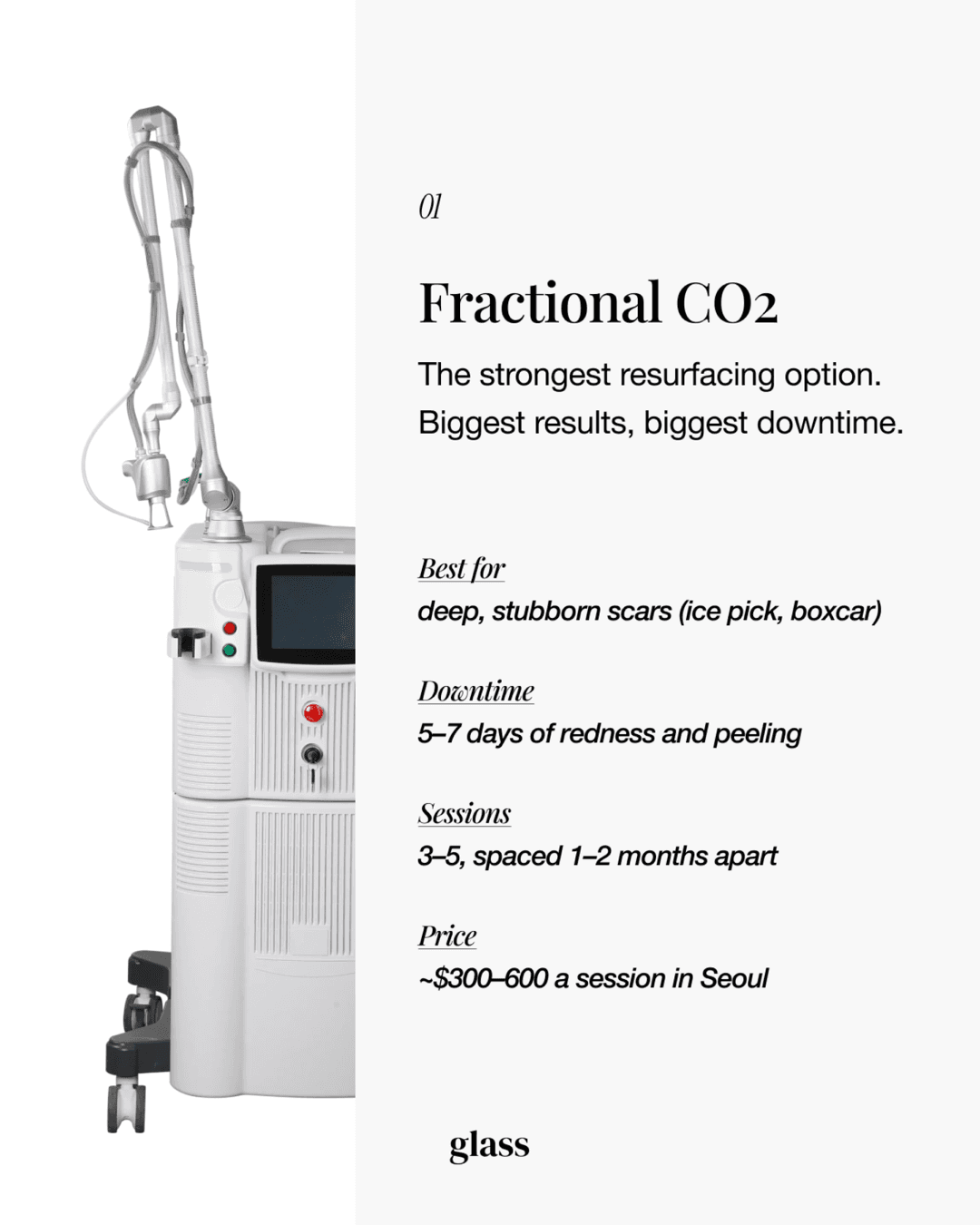
01 Fractional CO2 Laser
This is the strongest resurfacing option available. A fractional CO2 laser creates thousands of microscopic channels in the skin, vaporizing damaged tissue and triggering aggressive collagen remodeling from the inside out.
Best for: Deep, stubborn scars — ice pick and boxcar types that haven't responded to gentler treatments.
What the research says: A clinical review found that 81% of patients showed reduced scar severity scores after fractional CO2 treatment. Most studies report 30–70% visible improvement, with the strongest results appearing 6 to 8 months after the final session as collagen continues to rebuild. Results vary depending on scar depth, skin type, and aftercare.
Downtime: 5 to 7 days of redness and peeling. Your skin will look sunburned, then flake. Plan to stay out of the sun and off camera.
Sessions: 3 to 5, spaced 1 to 2 months apart.
Price in Seoul: ~$300–600 per session.
A Korean study on fractional laser resurfacing found it particularly effective as monotherapy for rolling and superficial boxcar scars, with minimal adverse effects. For deep ice pick scars, Korean dermatologists often pair CO2 with subcision — a technique that releases the tethered scar tissue before the laser resurfaces the top layer.
Fractional CO2 is not subtle. It works because it's aggressive. If your scars are deep enough that serums and peels haven't made a dent, this is the treatment Korean dermatologists reach for first.
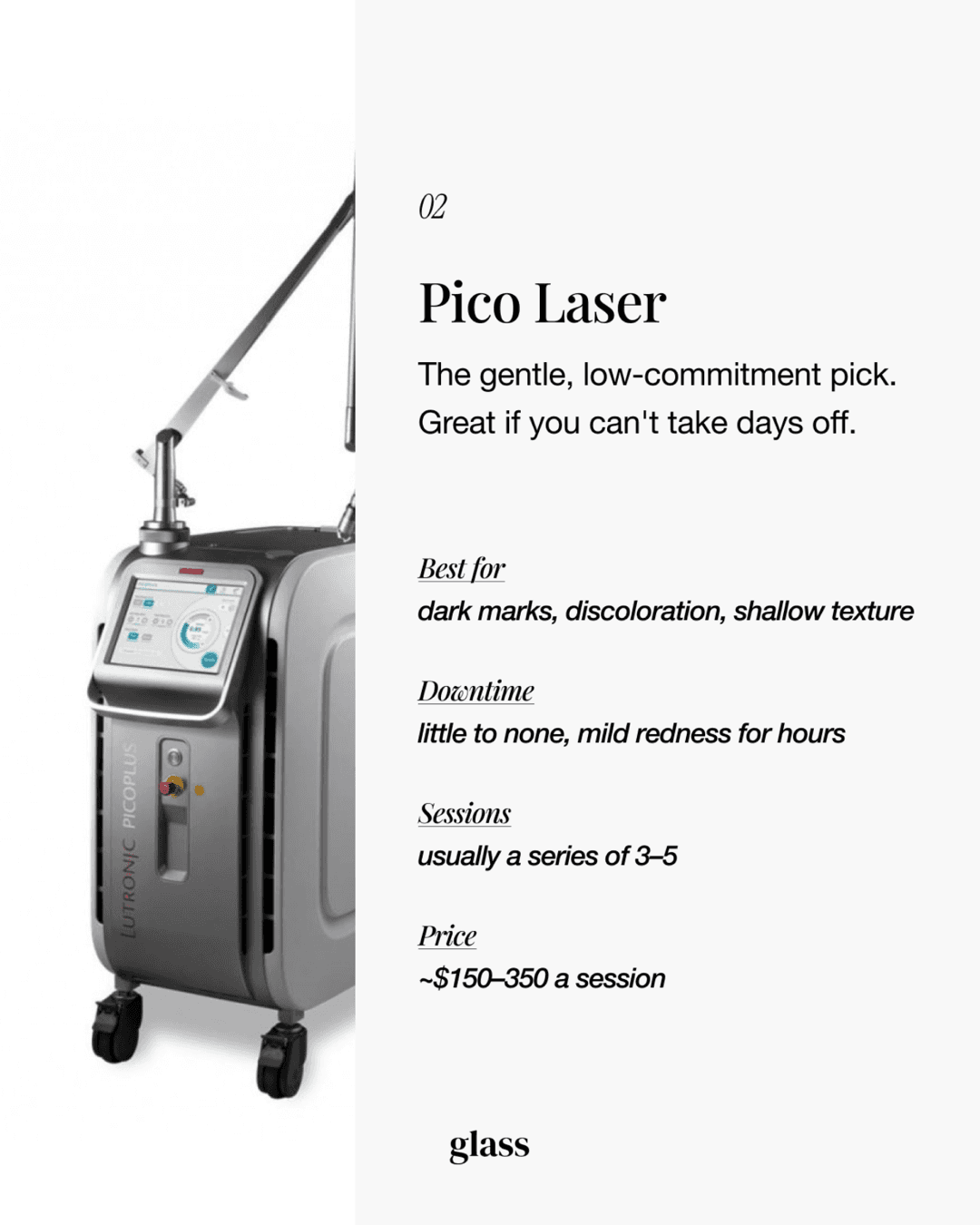
02 Pico Laser
If fractional CO2 is a sledgehammer, Pico is a precision instrument. It delivers ultra-short pulses — measured in picoseconds — that shatter pigment particles and stimulate collagen without ablating the surface.
Best for: Dark marks, discoloration, and shallow texture. Especially effective for post-inflammatory hyperpigmentation — those flat, dark spots acne leaves behind long after the breakout clears.
Downtime: Little to none. Mild redness for a few hours. You can go back to your day.
Sessions: A series of 3 to 5.
Price in Seoul: ~$150–350 per session.
Pico works by delivering energy in trillionths of a second — fast enough to shatter pigment particles into fragments small enough for your body to clear naturally. The same ultra-short pulses create microscopic cavities in the dermis that stimulate new collagen without the open wounds that ablative lasers leave behind.
Pico is the treatment for people who cannot take a week off. It won't resurface deep ice pick scars the way CO2 does, but for surface-level damage and discoloration, it's fast, effective, and low-risk. Many Korean clinics use Pico as a finishing treatment after CO2 has addressed the deeper structural damage.
03 RF Microneedling
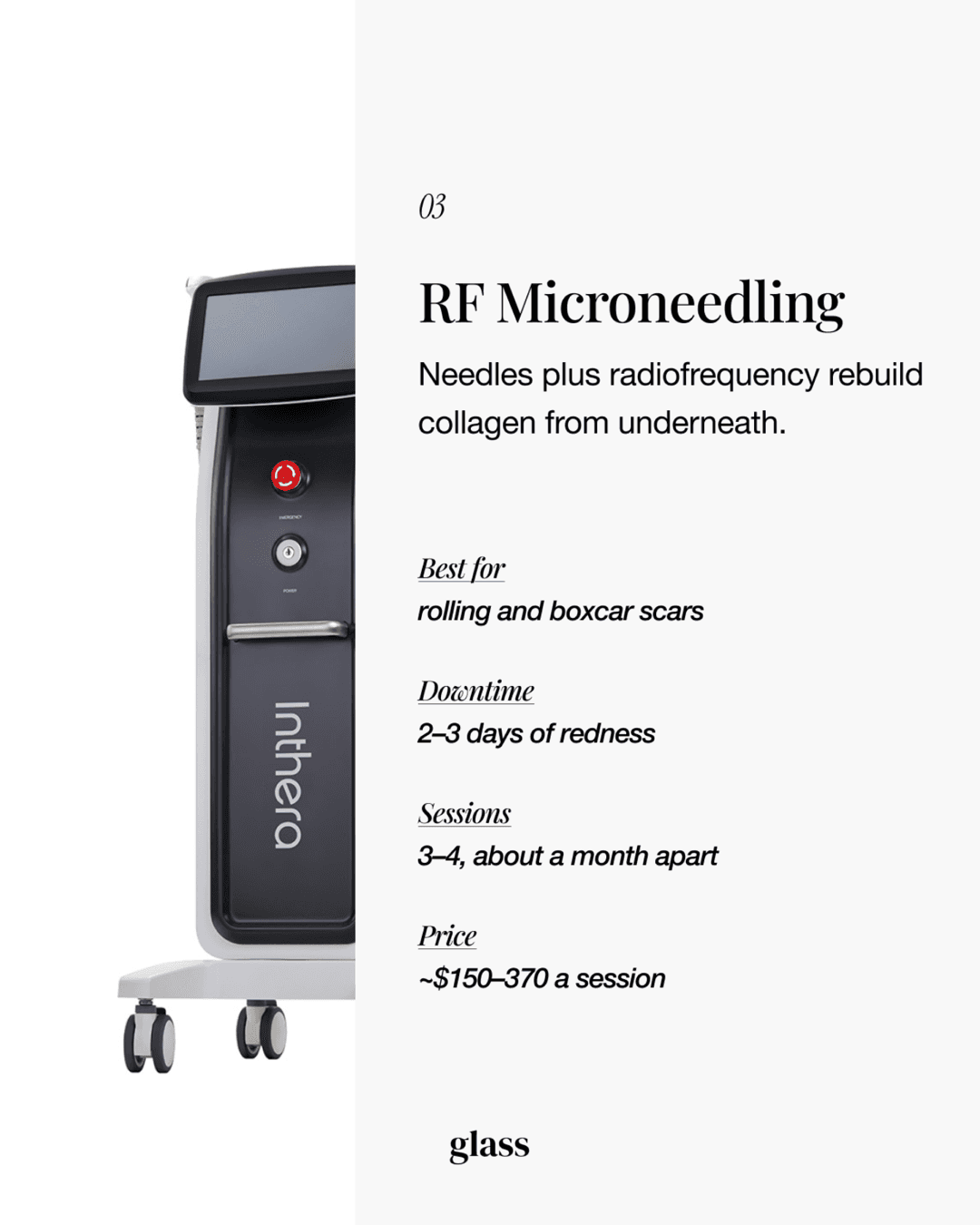
RF microneedling combines tiny needles with radiofrequency energy. The needles penetrate the skin at controlled depths while RF energy heats the tissue underneath — triggering collagen and elastin production from below the surface.
Best for: Rolling and boxcar scars. The collagen-rebuilding effect smooths out the uneven foundation that causes these scar types.
Downtime: 2 to 3 days of redness.
Sessions: 3 to 4, about a month apart.
Price in Seoul: ~$150–370 per session.
Devices like Potenza, Sylfirm X, and Inthera dominate Korean clinics. The key advantage of RF microneedling over ablative lasers is precision — the needles deliver energy exactly where it's needed, at controlled depths, without damaging the surface layer. That makes recovery faster and more predictable.
RF microneedling is also the safest option for darker skin tones — it bypasses melanin entirely, which means lower risk of post-treatment hyperpigmentation. Korean dermatologists, who treat a wide range of skin types daily, lean on this heavily for patients where pigment safety is a priority. If you have Fitzpatrick type III or above and your primary concern is textured scarring, RF microneedling is likely where your dermatologist will start.
Quick Comparison
| Fractional CO2 | Pico Laser | RF Microneedling | |
|---|---|---|---|
| Best for | Ice pick, deep boxcar | Dark marks, PIH, shallow texture | Rolling, boxcar |
| Downtime | 5–7 days | Hours | 2–3 days |
| Sessions | 3–5 | 3–5 | 3–4 |
| Price (Seoul) | $300–600 | $150–350 | $150–370 |
| Intensity | Highest | Lowest | Moderate |
How Much It Costs — Korea vs the United States
The technology is the same. The machines are the same. The training is comparable. The price is not.
| Treatment | Seoul (per session) | United States (per session) | Savings |
|---|---|---|---|
| Fractional CO2 | $300–600 | $1,500–3,500 | 60–80% |
| Pico Laser | $150–350 | $400–800 | 50–60% |
| RF Microneedling | $150–370 | $500–1,200 | 60–70% |
| Fraxel | $200–400 | $800–1,500 | 60–75% |
A full treatment protocol — 4 to 6 sessions over several months — runs $3,000–8,000 in Seoul. The same protocol in the US costs $5,000–15,000 or more.
That's not a rounding error. It's a structural difference driven by competition, patient volume, and a market where dermatology clinics outnumber coffee shops in some Seoul neighborhoods.
Even factoring in flights and accommodation, most patients come out ahead. A round-trip to Seoul, a week in a hotel near Gangnam, and a full laser protocol still costs less than the same treatment at a Manhattan or LA dermatology practice.
Here's a realistic example. A patient with moderate boxcar and rolling scars chooses 4 sessions of RF microneedling plus 2 sessions of fractional CO2 in Seoul. Total treatment cost: roughly $2,400–3,800. The same protocol in the US — assuming you can even find a practice that offers both devices — would run $7,000–14,000. The savings alone cover your flight and hotel.
What to Know Before You Book
This is not a one-visit fix. Korean laser treatment for acne scars takes multiple sessions over months to meaningfully improve. The biology is non-negotiable — collagen remodeling happens on its own timeline, and no machine can speed that up. If someone promises dramatic results from a single treatment, that's your cue to leave.
Plan for 3 to 5 sessions. Most laser protocols space treatments 4 to 8 weeks apart. That means either a longer stay in Seoul or planning return trips. Some clinics offer consultation packages for international patients that help you map out a realistic timeline.
Figure out your scar type first. Not every laser works on every scar. Ice pick scars need the depth of fractional CO2. Surface discoloration responds to Pico. Rolling scars benefit most from RF microneedling. Knowing what you have before you walk in puts you in a stronger position — and helps you find the right clinic for your specific case.
Don't skip sunscreen after treatment. Post-laser skin is vulnerable to UV damage, and sun exposure during recovery can trigger hyperpigmentation worse than what you started with. SPF 50, every single day, rain or shine. Korean dermatologists will tell you this emphatically — and they're right. This is especially important if you're treating PIH, where the whole point is removing dark marks that UV exposure creates.
Results take time to show. Collagen remodeling continues for 6 to 8 months after your last session. The skin you see at week two is not the final result. The skin you see at month three is closer, but still not final. Give it the full timeline before judging whether it worked.
Ask about combination protocols. The best results in Korean clinics come from combining treatments — CO2 for depth, Pico for pigment, RF microneedling for collagen. If a clinic offers only one device, consider looking further. The right clinic for your case will have multiple options and a dermatologist who can explain why they're choosing one over another.
Some patients also combine laser protocols with skin-boosting treatments like Juvelook to accelerate recovery and improve overall skin quality between sessions — another advantage of treating in Seoul, where these options are widely available.
The Glass Beauty Seoul Take
Korean laser treatment for acne scars works — not because the machines are special, but because the system behind them is different. Dermatologists who see acne scars hundreds of times a month develop pattern recognition that no amount of textbook study can replicate. They know which scars respond to what, how deep to go, and when to combine treatments instead of stacking sessions on a single device.
The cost advantage is real — 40 to 70% lower than the US for equivalent technology and physician-led care. But the bigger advantage is the approach itself. Korean clinics treat acne scars as a multi-step protocol, not a single-device gamble.
If you've spent years cycling through retinols and chemical peels that never quite worked, laser treatment in Korea is not a last resort. It's where a growing number of people go when they're ready to actually address it.
The gap between what you can do at home and what a Korean dermatologist can do in a treatment room is not small. It's a different category of intervention — and the pricing in Seoul makes it accessible in a way it isn't in most US cities.
Start by identifying your scar type. Match it to the right treatment. The rest is logistics.
Glass Beauty Seoul is building the guide to Korean skin treatments — what works, what it costs, and how to navigate it. Follow along for honest breakdowns of every treatment worth knowing about.
Frequently Asked Questions
Which laser is best for deep ice pick acne scars?
Fractional CO2 laser is the most effective option for deep ice pick scars. It creates microscopic channels that reach the deepest layers of scar tissue and trigger aggressive collagen remodeling. Korean dermatologists often combine it with subcision for the most stubborn cases. Expect 3 to 5 sessions with 5 to 7 days of downtime per treatment.
How many sessions do you need for acne scar laser treatment in Korea?
Most treatments require 3 to 5 sessions spaced 4 to 8 weeks apart. Full improvement appears over 6 to 8 months as collagen continues to remodel beneath the surface. The exact number depends on your scar type, depth, and chosen treatment.
Is Korean laser treatment safe for darker skin tones?
RF microneedling — using devices like Potenza and Sylfirm X — is the safest laser-adjacent option for darker skin because it bypasses melanin entirely. Korean dermatologists have extensive experience treating Fitzpatrick skin types III through V and adjust protocols specifically to minimize hyperpigmentation risk.
Can you combine different laser treatments for acne scars?
Korean clinics regularly combine treatments in a single protocol. A common approach pairs fractional CO2 for deep structural scars with Pico laser for surface discoloration, or RF microneedling with biologic boosters like PRP. This layered method is one of the reasons Korean treatment outcomes tend to be more thorough than single-device approaches.
Frequently Asked Questions
Which laser is best for deep ice pick acne scars?+
Fractional CO2 laser is the most effective option for deep ice pick scars. It creates microscopic channels that reach the deepest layers of scar tissue and trigger aggressive collagen remodeling. Korean dermatologists often combine it with subcision for the most stubborn cases. Expect 3 to 5 sessions with 5 to 7 days of downtime per treatment.
How many sessions do you need for acne scar laser treatment in Korea?+
Most treatments require 3 to 5 sessions spaced 4 to 8 weeks apart. Full improvement appears over 6 to 8 months as collagen continues to remodel beneath the surface. The exact number depends on your scar type, depth, and chosen treatment.
Is Korean laser treatment safe for darker skin tones?+
RF microneedling — using devices like Potenza and Sylfirm X — is the safest laser-adjacent option for darker skin because it bypasses melanin entirely. Korean dermatologists have extensive experience treating Fitzpatrick skin types III through V and adjust protocols specifically to minimize hyperpigmentation risk.
Can you combine different laser treatments for acne scars?+
Korean clinics regularly combine treatments in a single protocol. A common approach pairs fractional CO2 for deep structural scars with Pico laser for surface discoloration, or RF microneedling with biologic boosters like PRP. This layered method is one of the reasons Korean treatment outcomes tend to be more thorough than single-device approaches.
Get the Seoul Glow
K-beauty insights, treatment guides, and trend alerts — delivered weekly.