The 4 Korean Beauty Devices Koreans Actually Use
They all look alike and do completely different things. Sort them by energy — EMS, HIFU, ultrasound, RF — and the choice makes itself.
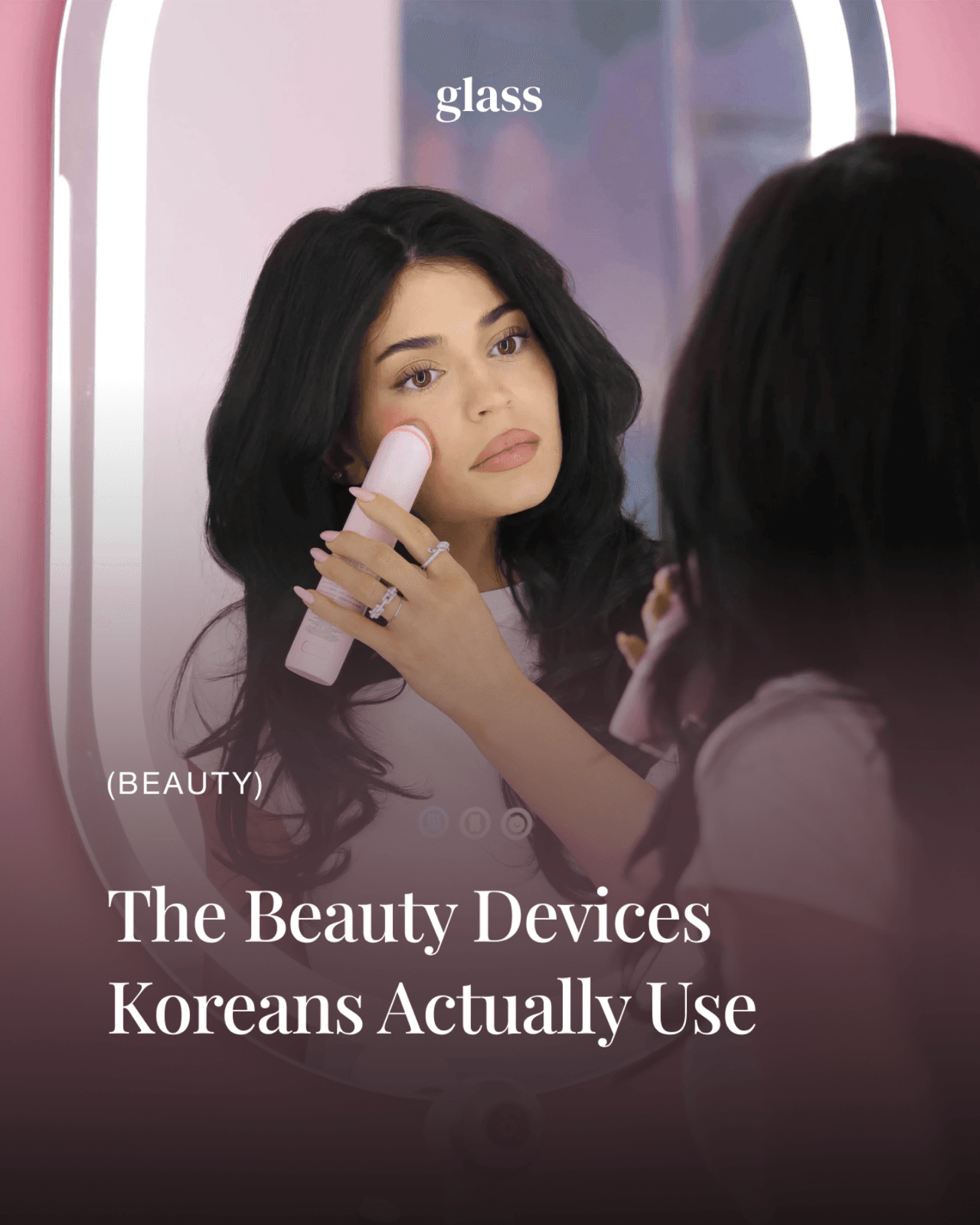
One Korean company has sold six million beauty devices. Not serums — devices. Handheld tools with a charging cable, a mode button, and a price tag north of $250. APR, the company behind Medicube, crossed that number in January 2026, and more than half of those units shipped outside Korea.
Inside Korea, the number reads differently. A beauty device there isn't a gadget you get talked into on a Black Friday page. It's a step — the thing you reach for on the nights between clinic visits, the way you'd reach for a toner. South Korea's beauty device market reached $1.32 billion in 2024, in a country of 52 million people.
The problem for everyone else is that the devices all look the same. Same matte cylinder, same metal head, same pastel. And they do completely different things. Koreans don't sort them by brand or by whichever one went viral last month. They sort them by energy — what the head actually sends into your skin. Four energies matter: EMS, HIFU, ultrasound, and RF. Here's what each one does, which Korean beauty device leads its category, and — the part the sales pages skip — what none of them can do.
We're not paid by any of these brands. These are the four Koreans actually reach for.
The Clinic Came Home
Korea's home device market didn't appear from nowhere. It grew out of the clinic.
Seoul has the densest concentration of dermatology clinics in the world, and treatments that Americans think of as a once-a-decade splurge — ultrasound lifting, radiofrequency tightening — are annual maintenance there, priced between $150 and $600 a session. Once a treatment is routine, a new question appears: what do you do in the eleven months between appointments?
Home devices answered it. They run on the same four energies the clinics use, at a fraction of the power — low enough to be safe without a doctor in the room, which is exactly why they can't replicate the appointment. The framing that helps more than any spec sheet: the clinic makes the result. The device holds it.
| Energy | What it does | Best for | The device Koreans reach for | Price | Typical cadence |
|---|---|---|---|---|---|
| EMS | Low current contracts facial muscle | Tone, a quick lift before an event | Medicube Age-R Booster Pro | ~$300 | Daily, 5–10 min |
| HIFU | Focused ultrasound heats deep tissue | Jawline, contour over time | Medicube Age-R High Focus Shot | $280–372 | Once a week |
| Ultrasound | Fast, gentle vibration pushes hydration in | Glow, glass-skin hydration | THOME The Glow | ~$400 | Daily, ~12 min |
| RF | Heat in the dermis tightens collagen | Loose, crepey skin | LG Pra.L Therma Shot Ultimate | ~$450 | 2–3 times a week |
Prices are US street prices at the time of writing. They move — Medicube runs sales constantly.
01. EMS — Tone and Lift
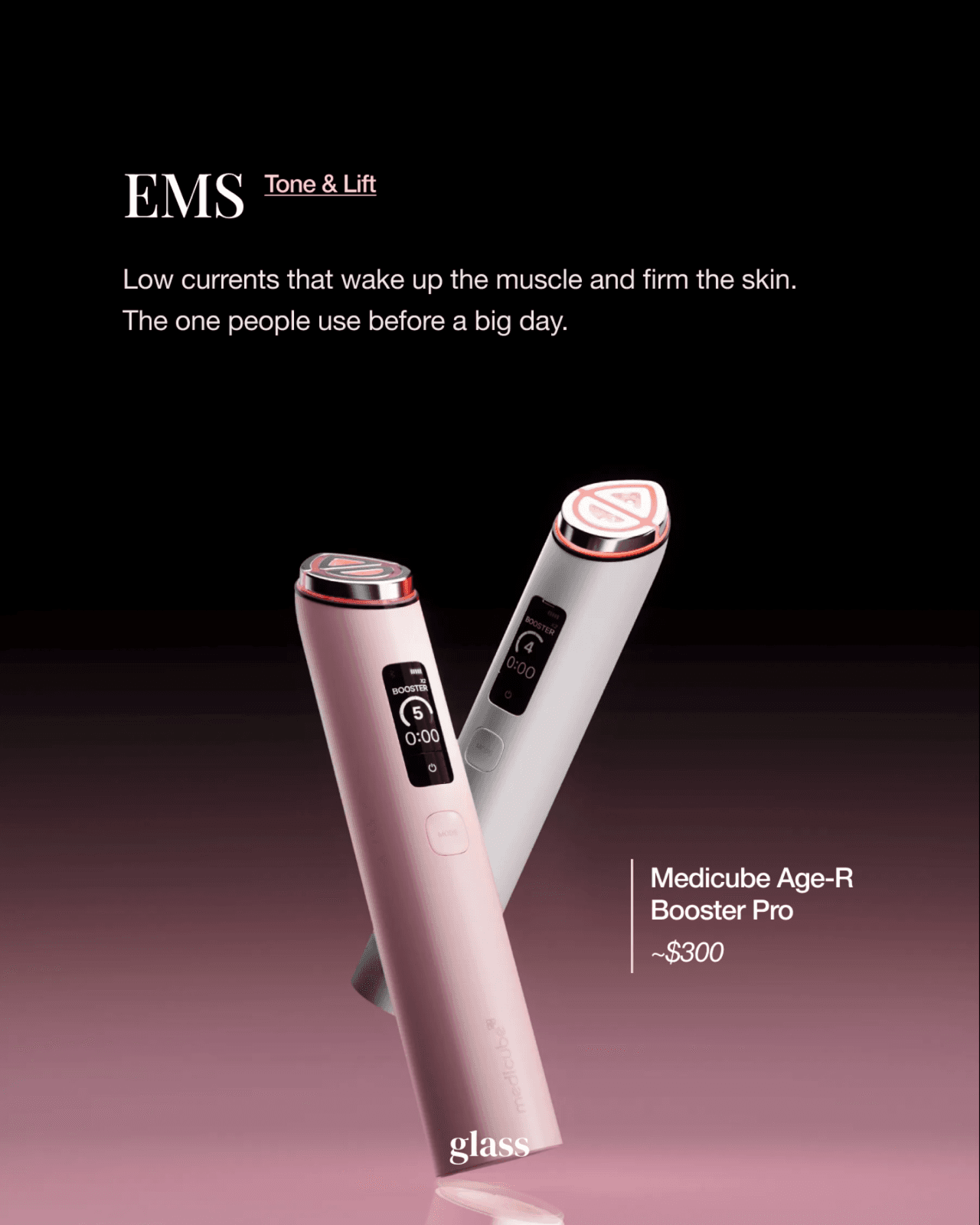
EMS stands for electrical muscle stimulation. A low current passes through the skin into the muscle underneath and makes it contract — the same principle a physical therapist uses on a knee. On the face, the muscles under the cheek and along the jaw get a workout they never get on their own.
The effect is the one people can see the same day. Cheeks read lifted, the jaw reads sharper, morning puffiness drains. That's why this is the device Koreans use before a big day — the wedding, the reunion, the photo. It's also why the effect fades within a day or two unless you keep it up. Muscle tone is a habit, not a purchase.
Kept up, it holds. A randomized trial of 108 women in the Journal of Cosmetic Dermatology measured cheek muscle thickness before and after 12 weeks of daily facial electrical stimulation — and found it had measurably increased. A Korean study of an at-home device with both microcurrent and EMS modes reported visible lifting of the cheek and a reduction in the sagging under the chin in the EMS group.
One distinction the marketing blurs: microcurrent and EMS are not the same thing. Microcurrent runs below the level you can feel and doesn't contract the muscle. EMS does. If you want the training effect, you want the mode that makes the muscle twitch.
The device Koreans reach for is the Medicube Age-R Booster Pro — six modes in one wand, including an electroporation "booster" that helps serums absorb, a microcurrent mode, an EMS mode Medicube calls Derma Shot, and LED. It has sold more than two million units on its own and sits around $300, often less on sale. One caveat the manual means seriously: skip EMS if you have a pacemaker or metal implants in your face.
02. HIFU — Deep Lift
HIFU is high-intensity focused ultrasound, and it's the energy behind the clinic lift. Ultherapy and Korea's Shurink converge ultrasound to a point several millimeters below the surface, creating tiny points of heat that trigger collagen to rebuild and tighten over the following months. A 2025 systematic review in the Aesthetic Surgery Journal put the improvement in skin laxity from clinic HIFU at 18 to 30 percent, strongest along the lower face and jaw. We covered how the clinic versions compare, and what they cost in Seoul versus the US.
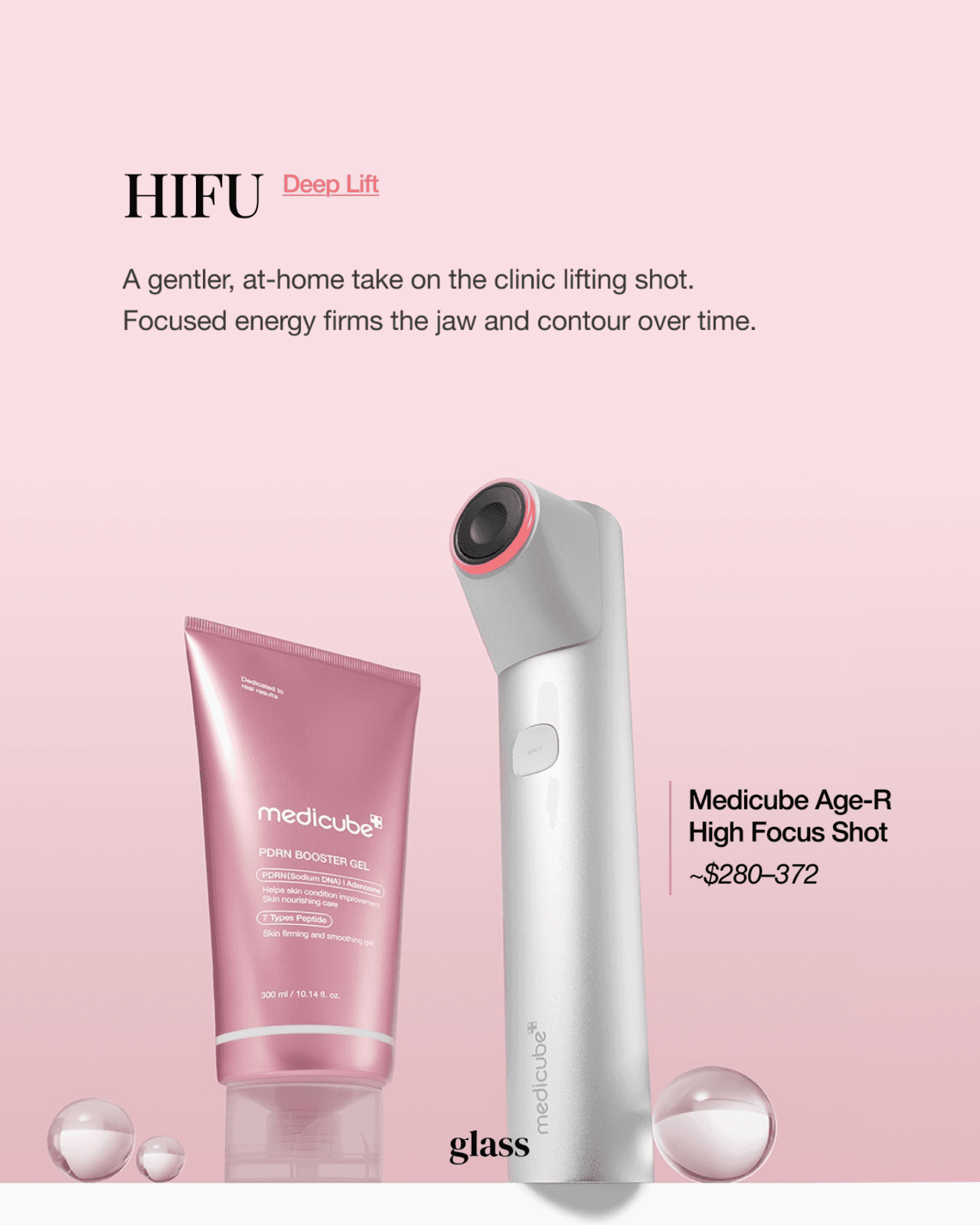
The home version runs the same energy at far lower power. The Medicube Age-R High Focus Shot specifies a focal depth of 4.5 mm — the same depth clinic devices target. A session means gliding the head across the jaw and cheek for 600 to 1,200 shots over a conductive gel, once a week. Medicube pairs it with a PDRN booster gel, the same regenerating ingredient Korean clinics inject.
Here's the honest line on evidence. The only published study of a home-use HIFU device, in Skin Research and Technology, was run on animal skin — it found a thicker dermis and more type I and III collagen after two weeks. There are no human trials of home HIFU in the literature yet. What the technology can do is well established. What a handheld version does on a real face over six months is, for now, what users report rather than what studies show.
So treat this one as what the carousel called it: a gentler take on the clinic lifting shot. Contour is the slowest thing to move at home, and results build over months, not weeks. Price runs $280 to $372 depending on the bundle.
03. Ultrasound — Glow and Hydration
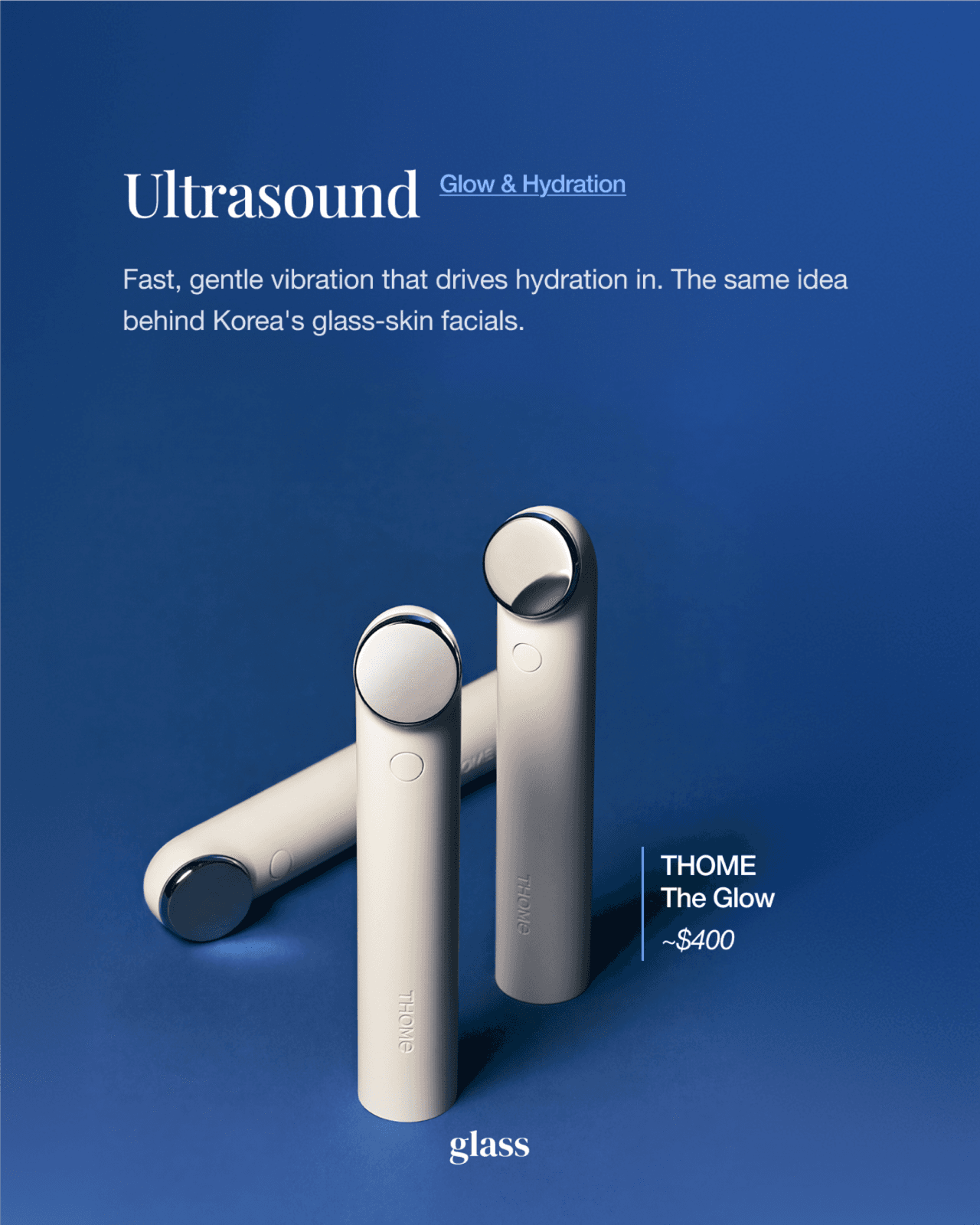
This is the opposite of HIFU, and the confusion between the two is the most common mistake people make buying a Korean beauty device. Same word — ultrasound. Different job.
HIFU focuses energy to a hot point deep in the tissue. Plain ultrasound doesn't focus and doesn't heat. It vibrates — millions of times a second, too fast to feel as anything but a faint warmth — and that vibration does something specific to the outer layer of skin. It loosens the barrier for a moment. Researchers call it sonophoresis: in lab measurements, ultrasound raised the skin's permeability to water by as much as 100-fold, with the barrier recovering almost entirely within a couple of hours. Nothing is damaged. The door just opens briefly.
That's the whole logic of the glass-skin facial in Korea — a hydrating ampoule, then an ultrasound head to drive it in. At home, you do the same thing with a serum or gel and a device. The THOME The Glow runs two frequencies, 3 MHz for deeper hydration and 10 MHz for the surface, and asks for about 12 minutes a day. The immediate payoff is plump, reflective skin. The cumulative payoff is hydration that actually reaches where it's needed — which makes it the natural partner to a layered Korean night routine. It runs about $400.
If your goal is glow rather than lift, this is the one. It's also the gentlest of the four, which makes it the easiest to use daily and the hardest to overdo.
04. RF — Firm and Tighten
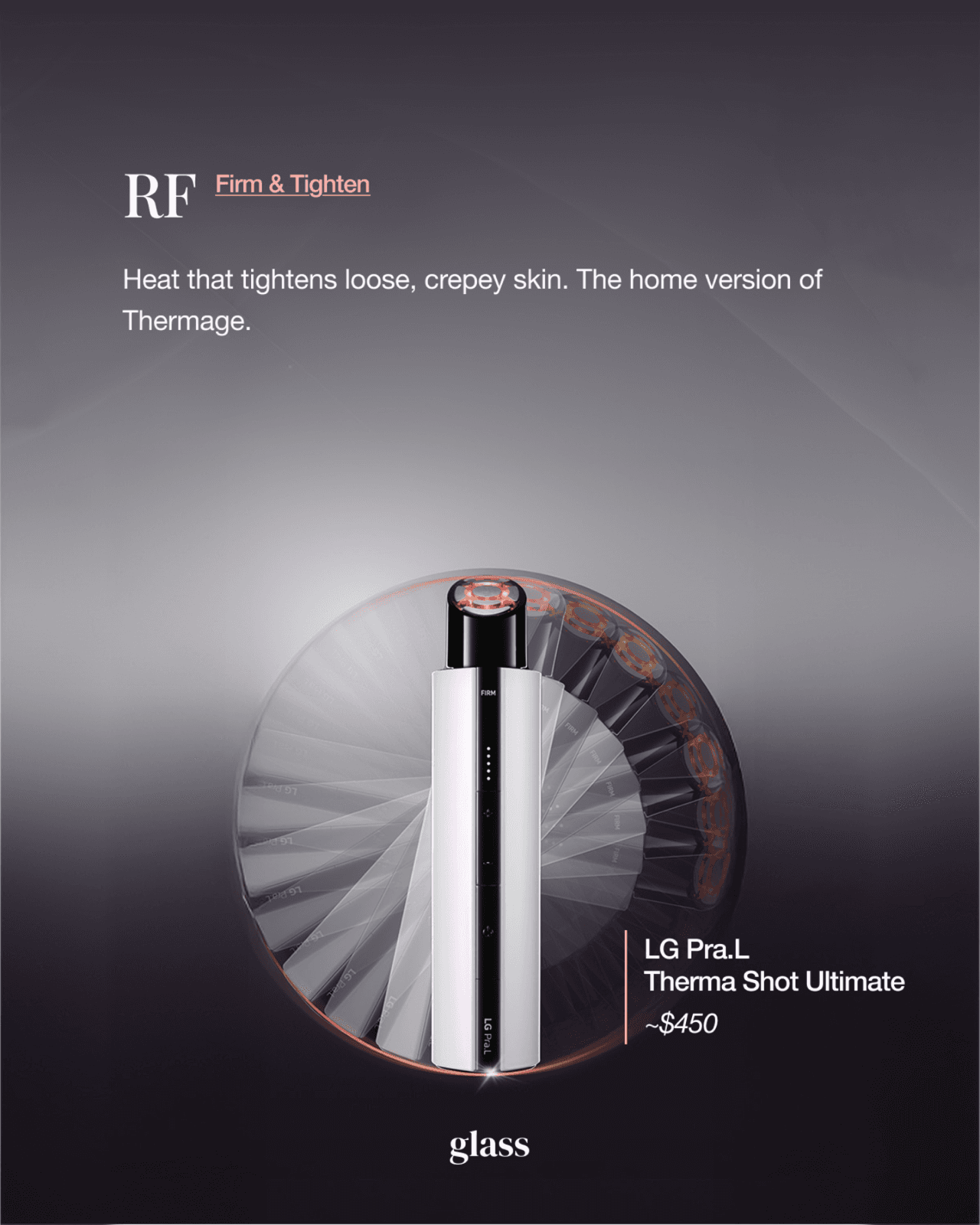
RF is radiofrequency — electrical energy that generates heat in the dermis, the layer where collagen lives. Warm collagen fibers contract, and over the following weeks the skin responds by building more. The result isn't lift, it's firmness: skin that had gone soft, thin, or crepey reads tighter and smoother. In the clinic, this is Thermage — around $4,000 in the US, $1,300 to $2,600 in Seoul — or Korea's Oligio at $220 to $600.
Of the four energies, home RF has the best human evidence. A 12-week study in the Journal of Cosmetic and Laser Therapy followed 47 adults using a handheld RF device three times a week for a month, then twice a week. Expert graders recorded significant improvements in wrinkles, firmness, elasticity, and jawline lift. Every participant described it as painless. The only side effect was mild redness that cleared within 15 minutes.
The device Koreans reach for is the LG Pra.L Therma Shot Ultimate — LG, the appliance company, which tells you how mainstream this category is in Korea. It layers RF with EMS and microcurrent, uses a contact sensor that only fires when the head is properly on skin, and offers five modes: Glow, Firm, Jaw, Pore, and Eye. It's the home version of Thermage in the same sense a stationary bike is the home version of a spin class — same movement, your pace. Around $450.
This is the one for anyone past their mid-thirties who's noticed the skin along the jaw and cheek has gone a little soft without actually sagging. RF addresses that stage precisely.
So Which Do You Need?
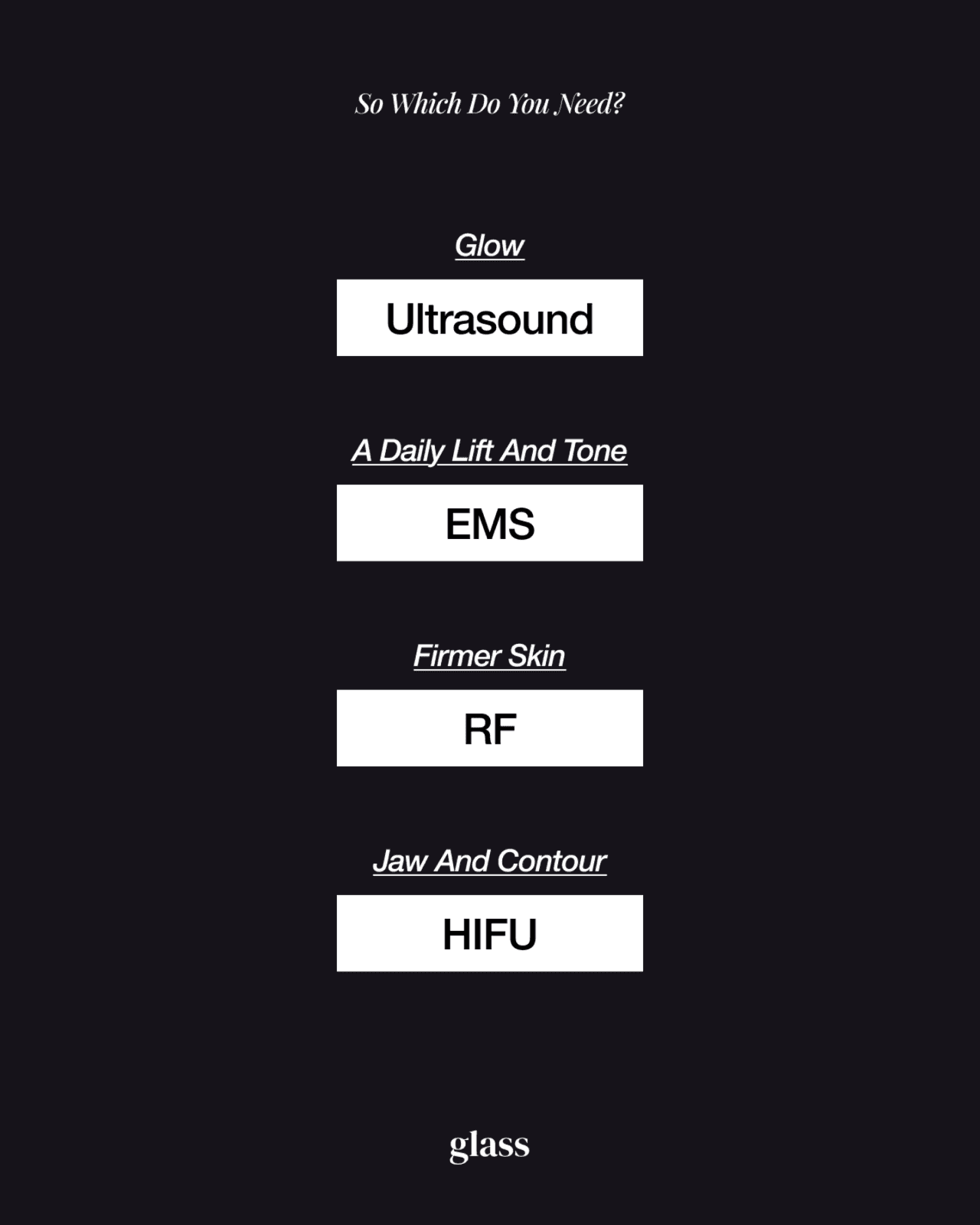
Pick by goal, not by algorithm. The matching is simple once you think in energies:
- Glow — ultrasound
- A daily lift and tone — EMS
- Firmer skin — RF
- Jaw and contour — HIFU
Koreans rarely own all four. The common pairings are a daily pair — ultrasound for hydration, EMS for tone — or a weekly pair, RF and HIFU, for firm-and-lift. If you're buying one, buy for the concern you actually see in the mirror, not the one you're worried about in ten years. Under 35 and chasing glow, that's ultrasound. Past 35 with skin that's gone soft, that's RF.
And one honest note on contour. If your jawline is the main concern, a home HIFU device costs about what a single Shurink session in Seoul costs — and the session does in 30 minutes what the device works toward over months. Buy the device to maintain a lift. Don't buy it expecting to create one.
What They Hold, and What They Can't
A device costs roughly one Korean clinic session. That's the frame to hold it in.
| Goal | In a Seoul clinic | At home |
|---|---|---|
| Lift | Shurink $150–350 or Ultherapy $600–1,800. One session, results last 1–2 years | High Focus Shot $280–372. Weekly, for months |
| Firm | Oligio $220–600 or Thermage $1,300–2,600. One session, results last about a year | Therma Shot Ultimate ~$450. Two to three times a week |
| Glow | Aqua peel or ultrasound facial $50–100. Same day | The Glow ~$400. Daily |
| Tone | Not a clinic treatment — it's a muscle | Booster Pro ~$300. Daily |
Used consistently, a device earns its price back by stretching the interval between sessions. Used the way most devices actually get used — three enthusiastic weeks, then a drawer — it's the most expensive thing in your bathroom. Every study above measured results at four to twelve weeks. Most people quit at three.
The other thing they can't do is diagnose. A device treats the concern you've named. A dermatologist tells you whether you've named the right one — whether the softness along your jaw is laxity that RF will tighten or volume loss that no amount of heat will fix. That conversation is why a first visit to a Seoul clinic is worth more than a fourth device.
The Glass Beauty Seoul Take
The device was never the point. The habit is.
What Korea built isn't a market for gadgets — it's a system where the clinic and the bathroom shelf do different jobs and both get done. The clinic makes the result: a Shurink lift, an Oligio tightening, a proper glass-skin facial. The device holds it, ten minutes at a time, until the next visit. Americans tend to buy the device instead of the treatment and then wonder why it underdelivers. It was never designed to be the treatment.
So shop Korean beauty devices by energy, not by brand. Buy one, maybe two, for the concern you can see today. And use it — the evidence is real, but all of it was measured on people who showed up for twelve weeks.
Then notice the moment you start pricing a third device. That's the moment to price a flight instead. A week in Seoul covers the treatment the device was imitating, at a fraction of the US cost, with a doctor who can tell you which energy your face actually needs. The device will still be there when you get home — and for the first time, it'll have something to hold.
Glass Beauty Seoul is building the guide to Korean skin treatments for the rest of the world — what works, what it costs, and how to get it done in Seoul. Follow along as we break down every treatment, one honest article at a time.
Frequently Asked Questions
Do Korean beauty devices actually work?+
Yes, within limits. Home RF has the strongest human evidence: a 12-week study of 47 adults found significant improvements in wrinkles, firmness, and jawline lift with no side effects beyond brief redness. EMS measurably increased cheek muscle thickness in a 108-woman trial. Ultrasound reliably improves absorption of what you layer under it. Home HIFU has no human trials yet. All results in these studies came from consistent use over four to twelve weeks.
What is the difference between EMS, HIFU, ultrasound, and RF devices?+
They send different energies into different layers. EMS is a low electrical current that contracts facial muscle for tone. HIFU is focused ultrasound that heats deep tissue to lift the jaw and contour. Plain ultrasound is unfocused vibration that opens the skin barrier briefly so hydration absorbs, for glow. RF is radiofrequency heat in the dermis that tightens collagen for firmer skin.
How often should you use a Korean beauty device?+
It depends on the energy. EMS and ultrasound devices are built for daily use, five to twelve minutes a session. RF devices are typically used two to three times a week. Home HIFU is used about once a week. Every clinical result on record was measured after four to twelve weeks of consistent use, so the cadence matters more than the device.
Can an at-home HIFU device replace Ultherapy or Shurink?+
No. A home HIFU device runs the same focused ultrasound at far lower power, and results build over months rather than from a single session. A Shurink session in Seoul costs $150 to $350, about the same as the Medicube High Focus Shot, and does in 30 minutes what the device works toward over months. Use the device to maintain a clinic lift, not to create one.
Which Korean beauty device should a beginner buy first?+
Buy for the concern you see today, not the one you fear later. If the goal is glow and hydration, start with an ultrasound device like THOME The Glow. If skin along the jaw and cheeks has gone soft without sagging, start with an RF device like the LG Pra.L Therma Shot Ultimate. EMS is the pick if you want a visible same-day lift and tone. Koreans rarely own all four.
Get the Seoul Glow
K-beauty insights, treatment guides, and trend alerts — delivered weekly.