Best Time of Year for Laser Treatment: Why Fall Wins
Skin treatments have a season, and it is not spring. Why lasers wait for your tan to fade, and why collagen treatments start in October.
Seoul's midday UV index peaks around 10 in July. By December, it sits near 2. That one number explains why the best time of year for laser treatment is not the season most people book it.
Most of us think about our skin in spring, when sleeves get shorter and swimsuit season is on the calendar. Clinics think about it differently. For lasers, peels, and collagen treatments, the calendar that matters is the sun's. And that calendar says the season runs from fall into winter. It just started.
Why Spring Is the Wrong Guess
Spring feels like the logical moment. You want clear skin by summer, so you book in April. The problem is what comes next: longer days, stronger sun, and more time outdoors — right when your skin is still healing.
Work backward instead. Most laser and resurfacing plans are a series, not a single visit, and each session needs recovery time. September through January gives you room for the full course and the healing that follows, all before the long, bright days return. Start in spring and you are healing just as the sun climbs toward its yearly peak.
The Sun Is the Whole Reason
Two things make summer hard on laser treatment, and both come down to UV.
01. Lasers read your tan as a target
Lasers that clear dark spots work by targeting pigment. They cannot tell the difference between the sun spot you want gone and the tan you got last month. The American Academy of Dermatology puts it plainly: if you arrive with a tan or sunburn, your dermatologist cannot treat you, because the laser could burn or discolor your skin.
02. Healing skin is sun-sensitive skin
Resurfacing lasers and peels leave skin raw and reactive while it heals. Sun on freshly treated skin raises the risk of new discoloration — the exact problem many people booked the treatment to fix. The AAD advises protecting treated skin from the sun until it fully heals, and Cleveland Clinic recommends broad-spectrum sunscreen for weeks before and after resurfacing.
In winter, that protection mostly happens on its own. Shorter days, more time indoors, more skin covered. In July, it is a daily fight.
Treatment Season Starts When Your Tan Fades
Summer ends on the calendar long before it ends on your skin. A tan can hold on for weeks after the last beach day, and clinics may ask you to wait until it has fully faded before any laser touches your face.
That is why treatment season starts a little behind the weather. September is the opening, not the peak. Cleveland Clinic's prep guidance for laser resurfacing is a useful benchmark: no tanning and daily broad-spectrum sunscreen for four weeks before treatment.
So if you spent August outdoors, the move is simple:
- Stop tanning now — self-tanner included, until you have asked your clinic about it
- Wear SPF 30 or higher every day, even on cloudy fall mornings
- Book your consultation and let the clinic judge when your skin is ready
What Gets Booked in October
Fall is not one treatment. It is two kinds of treatment with two different clocks.
Dark-spot lasers and resurfacing
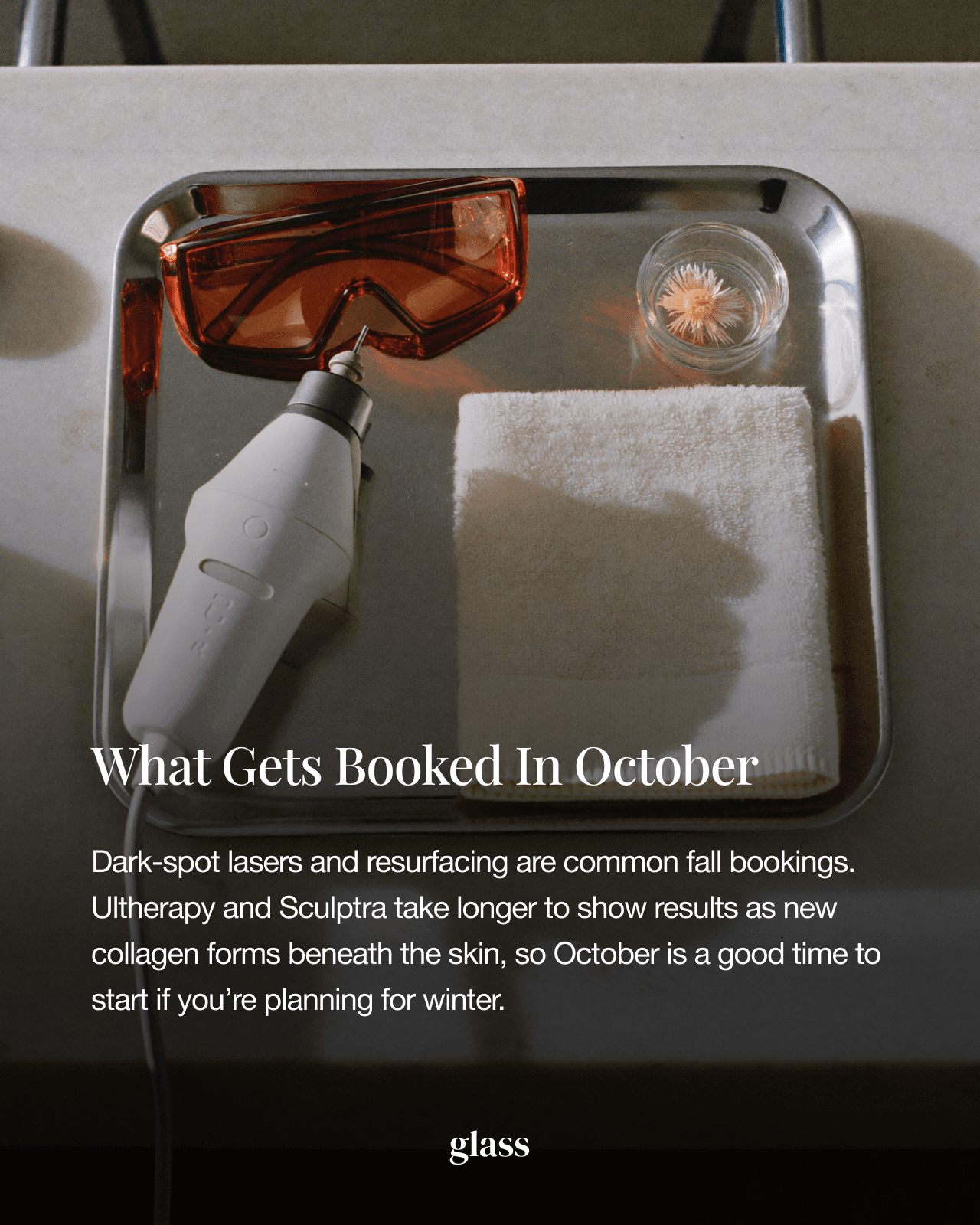
These are the classic fall bookings. Pigment lasers and resurfacing benefit most from low sun before and after. Each session comes with its own healing window — from a few days of redness to longer for deeper resurfacing — and you want every one of those windows to land in low-UV months. If spots are your main concern, our guide to sun spot removal in Korea covers pico versus IPL in detail.
Ultherapy and Sculptra
These run on a slower clock. Neither works by resurfacing your skin — both prompt your body to build new collagen, and collagen takes time.
- Ultherapy uses focused ultrasound under the skin. Results build gradually, with lifting typically showing over two to three months, and some continued improvement up to around six months.
- Sculptra is an injectable poly-L-lactic acid that stimulates collagen. Galderma says results can appear from about one month and last up to two years. It is usually done as a short series of sessions spaced weeks apart.
Do the math and the calendar decides for you. Start in October, and you see the result in winter — in time for the holidays and the new year, not halfway through spring. For how the two lifting treatments compare, read Ultherapy vs Thermage in Korea.
| Treatment | What it does | When results show | When to book for winter |
|---|---|---|---|
| Dark-spot laser | Breaks up pigment | After healing, often over a series | Once your tan fades, September to January |
| Laser resurfacing | Renews the skin surface | After healing, from days to weeks | Fall, so healing lands in low sun |
| Ultherapy | Builds collagen with ultrasound | Gradually over 2 to 3 months | October |
| Sculptra | Builds collagen with an injectable | From about 1 month, building over a series | October, to fit the series |
Everyone's skin and timeline are different, and results vary. Your clinic sets the plan.
Plan Your Seoul Trip Around It
Seoul runs on the same seasons you do. Its UV curve follows the same northern-hemisphere arc — strongest in summer, lowest in December and January — so treatment season there opens at the same moment it opens at home.
That makes the next few months a natural window for a Seoul skin trip. A few things to plan for:
- Book treatments early in the trip. Redness and healing time belong in Seoul, not on the flight home
- Leave room between sessions. Collagen treatments run on months, not days — ask how your plan continues once you are home
- Bring the sun habit with you. Low UV is not no UV. Sunscreen stays non-negotiable on treated skin
If you have not picked a clinic yet, start with our guide to finding the best skin clinic in Seoul as a foreigner. Working toward a date? Our pre-event treatment timeline maps what to book and when.

The Glass Beauty Seoul Take
Timing is the least talked-about part of skin treatment, and it is the one you control completely. The same laser on the same skin is a different experience in October than in June — less pigment in the way, less sun on the healing, less work to protect the result.
So the best time of year for laser treatment is not a secret. It is fall into winter, starting as soon as your tan is gone. For collagen treatments, it is October, because the payoff arrives months later.
If you have been waiting for the right moment to finally treat those spots or that loss of firmness, this is it. Book the consultation now — your winter skin is decided this month.
Glass Beauty Seoul is building the most honest guide to Korean skin care and treatment for readers outside Korea. Follow along as we break down what Seoul knows first — and when to go.
Frequently Asked Questions
What is the best time of year for laser treatment?+
Fall through winter, roughly September to January. UV is lower, you spend more time indoors, and your summer tan has had time to fade, which makes both the treatment and the healing easier to protect.
Can you get laser treatment with a tan?+
Usually not. The American Academy of Dermatology says a dermatologist cannot treat you if you arrive with a tan or sunburn, because the laser can burn or discolor the skin. Most clinics ask you to wait until the tan has fully faded.
How long should you avoid the sun before laser treatment?+
It depends on the laser and your skin, so follow your clinic. As a benchmark, Cleveland Clinic advises avoiding tanning and wearing broad-spectrum sunscreen daily for four weeks before laser resurfacing.
When should I start Ultherapy or Sculptra for results by winter?+
October is a good start. Ultherapy results build gradually over two to three months, and Sculptra is usually done as a short series of sessions weeks apart, with results building from about one month on.
Is it bad to get laser treatment in summer?+
Not always, but it takes more planning. Pigment lasers and resurfacing need strict sun avoidance before and after, which is harder in summer. Ask your clinic whether your specific treatment suits the season.
Get the Seoul Glow
K-beauty insights, treatment guides, and trend alerts — delivered weekly.