Skin Treatments in Your 30s: What's Worth Booking Now
You do not need every treatment at once. Match Botox, IPL and skin boosters to what your skin is showing you, and let tightening and filler wait until you need them.

Somewhere in your early 30s, the treatment menu starts to feel like homework. Botox, lasers, boosters, ultrasound, filler — everyone you follow seems to be booking all of them at once. You do not need to. The skin treatments in your 30s that are worth booking now are the ones that answer something your face is already showing you. The rest can wait.
This is the short list: three treatments matched to three signs, and two that can sit on the shelf until your skin asks for them.
You Don't Need Everything in Your 30s
Skin in your 30s changes slowly, and it changes in two places first. The lines you make when you smile or frown take longer to smooth out once your face relaxes. And years of sun start to surface. The American Academy of Dermatology notes that every time you go outdoors without sun protection, UV light damages your skin — and that damage adds up into wrinkles and age spots.
Firmness and volume usually hold on longer. That is the whole logic of this list: book for the change you can see, not the decade you are in.
| What you notice | Worth a look | How long it lasts | Source |
|---|---|---|---|
| Lines that stay after your face relaxes | Botox | About 3 to 4 months | AAD |
| Brown spots from years of sun | IPL or a pigment laser | IPL is usually a series of 5 to 6 sessions | UT Southwestern |
| Dull, rough or tired-looking skin | Skinvive or Rejuran | Skinvive: up to 6 months, per the maker | Skinvive |
| Skin starting to loosen | Ultherapy or Thermage | Results build over 2 to 6 months | AAD |
| Volume your face has lost | Filler | 4 to 12 months for hyaluronic acid gel | AAD |
The first three rows are the "now, if you see it" list. The last two are the "later, when it happens" list.
Botox, If Lines Start to Linger
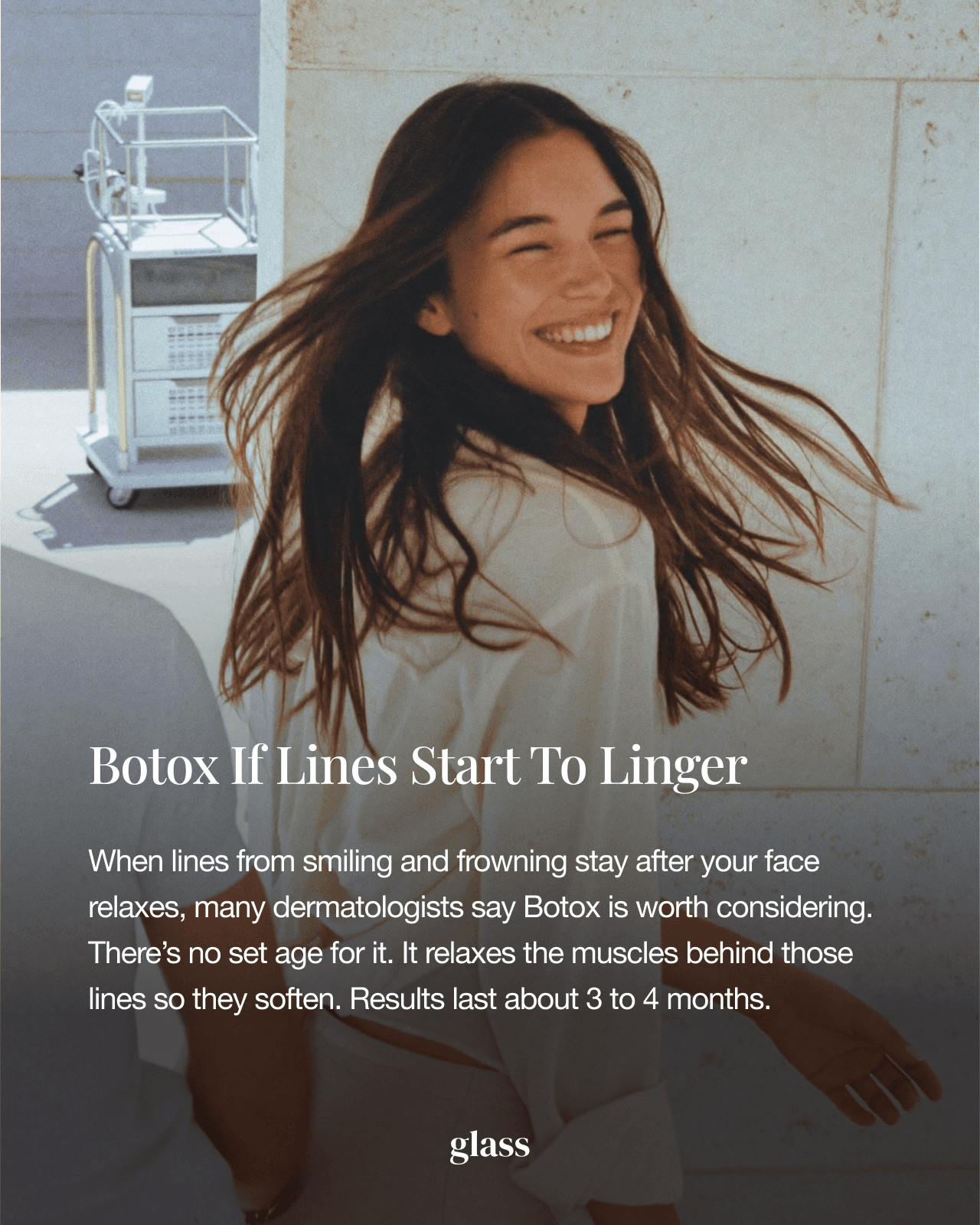
The cue is not your birthday. It is the line that is still there after the smile is gone. Lines that only appear while your face is moving are just expression. Lines that stay once your face is at rest are the point where many dermatologists say Botox is worth a conversation.
There is no set starting age. The FDA-approved use for Botox Cosmetic covers moderate to severe forehead lines, crow's feet and frown lines in adults — the criteria are the lines, not a number on your ID.
The mechanism is simple. A dermatologist injects small amounts into the muscles behind those lines, and the AAD explains that this temporarily relaxes the targeted muscles so fine lines and wrinkles diminish. Most people see results within 3 to 7 days, and the effect lasts about 3 to 4 months — sometimes longer.
That timeline matters for planning. Botox is not a one-time decision; it is a commitment you renew a few times a year if you like the result. If you are still deciding between relaxing a line and filling one, our guide to Botox vs filler breaks down what each one does.
IPL or a Pigment Laser, If Spots Show Up
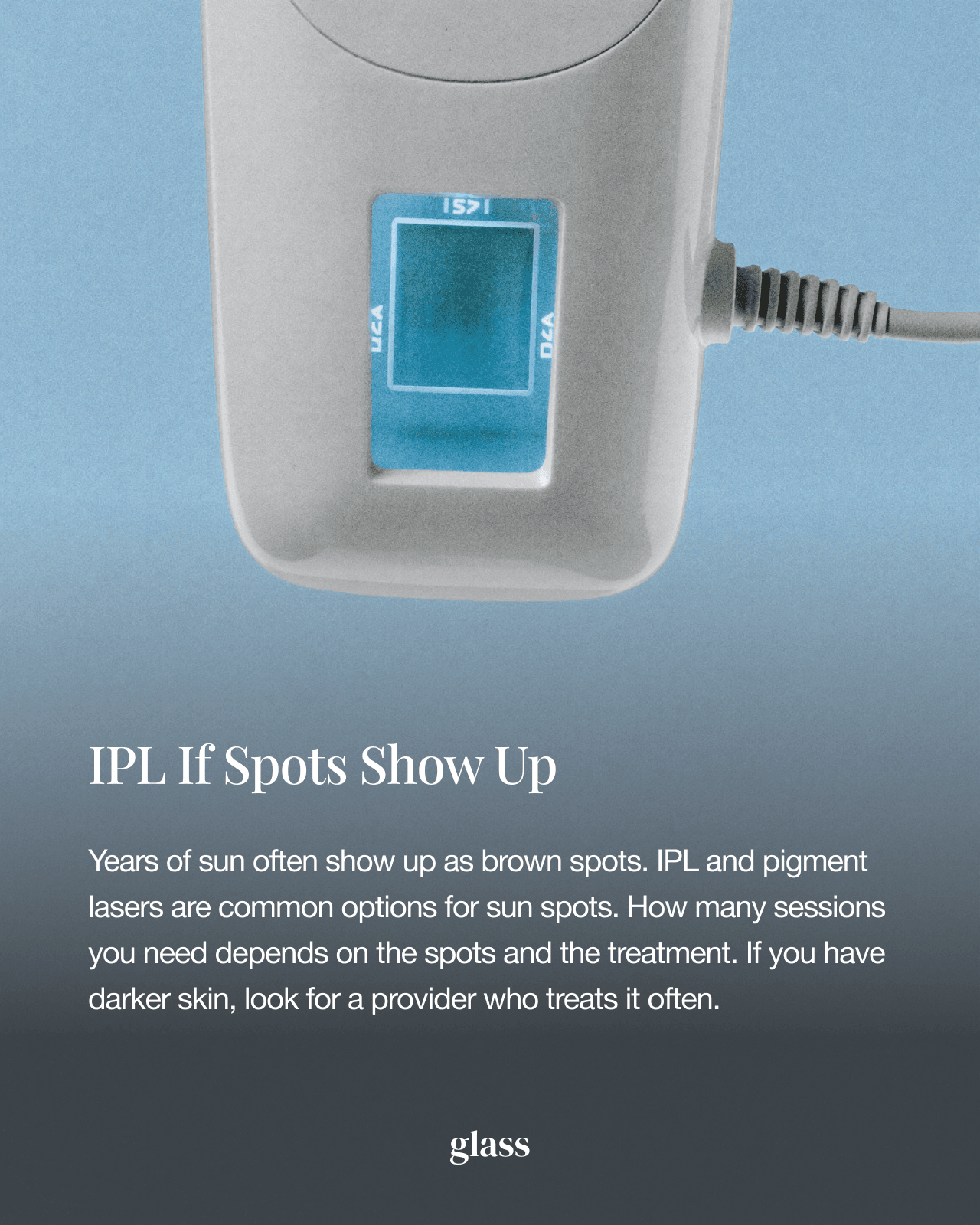
Your 30s are when the sun from your teens and 20s starts to show as brown spots. For those, the AAD lists intense pulsed light and laser resurfacing among the treatments dermatologists use. IPL and pigment lasers are the two most common starting points.
The number of sessions is set by the spots and the treatment. The AAD says one or two laser treatments can treat age spots, with side effects such as crusting or temporary darkening of the spots that tend to fade quickly. IPL usually runs longer: UT Southwestern says most patients need five to six sessions spaced about two to four weeks apart. Our guide on how many laser sessions you need explains why one visit rarely tells the whole story.
If you have darker skin, the provider matters more than the device. The AAD notes that darker skin is more prone to burns and dark marks after laser treatments and recommends a board-certified dermatologist with experience treating darker skin. UT Southwestern adds that people with darker skin tones or melasma may not be good candidates for IPL. Ask how often the clinic treats skin like yours before you book.
Timing helps too. Our piece on sun spot removal covers why fall and winter are the easiest seasons to treat pigment.
Skinvive or Rejuran, If Your Skin Looks Dull
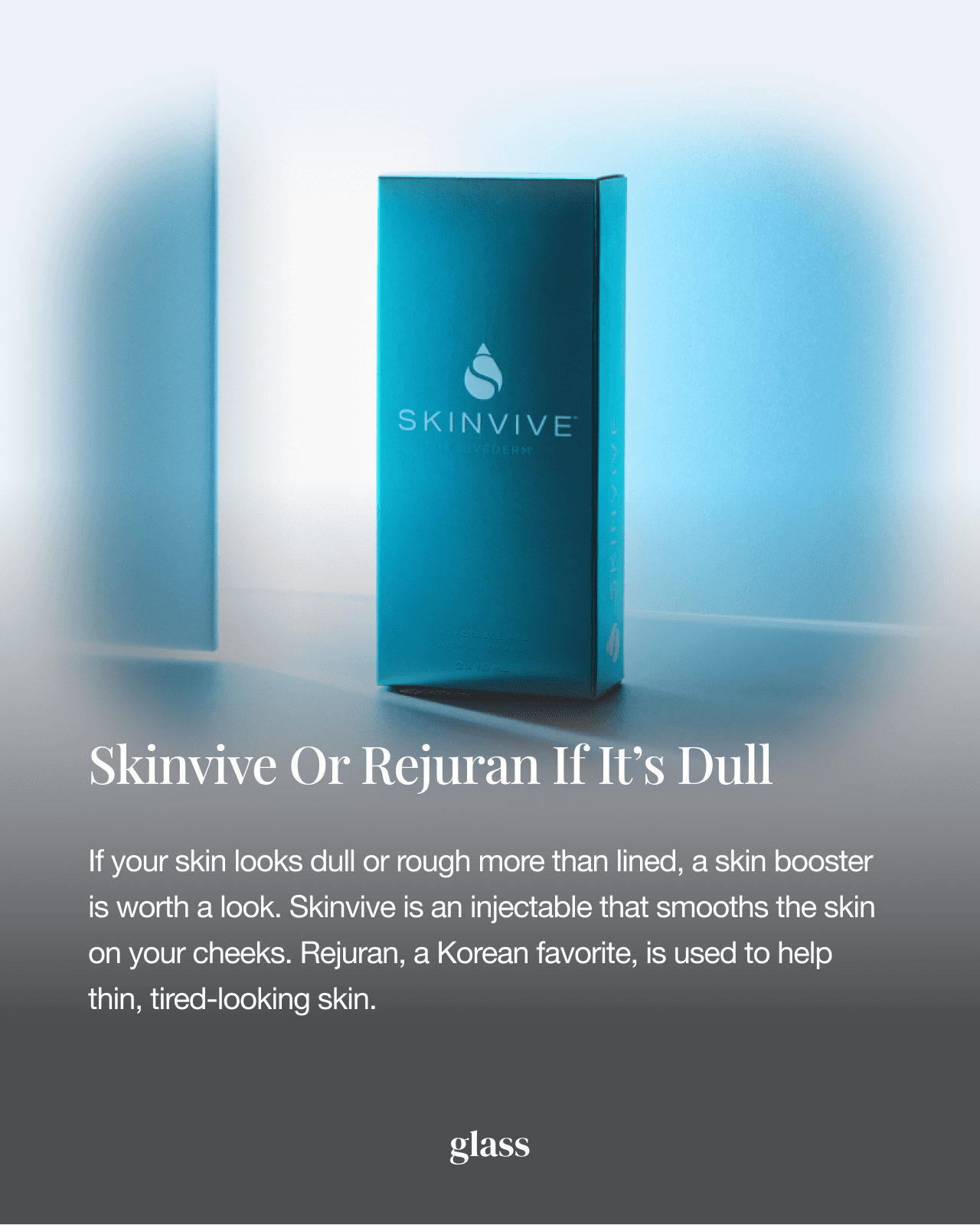
Some skin in the 30s is not lined so much as flat — rough, dull, tired-looking. That is a different problem, and it calls for a different tool: a skin booster.
Skinvive is the US option. It is an injectable gel approved to improve facial skin smoothness of the cheeks in adults over the age of 21. The maker reports the glow can last 6 months with optimal treatment.
Rejuran is the Korean favorite. It is built on polynucleotides, DNA fragments derived from salmon, and Seoul clinics use it for thin, tired-looking skin. A 2024 systematic review in the Journal of Cosmetic Dermatology found promising outcomes for wrinkles, skin texture and elasticity across nine studies — and was clear that those studies were of low to moderate quality. Rejuran is not FDA-approved in the US, which is why many people plan it into a trip to Korea. Our guide to Rejuran vs Juvelook vs PDRN compares the Korean boosters side by side.
The rule of thumb is simple: if your skin looks dull more than lined, start with a booster, not Botox.
Ultherapy, Thermage and Filler Can Wait
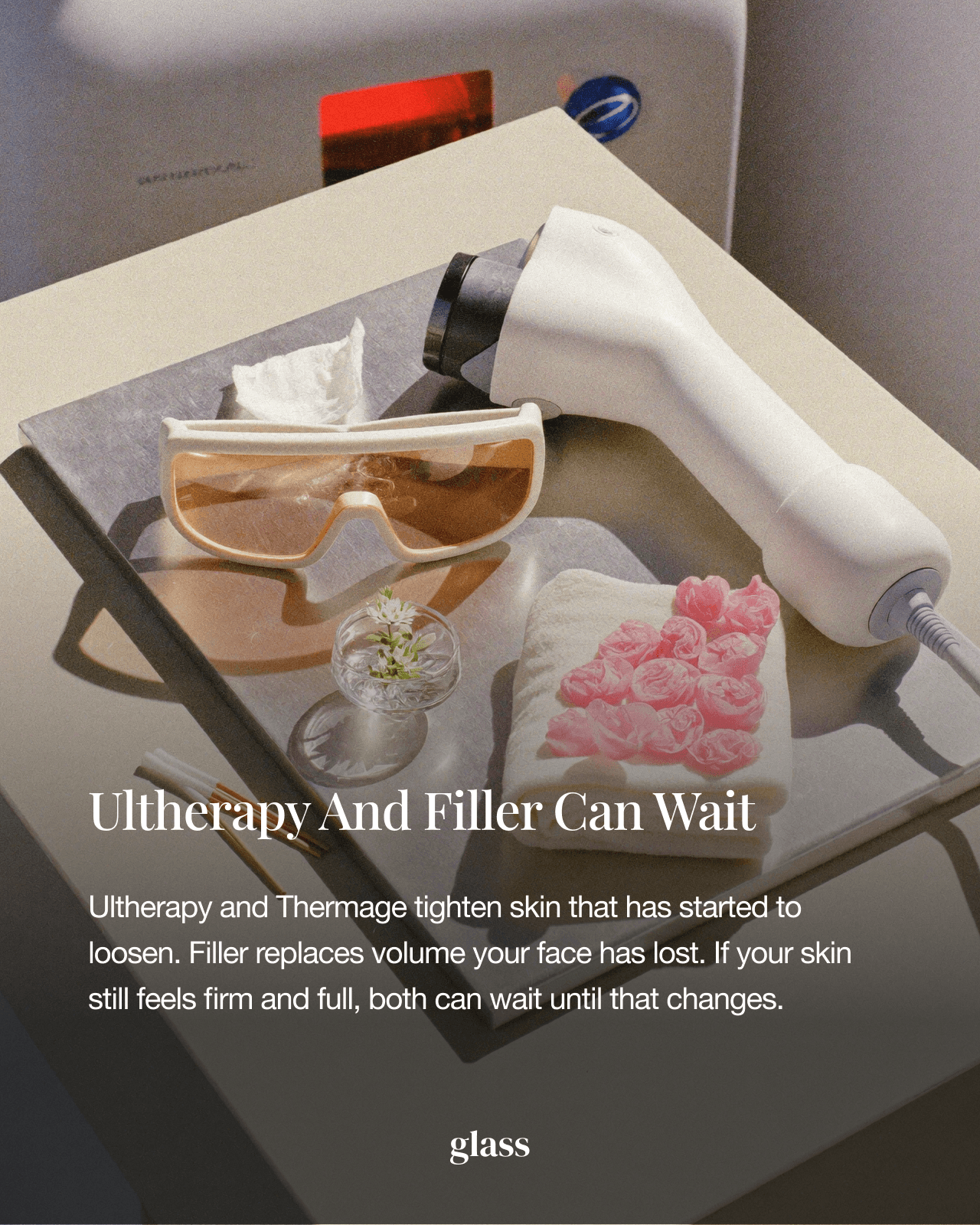
The two treatments with the biggest reputations are the two you can most easily skip for now.
Ultherapy and Thermage tighten skin that has started to loosen. Ultherapy uses ultrasound, Thermage uses radiofrequency, and both work by heating the deeper layers so your body builds collagen. The AAD says most people see modest lifting and tightening within 2 to 6 months after one ultrasound treatment, with the best radiofrequency results in about 6 months. They are designed for a small amount of sagging. If nothing has loosened yet, there is nothing for them to lift. Our comparison of Ultherapy vs Thermage explains which does what when the time comes.
Filler is the same logic, applied to volume. It replaces fullness your face has lost, and most fillers offer temporary results and require repeat treatments — hyaluronic acid gel lasts about 4 to 12 months. Adding volume to a face that has not lost any is not prevention. It is just more face.
If your skin still feels firm and full, both can wait until that changes. Results vary from person to person, and a dermatologist who examines your skin is the right judge of when that point arrives.
The Glass Beauty Seoul Take
The 30s are not a deadline. They are a decade of small, specific signals — a line that stays, a spot that appears, a texture that dulls — and each one has a matching answer. Booking against the signal keeps your money on treatments that change something you can see.
This is also how a good consultation should work, in Seoul or anywhere else. It starts with your skin, not a package: what is showing now, what can wait, and what order makes sense. If you are planning treatment in Korea, our guide to finding the best skin clinic in Seoul as a foreigner shows what that conversation sounds like in English.
So before you book skin treatments in your 30s, look in the mirror with your face relaxed. Book for what you see. Let the rest wait its turn.
Glass Beauty Seoul is building the most honest guide to Korean skin care and treatment for readers outside Korea. Follow along as we break down what Seoul knows first.
Questions.
What skin treatments should you get in your 30s?+
Book for what you can see. Botox suits lines that stay after your face relaxes, IPL or a pigment laser treats brown spots from sun exposure, and a skin booster helps dull or rough skin. Tightening and filler can usually wait until skin loosens or loses volume.
Should you get Botox in your 30s?+
There is no set starting age. Botox Cosmetic is approved for moderate to severe forehead lines, crow's feet and frown lines in adults, so the cue is lines that linger after your face relaxes. The AAD says results last about 3 to 4 months.
How many IPL sessions do you need for sun spots?+
It is set by the spots and the treatment. UT Southwestern says most IPL patients need five to six sessions spaced about two to four weeks apart, while the AAD says one or two laser treatments can treat age spots. If you have darker skin, choose a provider experienced with your skin tone.
What is the difference between Skinvive and Rejuran?+
Skinvive is an FDA-approved injectable gel for improving skin smoothness of the cheeks in adults over 21. Rejuran is a polynucleotide booster popular in Korea and is not FDA-approved in the US. Both are aimed at dull, rough or tired-looking skin rather than deep lines.
When should you start Ultherapy or filler?+
When there is something for them to fix. Ultherapy and Thermage are designed for skin that has started to loosen, and filler replaces volume your face has lost. If your skin still feels firm and full, both can wait.