Rejuran vs Juvelook vs PDRN: Which Skin Booster Is Yours?
Three Korean injectables, three different kinds of skin. Match the booster to what you see in the mirror, not the name on your feed.
Rejuran, PDRN, and Juvelook get talked about as if they were one treatment with three brand names. They are not. They are three different injections built for three different kinds of skin — and in the Rejuran vs Juvelook vs PDRN question, only one of them fits yours.
If you are weighing Rejuran vs Juvelook before a Seoul trip, or wondering where PDRN fits in, start with your skin, not the name trending on your feed. The right booster is closer to a diagnosis than a preference.
"Skin Booster" Is a Category, Not a Treatment
In Seoul, "skin booster" covers any injectable that works on skin quality rather than shape. Needles go into the upper dermis in a grid of tiny deposits, and the product does its work from there. What that work is depends entirely on the molecule.
Two of the three come from the same raw material — DNA purified from salmon. PDRN is made of shorter DNA fragments; PN (polynucleotide), the ingredient in Rejuran, is made of longer chains. That length difference changes behavior. Longer chains form a gel-like scaffold that binds more water, while shorter fragments act mainly as a repair signal through the skin's adenosine A2A receptor. We cover PDRN on its own in our guide to PDRN treatment in Korea.
The third, Juvelook, has no DNA in it at all. It pairs PDLLA — a dissolvable polymer that prompts your skin to build collagen — with hyaluronic acid.
So the question is not which one is best. It is which problem you are trying to solve:
- Irritated, reactive skin — PDRN
- Thin, crepey skin — Rejuran
- Slack skin that has lost firmness — Juvelook
PDRN If Your Skin Is Angry

PDRN is the booster for skin that has stopped cooperating — red, reactive, still marked from breakouts or a recent laser. Its reputation comes from wound care: PDRN has a long research record in healing ulcers and surgical sites, and it works by dialing down inflammation and supporting new blood vessel growth.
In aesthetics, that translates into recovery. Korean clinics often add PDRN after lasers or when skin feels sensitized, and a human trial after thyroid surgery found less redness and flatter scars with PDRN. The evidence for acne marks specifically is thinner — it is a reasonable use, not a proven one.
A typical course is three or four sessions, two to four weeks apart. Expect small raised bumps where the product went in, settling within one to three days. Because it is salmon-derived, flag any fish allergy before treatment. If you only want calmer, steadier skin before you start anything more aggressive, this is the gentle first step.
Rejuran If It's Thin and Crepey
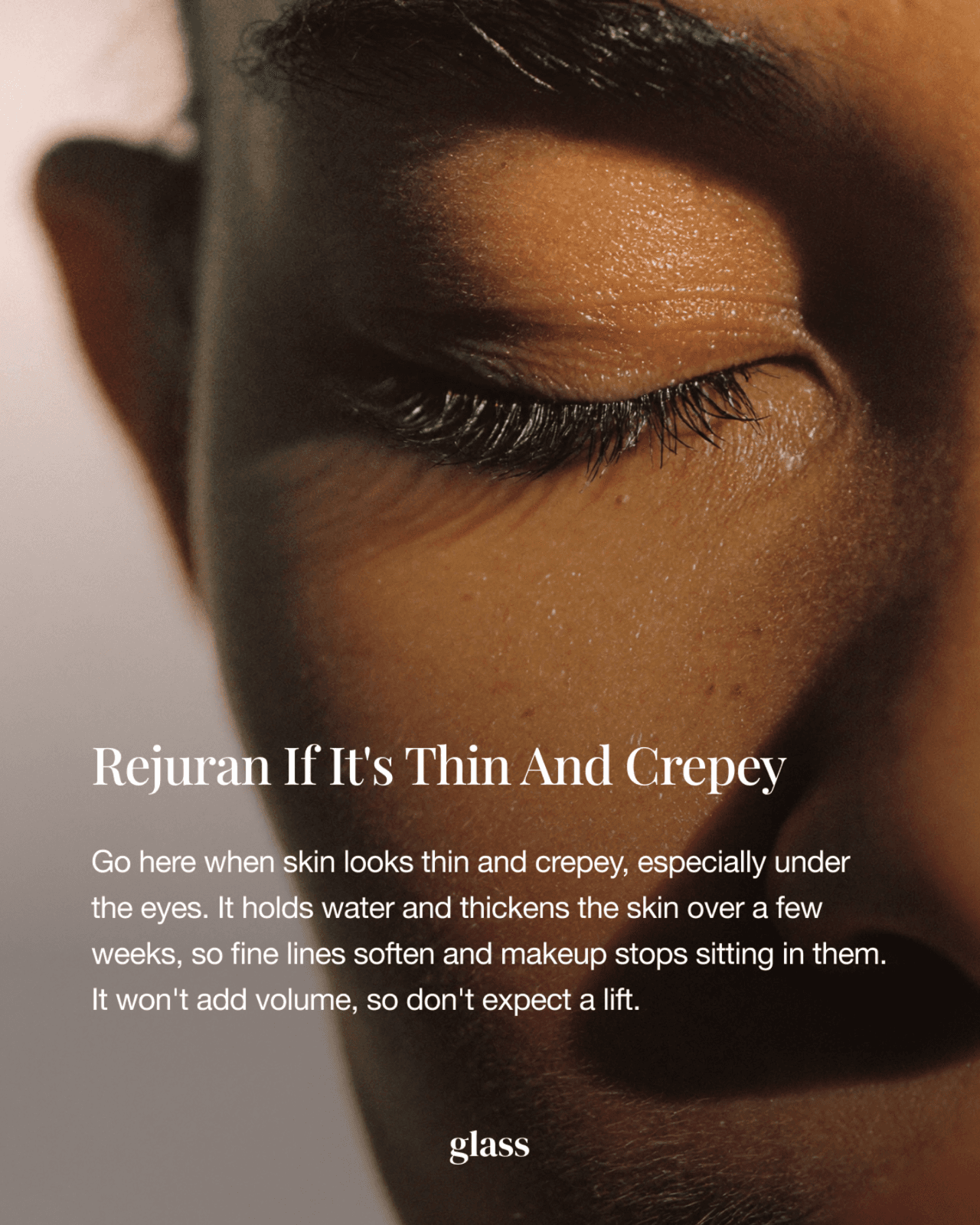
Rejuran is for skin that looks thin and crepey, especially under the eyes. Because PN chains hold water in the dermis, the effect reads as bounce: skin looks more hydrated and more elastic, fine lines soften, and concealer stops settling into them. A small Korean study of Rejuran against saline measured more water held in the skin and better elasticity within two weeks, and a survey of Korean dermatologists ranked fine lines as PN's strongest use.
The eye area has its own version. Many Seoul clinics offer Rejuran i, a version marketed specifically for thin under-eye skin.
What Rejuran does not do is volume. It is not a filler and it will not lift a jawline. Clinics usually plan three sessions, about three weeks apart, then maintenance. Expect visible bumps for one to three days and occasional bruising. If you have a fish allergy, tell the clinic before anything salmon-derived goes near your face.
Juvelook If You Want Firmness
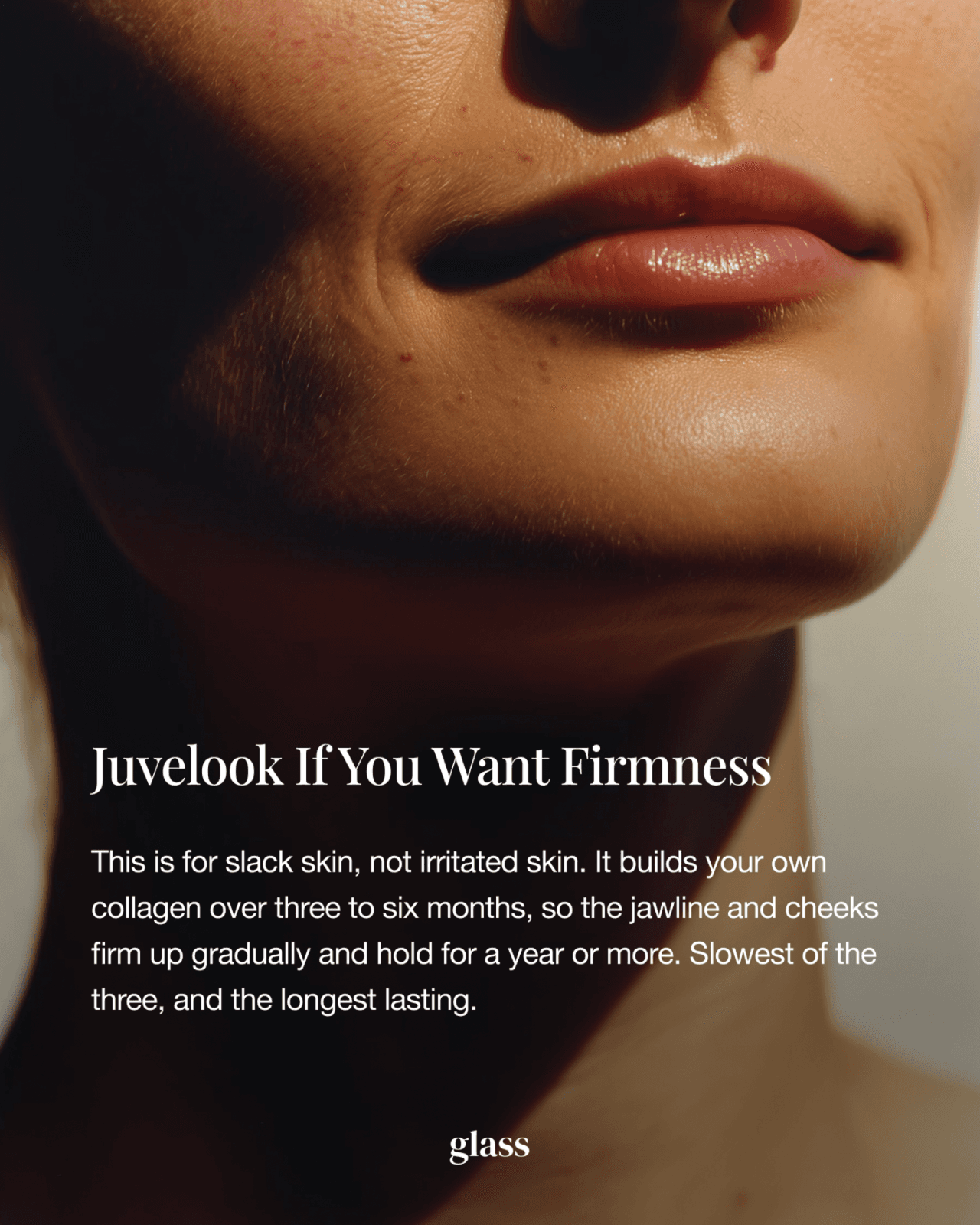
Juvelook is for slack skin, not irritated skin. PDLLA particles act as a scaffold that prompts your own fibroblasts to build new collagen, while the hyaluronic acid gives an early hydration boost as that process starts. The firmness builds gradually over three to six months, which makes Juvelook the slowest of the three to show — and the longest-lasting, with results that commonly hold six to twelve months.
Standard Juvelook sits shallow and targets skin quality: texture, fine lines, and early laxity. For deeper structural support in the cheeks, clinics use its sibling, Juvelook Volume. Most protocols call for two or three sessions, at least four weeks apart. Bruising and tenderness are the usual side effects, and nodules are rare. Our full Juvelook guide covers the treatment in depth, including how it differs from Sculptra.
Rejuran vs Juvelook vs PDRN, Side by Side
| PDRN | Rejuran (PN) | Juvelook (PDLLA + HA) | |
|---|---|---|---|
| Best for | Red, reactive, post-procedure skin | Thin, crepey skin, under-eyes | Slack skin, gradual firmness |
| How it works | Short DNA fragments calm and support repair | Long DNA chains hold water, improve elasticity | Polymer scaffold prompts new collagen |
| Typical course | 3–4 sessions, 2–4 weeks apart | ~3 sessions, ~3 weeks apart | 2–3 sessions, 4+ weeks apart |
| Shows up | Weeks | A few weeks | 3–6 months |
| Common downtime | Bumps for 1–3 days | Bumps for 1–3 days, possible bruising | Bruising, tenderness for a few days |
| Adds volume? | No | No | Not its main job |
Does it hurt? Clinics apply numbing cream for 30 minutes or more before any of these, and some add lidocaine. Most people describe a series of sharp pricks. Sedation is not standard for skin boosters — if a clinic pushes it, ask why.
Timing before you fly home. Book your first session early in the trip. Bumps from PDRN and Rejuran usually settle within one to three days, and bruising can take about a week to fade. Leave at least a few days before a long flight or an event, and schedule follow-up sessions around the recommended intervals rather than cramming them into one week.
None of these three injectables is FDA-approved in the US — which is why so many people plan them into a Korea trip. If you would rather start with something you can use at home, topical PDRN is the needle-free entry point, though it works at the surface rather than in the dermis. Results vary from person to person, and pregnancy, active infection, autoimmune conditions, or a fish allergy (for the two salmon-derived options) are reasons to hold off and talk to a doctor first.
The Glass Beauty Seoul Take
The mistake we see most often is booking the most famous name instead of the right one. Rejuran is the booster everyone has heard of, so it gets chosen for skin that actually needs calming or collagen. The comparison of Rejuran vs Juvelook is not a contest — they answer different questions, and PDRN answers a third.
Match the treatment to what you see in the mirror. Angry skin wants PDRN. Thin, crepey skin wants Rejuran. Skin that has lost its hold wants Juvelook, and patience. A good Seoul clinic will confirm the match in consultation — and sometimes combine two across a course.
Not sure which one fits your concern? Send us your skin goal, and we'll match you with a Seoul clinic that does it.
Glass Beauty Seoul is building the most honest guide to Korean skin treatment for readers outside Korea. Follow along as we break down every booster, laser, and clinic worth your trip.
Frequently Asked Questions
What is the difference between Rejuran and Juvelook?+
Rejuran is made of polynucleotides, long DNA chains from salmon that hold water and improve elasticity, so it suits thin, crepey skin. Juvelook combines PDLLA with hyaluronic acid to prompt new collagen over three to six months, so it suits skin that has lost firmness. They solve different problems rather than competing.
Is Rejuran the same as PDRN?+
No. Both come from salmon DNA, but Rejuran uses PN, longer chains that form a water-binding gel, while PDRN uses shorter fragments that mainly act as a repair signal. PDRN is typically chosen for irritated or post-procedure skin, Rejuran for crepey texture and fine lines.
Which skin booster should I start with?+
Start with the one that matches your main concern: PDRN for redness and sensitivity, Rejuran for thin or crepey skin, Juvelook for laxity. If your skin is reactive, many clinics calm it with PDRN first. A consultation should confirm the match before you book a full course.
How many sessions do skin boosters need?+
PDRN usually takes three or four sessions two to four weeks apart, Rejuran about three sessions three weeks apart, and Juvelook two or three sessions at least four weeks apart. Results vary with skin type and age, and maintenance sessions follow.
Can I fly home right after a skin booster?+
Most people can travel within a few days. Bumps from PDRN and Rejuran usually settle in one to three days, while bruising from any of the three can take about a week to fade. Book your first session early in the trip and plan follow-ups around the recommended intervals.
Get the Seoul Glow
K-beauty insights, treatment guides, and trend alerts — delivered weekly.